Crushed ice is made by breaking larger, harder ice into irregular pieces. Flake ice is produced directly as thin, flat flakes. Both can chill seafood, but they differ in how they contact the product, how they are handled and stored, and what equipment is required.
For seafood processors, the choice depends on the product and the way the plant operates. The cooling needs of fresh catch and delicate fillets are different, as are the demands of long transport times, existing ice equipment, and seasonal production peaks.
Key Differences Between Crushed Ice and Flake Ice
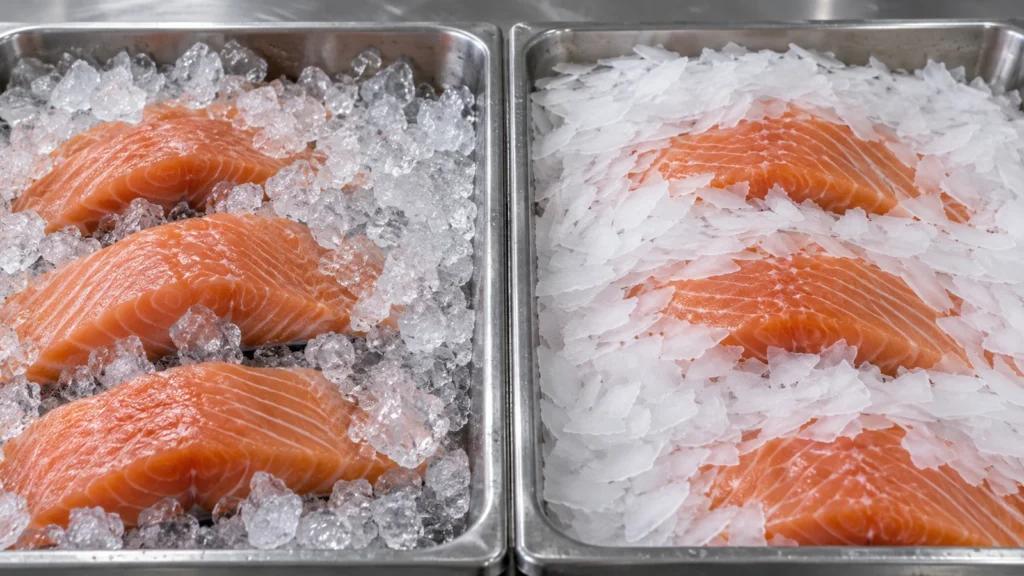
The main differences lie in the structure of the ice and the way it is produced. Flake ice is soft and easy to spread across irregular seafood surfaces. Crushed ice is harder and denser, and its final shape depends on the original ice and the crusher setting.
| Feature | Crushed Ice | Flake Ice |
| Production | Hard ice is mechanically crushed | A thin ice layer is removed from a refrigerated surface |
| Form | Irregular, hard fragments | Thin, flat, soft flakes |
| Product contact | Leaves more gaps when pieces are coarse | Conforms closely to fish and containers |
| Cooling behavior | Depends strongly on particle size and packing | Provides broad contact for rapid product cooling |
| Product protection | Coarse or sharp pieces may mark delicate seafood | Smooth flakes spread pressure over a wider area |
| Storage density | Typically higher for crushed block ice, but varies with the source ice and particle size | Typically lower bulk density and more storage volume per unit weight |
| Equipment | Ice maker, crusher, storage, and handling equipment | Flake ice machine, storage, and handling equipment |
Production Method
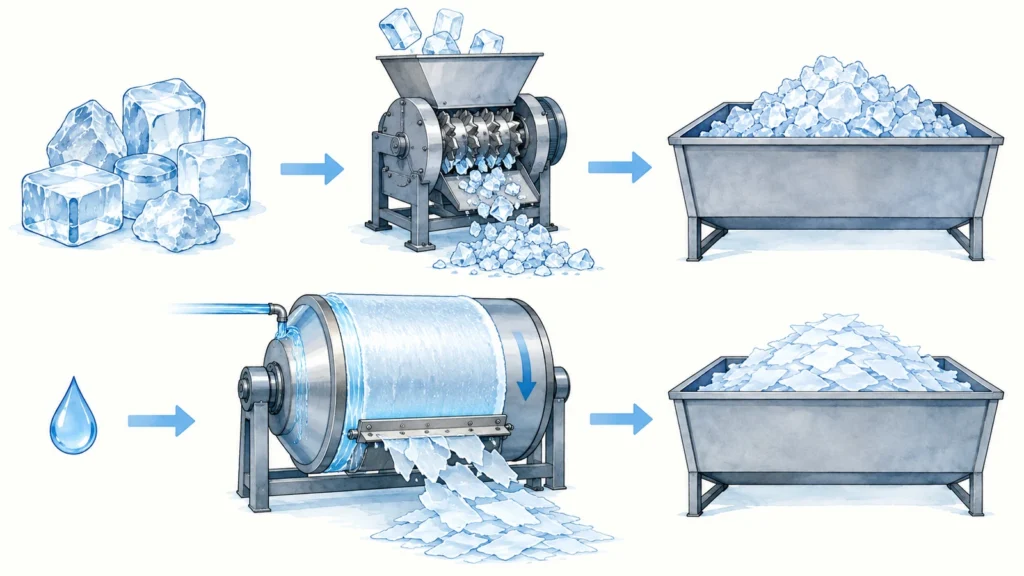
Crushed ice is a secondary product. A plant first makes or receives block, tube, cube, or another form of hard ice, then feeds it into a crusher. The feed size, ice hardness, crusher design, and blade or gap settings all affect the resulting particle size. Flake ice is made in a single production process. Water freezes in a thin layer on a refrigerated drum or similar surface, and a blade continuously removes the ice. No separate crushing stage is needed.
Physical Form and Texture
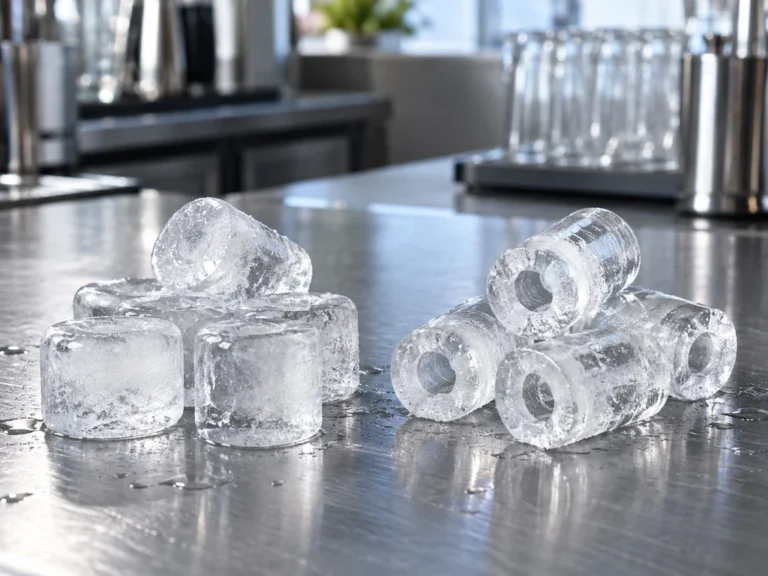
Crushed ice consists of solid fragments with uneven edges and sizes. Crushing it more finely improves coverage, but the particles remain as hard as the original ice. Flake ice is thin and flat, so it packs easily around whole fish, shellfish, fillets, and seafood boxes. It follows curved surfaces more closely and leaves fewer large air gaps.
Cooling Performance and Melting Behavior
Equal weights of solid ice have broadly similar latent cooling capacity. In practice, cooling performance also depends on contact area, bulk density, ice temperature, particle size, and operating conditions.
Flake ice usually transfers heat quickly because it covers more of the product surface. That large exposed area can also increase melting in warm conditions. Crushed ice may last longer when the pieces are coarse, while its higher bulk density allows more ice to fit into a container of limited volume. Any comparison of melt rate should account for product temperature, ambient heat, insulation, drainage, and holding time.
Product Protection
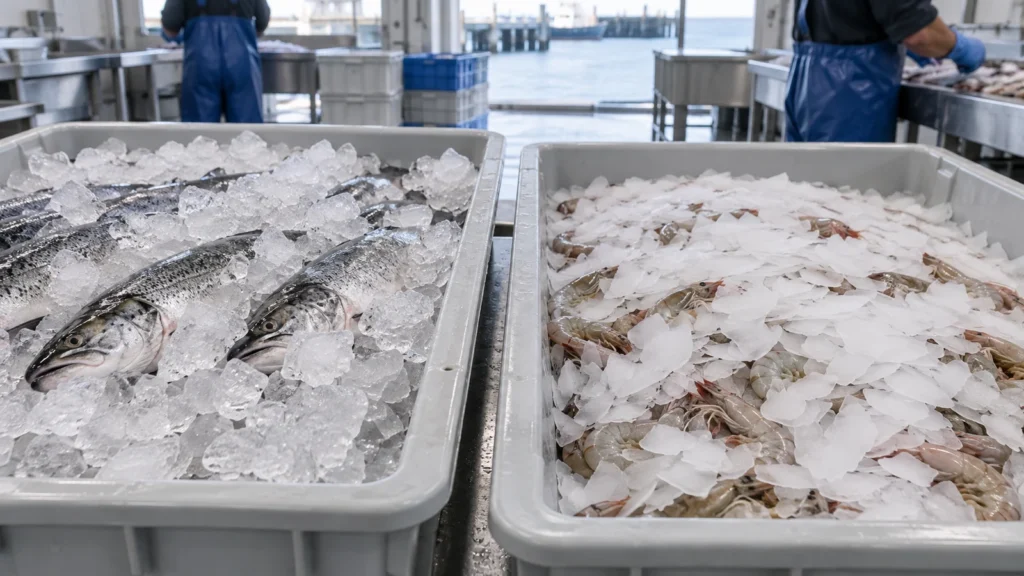
Flake ice is generally better for seafood that bruises, dents, or loses scales easily. Its thin flakes have fewer hard edges and spread their weight across a wider area. Crushed ice can also be used when the particle size is controlled and the seafood is packed correctly. Large or jagged pieces require more care when appearance and surface condition affect the product’s value.
Seafood Processing Applications
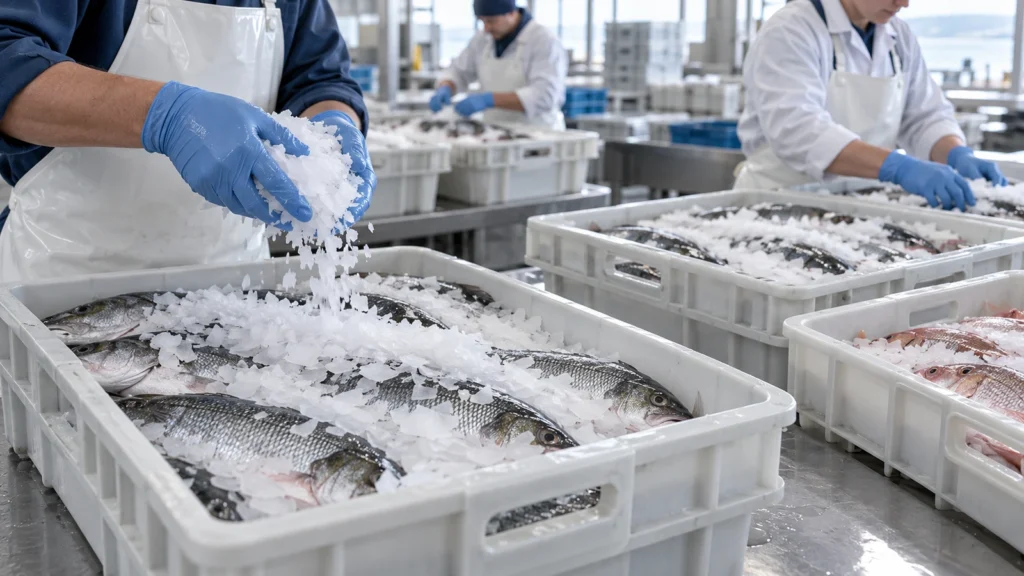
Flake ice suits direct-contact duties such as catch precooling, receiving, sorting, processing, layered packing, and retail display. It works well when the seafood needs even coverage and gentle handling.
Crushed ice is commonly used for transport, bulk chilling, and fish markets. It can also suit plants that already produce block or tube ice. One hard-ice supply can provide different particle sizes if the crusher and sanitation controls are suitable for the food application.
How Crushed Ice and Flake Ice Systems Differ
A flake ice system produces the final form of ice in one stage. A crushed ice system combines a hard-ice source with crushing equipment. Both systems need storage, discharge, and conveying equipment sized for the plant’s busiest operating period.
Flake Ice Production System
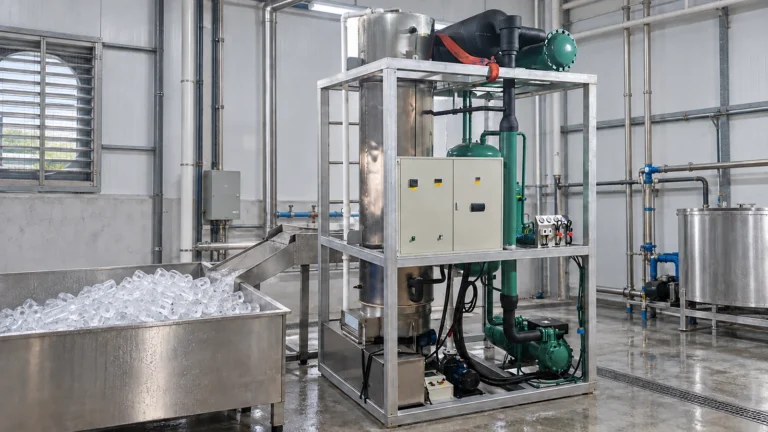
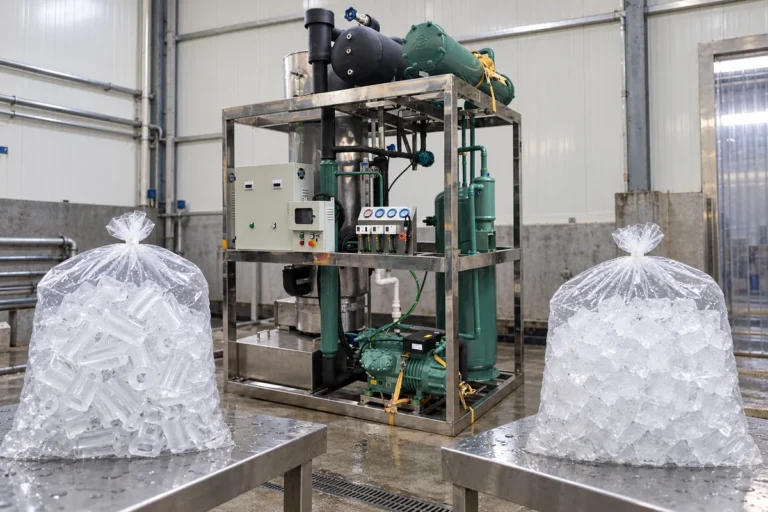
A complete flake ice system normally includes the ice machine, refrigeration equipment, controls, water supply, insulated storage, and a way to discharge or convey the ice. When selecting from a flake ice machine range, compare the rated output with the plant’s ambient temperature, inlet water temperature, production hours, and daily ice requirement.
Continuous production allows the plant to make and store ice outside its busiest processing period. The bin or ice room must hold the required amount while providing effective drainage, hygienic storage, and reliable discharge.
Crushed Ice Production System
A crushed ice line needs hard ice from an on-site machine or an external supplier. Depending on the layout, it may include an ice maker, storage room, hopper, crusher, conveyor, and delivery point. Crusher throughput has to match the available ice supply and the rate at which the processing line consumes ice. A tube ice crusher is designed for a defined feed form, for example, and should be checked before use with ice of another size or shape.
Installation and Operating Differences
A crushed ice plant has more process interfaces because the ice is made, stored or transferred, and then crushed. These extra transfer points add cleaning work and wear components. The arrangement may still be economical for a plant that already has suitable hard-ice production.
A flake ice plant has no separate crushing stage, but it still needs correctly sized refrigeration, storage, drainage, and delivery equipment. Compare the cost of the complete installed system, including the ice machine. This flake ice machine price comparison covers the effect of site conditions, condenser type, storage, auxiliary equipment, and delivery scope on project cost.
Choosing an Ice System for Seafood Processing
Flake ice is usually the better choice when the ice must make close, gentle contact with the seafood. Crushed ice is often more practical when a compatible hard-ice supply is already available. Once the ice type is chosen, production capacity and plant layout determine the equipment configuration.
Flake Ice for Direct Product Cooling
Flake ice works well with fresh fish, shellfish, fillets, and processing steps in which the ice must surround the product. It spreads readily through boxes and bins, cools the product quickly, and places less concentrated pressure on delicate surfaces.
The plant must still account for holding time and storage volume. Flake ice occupies more space per unit weight than crushed block ice, so a demand calculation based on weight must be converted into the actual bin volume.
Crushed Ice for Existing Hard-Ice Systems
Crushed ice can be a sensible choice for a plant that already makes block or tube ice, has a reliable external supply, or needs dense ice for transport containers with limited space. Adding a crusher gives the plant more flexibility without replacing the upstream ice source.
Before selecting the crusher, confirm the feed dimensions, required particle size, throughput, food-contact construction, cleaning access, and meltwater drainage. These details show whether the existing system can produce consistent, sanitary ice.
Ice System Sizing
Size the system for the highest ice demand within the available production window. Daily average demand alone can leave the plant short during peak periods. This fishery ice project planning framework explains how peak seafood volume, incoming product temperature, holding losses, production hours, storage, and distribution affect capacity.
The calculation should cover the ice used to bring seafood down to its target temperature, replace melt losses during holding, cover transfer losses, and maintain a reserve for peak landings or processing shifts. Ask the supplier to calculate output under the site’s highest ambient temperature and normal inlet water temperature.
Information to Provide for a Quote
A supplier needs operating data to calculate production capacity and select the refrigeration, storage, and ice delivery equipment.
| Parameter | Information to Provide | Why It Matters |
| Application | Seafood type, processing step, and target temperature | Defines the ice form and cooling duty |
| Ice demand | Daily use, peak hourly draw, and operating hours | Sets machine capacity |
| Site conditions | Maximum ambient and inlet water temperatures | Affects expected output |
| Utilities | Voltage, frequency, phase, and water supply | Determines equipment compatibility |
| Storage and delivery | Required reserve, delivery distance, and lift height | Sets storage and conveying requirements |
| Existing equipment | Ice makers, crushers, refrigeration, and available space | Identifies reusable equipment and layout limits |
For a project-specific configuration, submit your ice-system specifications with the required capacity, application, utilities, and site conditions.
Frequently Asked Questions
How Much Ice Is Needed per Ton of Seafood?
There is no fixed ratio. Demand changes with the incoming product temperature, ambient heat, insulation, and holding time. Cooling 1,000 kg of fish from 30°C to 0°C theoretically requires about 340 kg of ice before holding and handling losses are added.
How Should Ice Be Stored in a Seafood Processing Plant?
Store ice in a clean, insulated area with effective drainage and protection from contamination. The store should be sized for peak demand, and all contact surfaces should be cleaned on a documented schedule.
What Food Safety Requirements Apply to Seafood Ice Systems?
Ice that contacts seafood should be made from potable or approved clean water and protected from contamination during production, storage, and handling. The plant must also follow applicable HACCP controls and local food safety requirements.