Certain flake ice machines require a small, controlled salt dose to help ice release from the freezing surface and form consistent flakes. This requirement depends on machine design and feed-water chemistry; freshwater operation alone does not dictate whether dosing is necessary.
In industrial drum-type machines that scrape ice from a refrigerated surface, proper dosing distinguishes routine water conditioning from mechanical or feed faults.
Why Salt Helps Some Flake Ice Machines
For machines built for salt dosing, introducing trace sodium chloride modifies ice structure to aid separation and harvesting.
Easier Ice Release
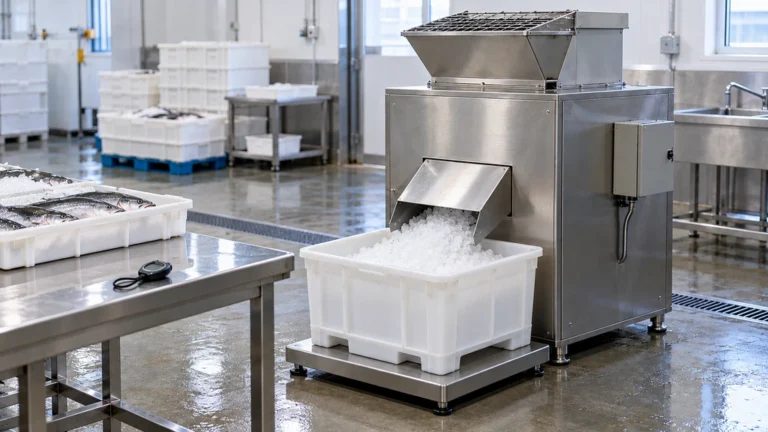
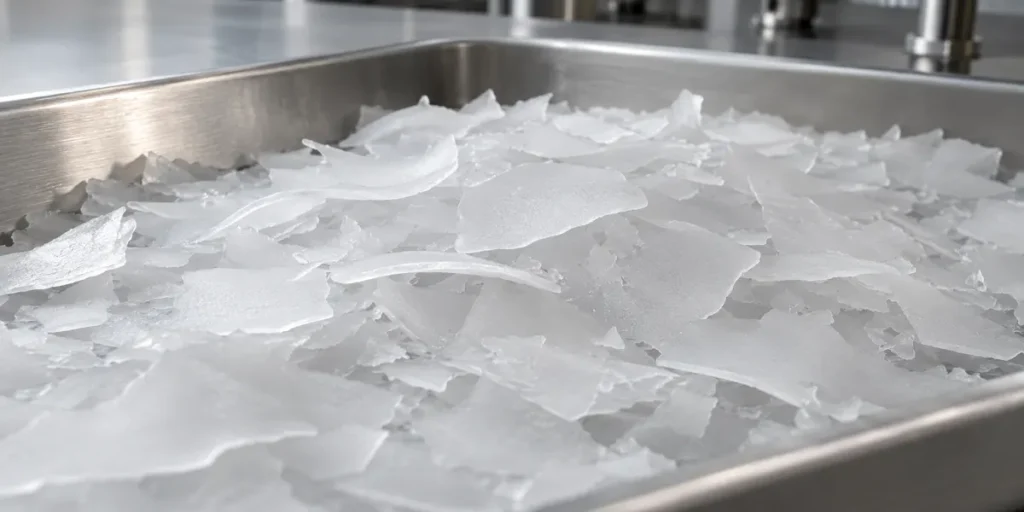
Trace salt reduces adhesion between the ice sheet and the evaporator drum. During flake ice production, water freezes into a thin sheet on the refrigerated drum surface before a blade breaks it away. If the sheet adheres too strongly, scraping demands higher mechanical force. In dosing-compatible evaporators, the salt addition lowers release resistance, cutting drive chatter and mechanical load on the blade assembly.
More Consistent Flakes
Proper dosing yields thicker, more uniform flakes with fewer powdery fines. When feed water is particularly soft, certain evaporator profiles struggle to form stable flakes. Manufacturer guidelines often recommend salt dosing to stabilize ice formation under these low-mineral conditions. Dosing targets the factory-specified flake standard. Adding salt past that threshold shifts the water chemistry outside design parameters rather than improving flake yield.
Which Flake Ice Machines Need Salt Dosing
Operating requirements across industrial flake ice machines fall into three categories: mandatory, optional, or unnecessary, depending on evaporator metallurgy and scraper mechanics.
Machines That Require Dosing
When manufacturer specifications mandate salt addition, the machine must operate with its dosing circuit active. Review the installation manual for model-specific requirements and feed-water thresholds. The mere presence of a dosing pump or a brine recipe in documentation does not confirm that salt is required; these components frequently serve as optional field accessories. Mandatory dosing should always be verified against the model manual and official commissioning records.
Machines With Optional Dosing
Certain designs produce ice without chemical conditioning but support dosing to resolve specific water-quality issues. For instance, maintenance manuals for some industrial models state that the evaporator operates standardly without salt, yet specify an optional dosing kit to remedy soft-water flake defects. Optional dosing treats identified water characteristics and harvesting issues. It is an application-specific correction, not a standard commissioning default.
Machines That Need No Extra Salt
Freshwater units engineered to run on untreated mains water require no dosing as long as ice discharge meets specification. Dedicated seawater units utilize the salinity already present in their supply. Operating a standard freshwater machine with concentrated brine will not convert it to seawater duty, as evaporator materials and refrigeration settings are engineered specifically for each water type. In fish and seafood cooling, the water source governs machine selection; seafood preservation alone does not dictate a seawater design.
How a Flake Ice Machine Salt Dosing System Works
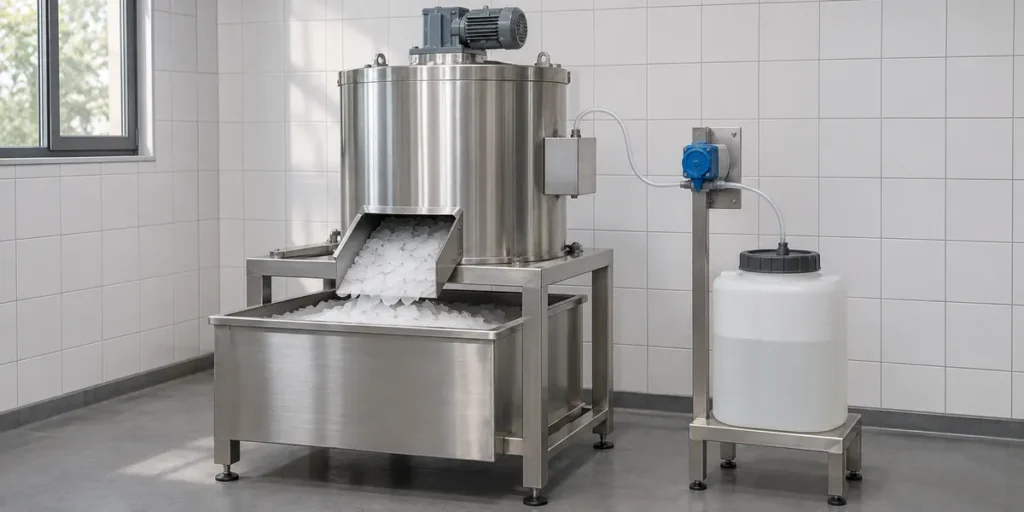
A pump-based system meters dissolved brine directly into the machine’s water circuit:
- An operator mixes salt and water in an external reservoir according to manufacturer specifications.
- A metering pump draws the solution through a dedicated suction line.
- The pump injects calibrated volumes into the water reservoir or distribution manifold.
- The brine blends into the incoming feed stream before entering the freezing drum.
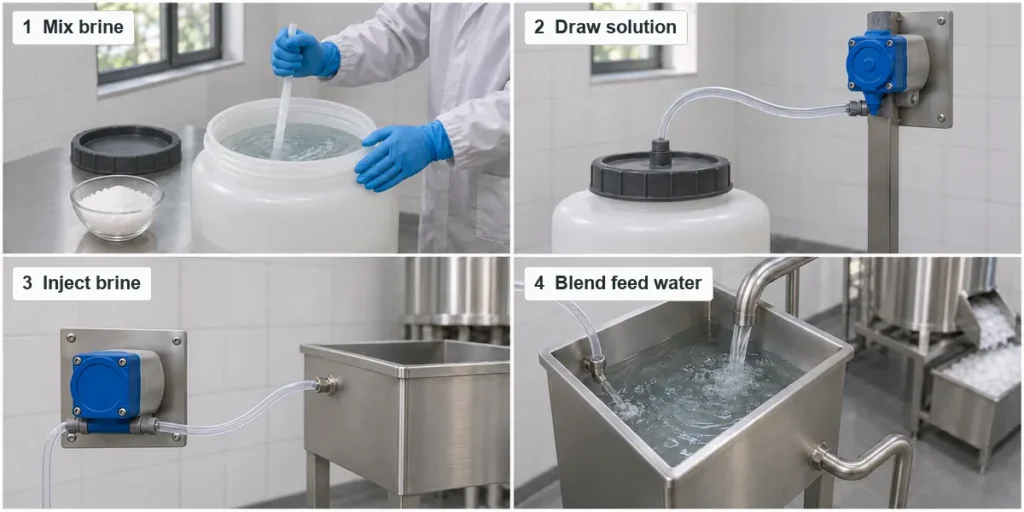
Basic configurations run on a fixed pump output. Automated setups incorporate a conductivity or salinity sensor that monitors reservoir concentration and cycles the pump on demand. Alternative systems rely on in-line salt tablet erosion feeders rather than liquid injection. Equipment scopes should clearly account for the reservoir, pump, and control hardware when comparing project quotes.
How Much Salt Should Be Added
Dosage rates depend on the specific machine model and local water conditions. Dosing protocols must define both total salt mass per unit of production and the delivery settings for the metering hardware.
Brine Concentration and Salt Dosage
Brine concentration refers to the dissolved salt ratio in the supply tank, whereas dosage defines the actual salt consumed relative to ice output.
These parameters require distinct measurements:
- Brine concentration: expressed as a percentage by mass.
- Pump delivery: measured in liters per hour.
- Salt consumption: calculated in grams per metric ton of ice.
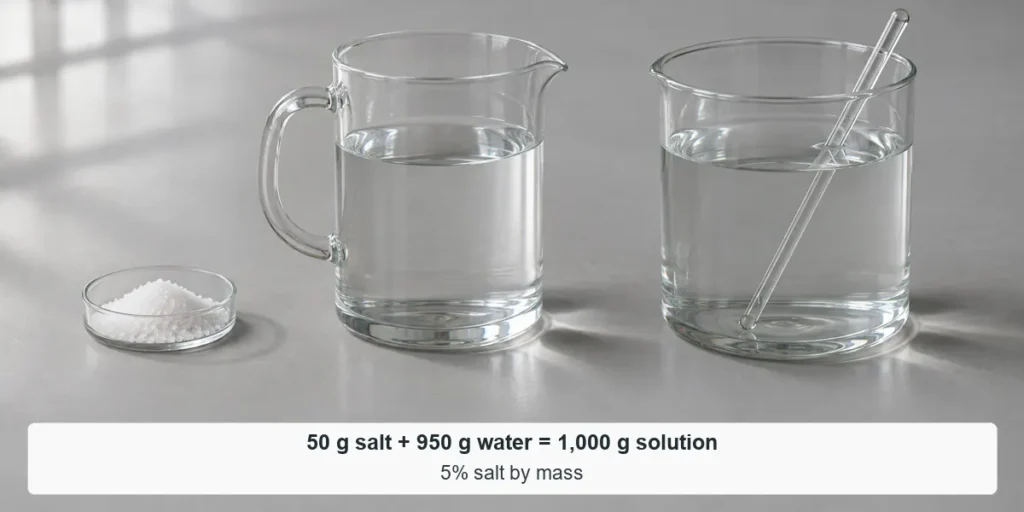
As a baseline example, a 5% solution by mass contains 50 grams of salt per kilogram of water. Metering 2 kilograms of this solution delivers 100 grams of dry salt. This calculation illustrates dosing mechanics rather than an operating guideline. Tank solution strength does not represent the salinity of the circulating water or the finished ice.
Determining the Correct Dose
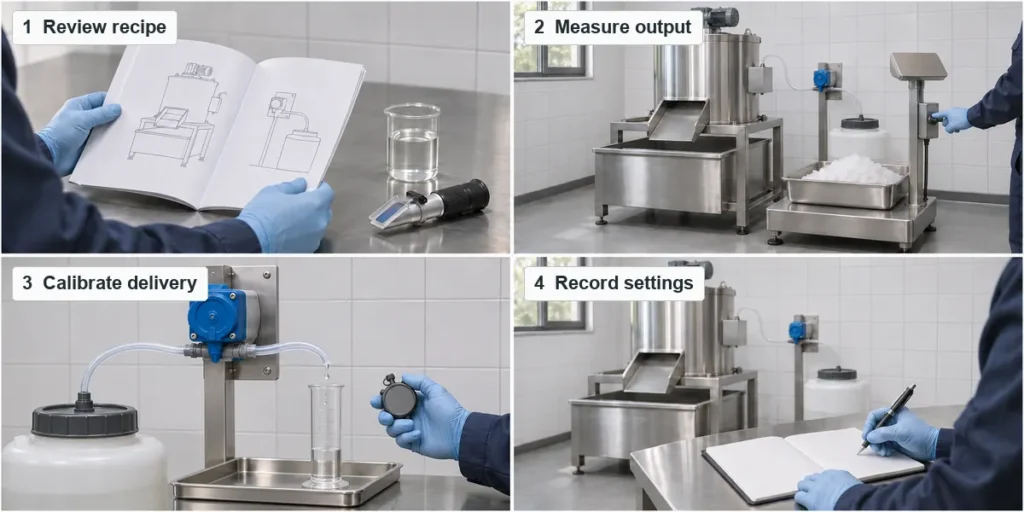
Baseline settings begin with manufacturer specifications, followed by verification of tank concentration and pump output. Certain industrial generator manuals cite a baseline consumption of 100 grams of salt per metric ton of harvested ice, subject to water analysis.
When dosing scales with production volume:
- Daily salt consumption = specified grams per tonne × actual tonnes produced per day.
Calculations must use actual operating tonnage rather than nameplate capacity. A 3-ton flake ice machine reflects output rated under standard ambient and water temperatures; field production fluctuates with ambient conditions. Commissioning technicians must calibrate pump discharge against the prepared solution strength. Logging the solution ratio alongside stroke or speed settings ensures operational repeatability.
What Happens When Salt Dosing Is Incorrect
Improper salinity alters ice structure and impedes harvesting. Under-dosing in machines that require salt leads to thin, brittle ice and excessive fines. Over-dosing weakens the ice structure prematurely; service literature notes that oversized flakes releasing ahead of the scraper blade indicate excessive salt.
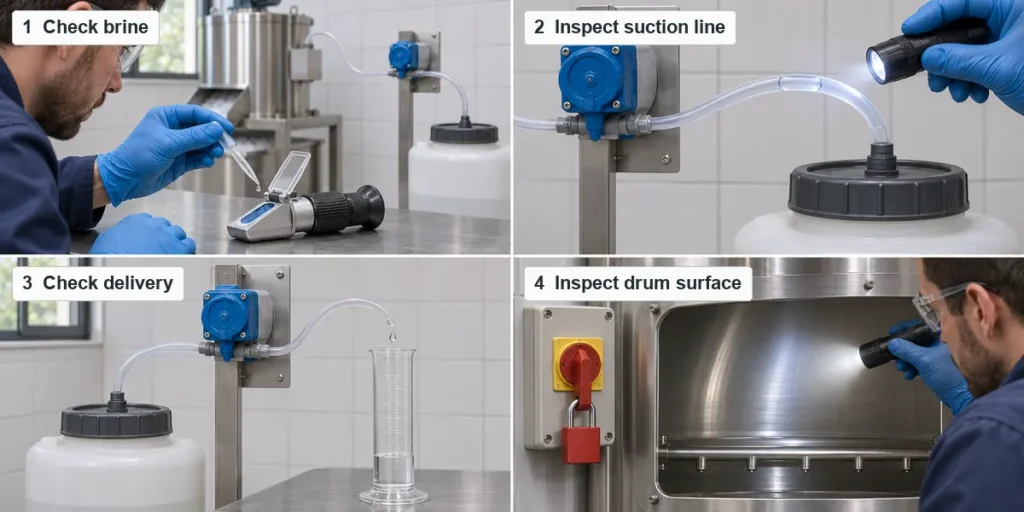
Symptoms like ice sticking can also stem from mineral scale, uneven water distribution, or worn scraper edges. A systematic troubleshooting sequence includes verifying:
- Brine tank solution ratio matches specifications.
- Suction tubing draws solution without air ingress.
- Metering pump and injection points discharge freely.
- Evaporator drum surface is free of scale and evenly wetted.
Loss of chemical feed requires re-priming according to pump service guidelines. Mechanical scraping noise or motor overload trips call for mechanical inspection prior to altering dosage rates.
To evaluate equipment requirements for specific sites, discuss your operating conditions with Mikeicemachine. Detail target output, water source analysis, and ice application to determine the correct dosing arrangement.
Frequently Asked Questions
What Type of Salt Should Be Used?
Use high-purity sodium chloride in the physical form mandated by the dosing hardware. Ice intended for direct food contact or food processing requires certified food-grade salt. Liquid dosing systems typically require fully dissolved, non-iodized evaporated salt, whereas tablet dispensers require specific tablet geometries. Unrefined rock salts or alternative chemical salts cause clogs and must not be used without manufacturer clearance.
Will Salt Dosing Make the Ice Salty?
Trace dosing rarely imparts a detectable taste, though sodium remains present in the harvested ice. Sensory inspection cannot verify process compliance. For food processing or salt-sensitive chemical applications, calculate residual sodium against final formulation limits or run laboratory conductivity tests on melted samples.
Can Salt Dosing Replace Cleaning or Water Treatment?
Salt dosing functions solely as a mechanical harvesting aid and does not substitute for descaling, sanitation, or filtration. Dosing modifies ice adhesion during freezing. It does not prevent mineral scale, control microbial growth, or correct incoming water hardness. Descaling schedules and water filtration must proceed independently in line with maintenance guidelines.