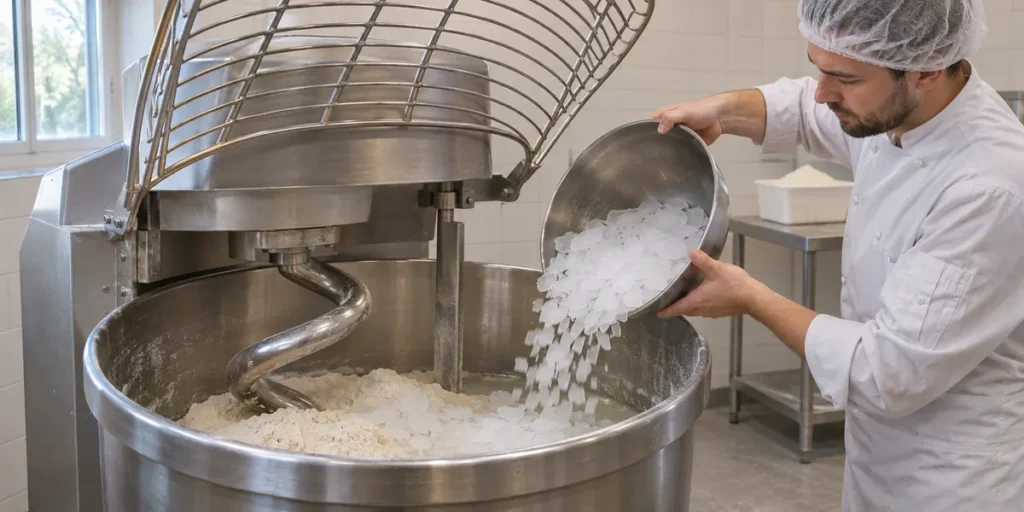
In commercial bakeries, flake ice is one of the most effective tools for controlling dough temperature during mixing. By substituting a calculated portion of recipe water with ice, bakeries absorb friction and ambient heat as the flakes melt, reaching the desired final dough temperature without throwing off target hydration.
For industrial wholesale bakeries and central commissaries, consistent results depend on a disciplined mixing sequence and an ice system engineered to match peak shift demand. The principles below apply to standard yeast doughs produced with potable freshwater ice.
Why Commercial Bakeries Use Flake Ice
Chilled water cools only through sensible heat transfer as its temperature rises. In warm production facilities, or when dealing with high-speed mixing and warm silo flour, chilled water rarely absorbs enough heat within the recipe’s liquid limit.
Ice provides far greater cooling density because it absorbs latent heat of fusion (roughly 80 cal/g or 334 J/g) as it transitions from solid to liquid. In bakery operations, this type of process cooling counteracts intensive motor friction while keeping recipe hydration intact.
Thin flakes work well because their high surface area allows them to melt and disperse evenly before gluten development finishes. The goal is never to chill the dough indiscriminately, but rather to bring the batch off the mixer at the exact desired dough temperature (DDT) scheduled for downstream processing.
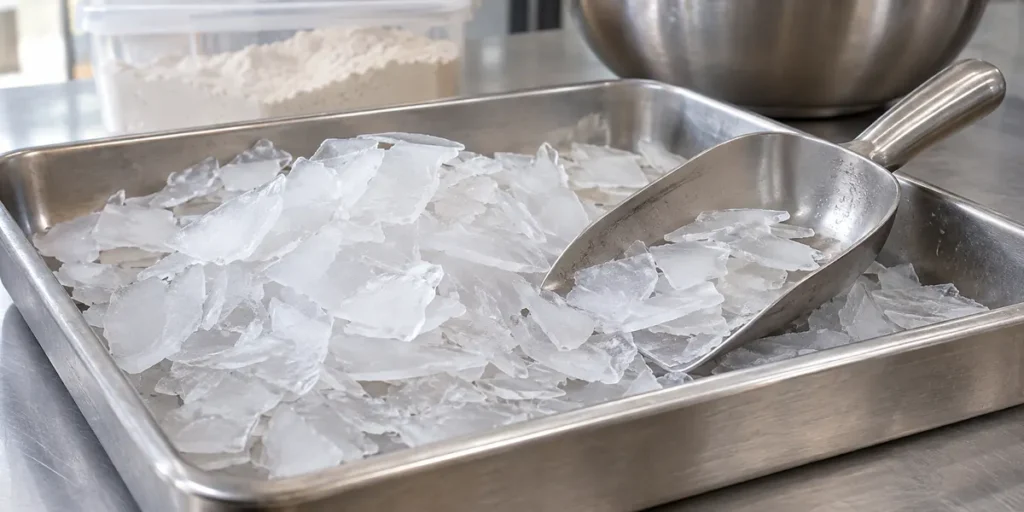
How to Manage Dough Temperature With Flake Ice
Predictable temperature control requires an established DDT, verified ingredient temperatures, and an exact ice calculation. Keep batch weights, ingredient sources, and mixer timers constant while establishing the baseline.
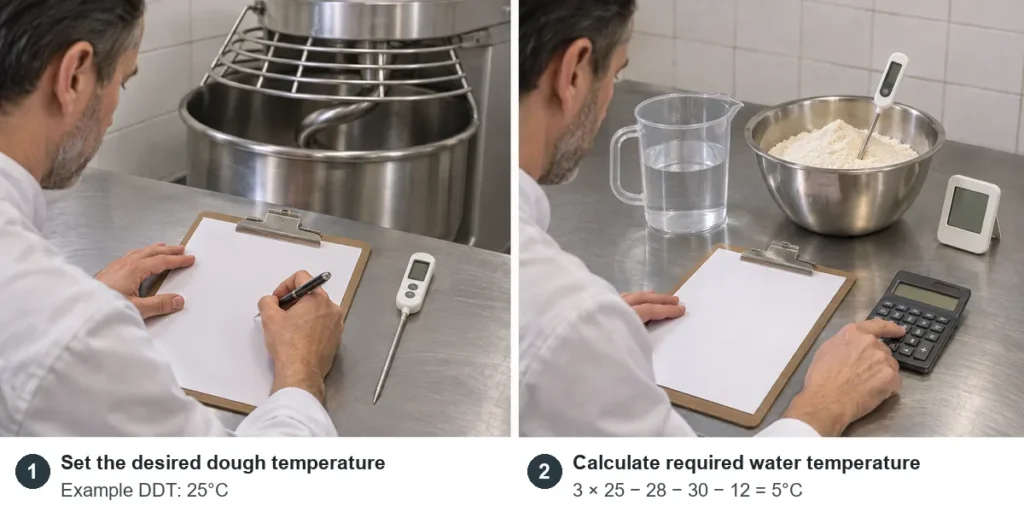
Step 1: Set the Desired Dough Temperature (DDT)
Define the target temperature for the dough immediately upon discharge from the mixer bowl. For most standard wheat doughs, 75–78°F (24–26°C) serves as an effective starting benchmark. Formulas bound for long retarders or high-percentage rye loaves typically run cooler. Base this target on proofing schedules and production history, then record the acceptable tolerance range in the batch sheet.
Step 2: Determine Required Water Temperature
Work backward from the DDT to find the required water temperature. For straight doughs mixed without a preferment, use the standard bakery balance equation:
Required water temperature = (3 × target dough temperature) − flour temperature − room temperature − friction factor
The friction factor accounts for the mechanical heat added by your specific mixer, tooling, and batch volume. To determine it, run a baseline trial using liquid water, record all temperatures, and solve:
Friction factor = (3 × actual dough temperature) − flour temperature − room temperature − water temperature
Use consistent temperature units throughout. In Celsius, with a target dough temperature of 25°C, flour at 28°C, ambient air at 30°C, and an established friction factor of 12°C:
Required water temperature = 75 − 28 − 30 − 12 = 5°C
For formulas using a preferment, multiply the target dough temperature by 4 and deduct the preferment temperature along with the other variables.
Step 3: Replace Part of the Water With Flake Ice
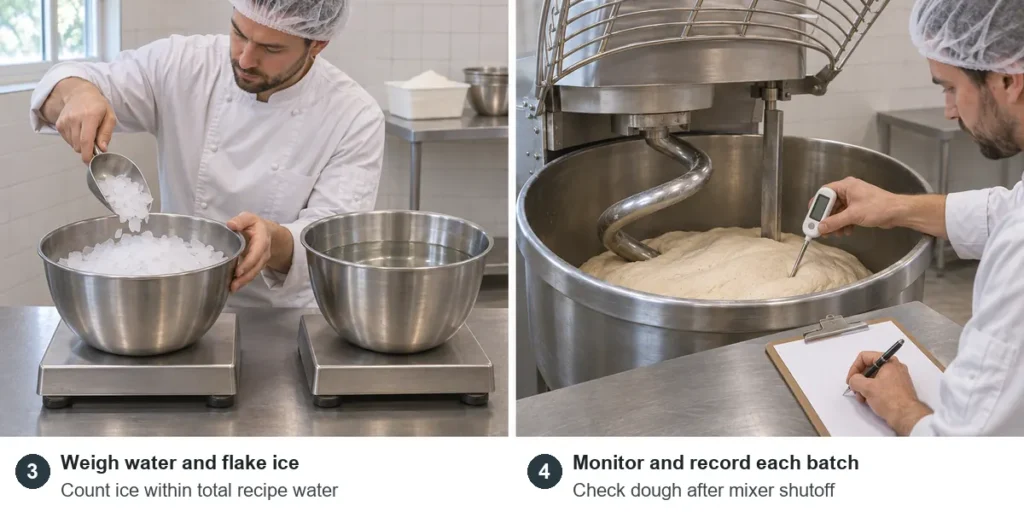
If the required water temperature drops below what your water chiller can deliver, substitute flake ice for a portion of the recipe water using this formula:
Ice mass = total recipe water × (available water temperature − required water temperature) ÷ (available water temperature + 80)
This calculation assumes freshwater ice at 0°C, complete melting during mixing, and a target water temperature above 0°C.
For a batch requiring 60 kg of total water, with incoming water at 25°C and a required water temperature of 5°C:
Ice mass = 60 × (25 − 5) ÷ (25 + 80) ≈ 11.4 kg
Scale out 11.4 kg of flake ice and 48.6 kg of liquid water.
Subcooled ice (for example, at −5°C) absorbs additional sensible heat before melting, providing slightly more cooling than calculated above. If calculations call for a sub-zero water temperature, conduct a full thermodynamic balance and verify results through pilot batches. Add ice following the mixer manufacturer’s recommended sequence to ensure all flakes melt before mixing concludes.
Step 4: Monitor and Adjust Each Batch
Check dough temperature immediately upon mixer shutoff using a calibrated digital insertion thermometer. On large spiral or horizontal tilt mixers, check multiple spots across the batch to detect any temperature stratification.
Log flour temperature, ambient room temperature, water temperature, ice weight, mix times, and discharge temperature. If temperatures drift, track down the specific variable that shifted. Avoid extending mix cycles simply to melt unblended ice flakes, as additional mixing generates more friction heat and can overdevelop the gluten structure.
Sizing a Bakery Ice Supply System
Ice system engineering hinges on three constraints: daily consumption, peak hourly pull, and available ice-making runtime. Nameplate daily tonnage alone will not guarantee that ice is ready when mixers need it.
Using the 11.4 kg batch dose calculated above, consider this production scenario:
| Production Parameter | Value and Unit | Sizing Purpose |
| Ice per batch | 11.4 kg/batch | Sets individual batch dose |
| Total batch rate | 4 batches/hour | Sets hourly demand (45.6 kg/h) |
| Mixing shift | 10 hours/day | Sets shift demand (456 kg/day) |
| Available ice-making time | 20 hours/day | Defines required production rate (22.8 kg/h before losses) |
| Mixer loading window | 11.4 kg within 2 minutes | Requires at least 5.7 kg/min delivery rate |
| Maximum storage duration | Production schedule dependent | Dictates bin design and discharge mechanics |
Here, an ice maker producing 22.8 kg/hour outputs only 228 kg across the 10-hour mixing shift, creating a 228 kg deficit against the shift’s 456 kg consumption. That gap must be built up in refrigerated storage before the shift starts. Size storage bins around the maximum cumulative deficit between production and usage curves, factoring in melt loss, dead zones around bin augers, and scheduled sanitation downtime.
Stored ice must remain loose and free-flowing. Because storage temperatures directly influence crusting and clumping, review ice storage conditions to preserve discharge reliability. Always request ice production derating charts based on your plant’s peak summer ambient temperatures and warmest water supply.
Choosing a Flake Ice Machine for Bakery Production
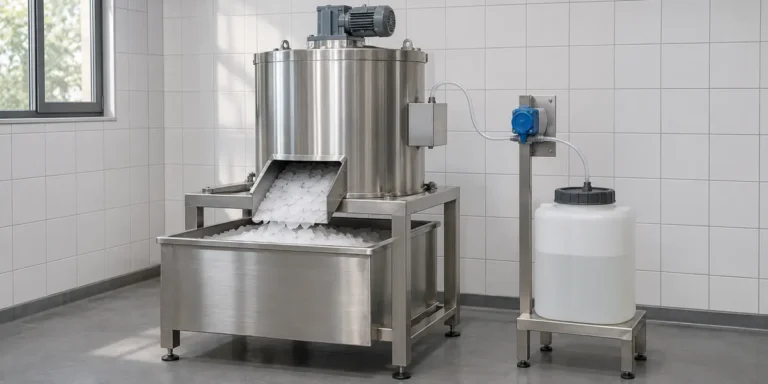
Select freshwater flake ice machines that deliver verified capacity under site utility conditions, then evaluate how the hardware fits plant sanitation, conveying, and maintenance workflows.
Ice Thickness and Melt Characteristics
Flakes must meter cleanly and dissolve completely inside standard mix times. A typical industrial 3-ton flake ice machine produces dry flakes approximately 2.5 mm thick at −5°C. Spiral mixers running short cycles for delicate pastry or artisan doughs require thin, brittle flakes that dissolve rapidly, whereas heavy-duty horizontal mixers running stiff sponge doughs can handle slightly heavier flakes without leaving unmelted pockets in the crumb.
Hygienic Construction
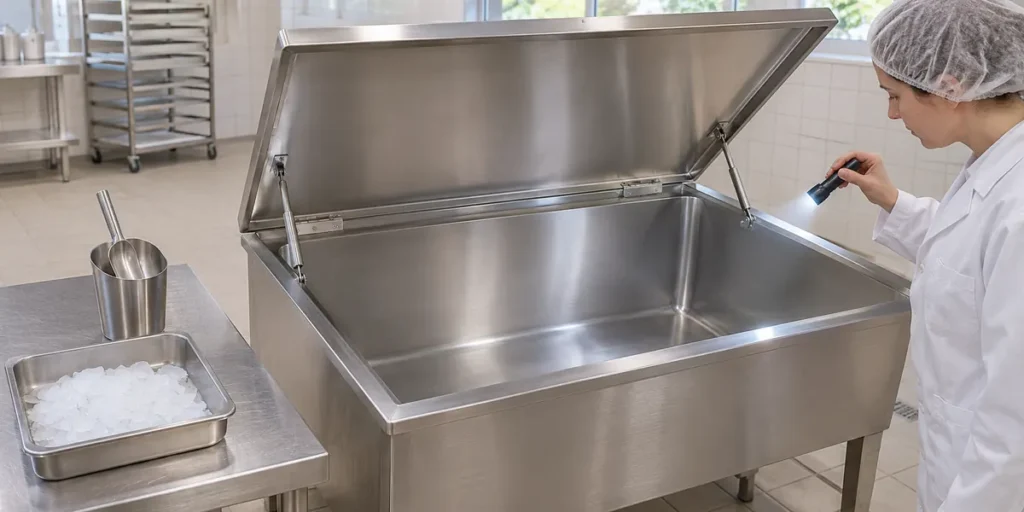
Every food-contact surface, including water distribution trays, freezing drums, scrapers, collection bins, and discharge chutes, must allow full access for visual inspection and sanitation. Materials must withstand regular contact with food-grade cleaning and sanitizing agents. Under U.S. 21 CFR 117.40, equipment in food manufacturing facilities must be designed for cleanability and corrosion resistance.
Mixer Integration and Conveyance
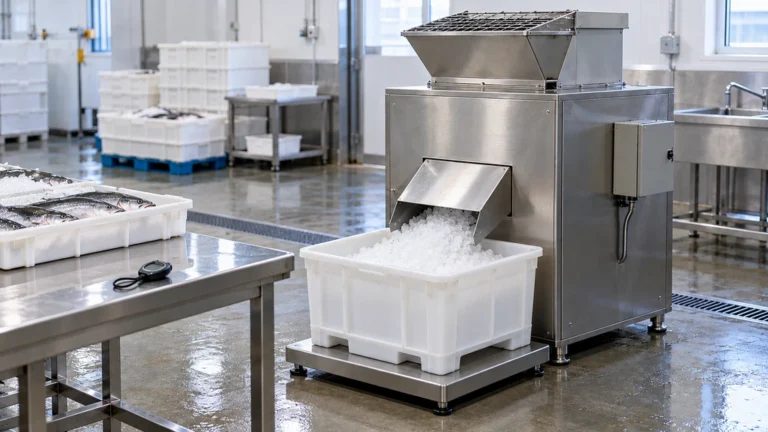
Confirm that the discharge setup aligns with your mixer deck height, batch cycles, and loading tolerances. Automated plants typically route flake ice through sanitary screw or pneumatic ice conveyor systems feeding into loss-in-weight or gain-in-weight hoppers above the mixer throat. Bin-full and conveyor interlocks must prevent overfilling and bridging. Always check the mixer manufacturer’s guidance regarding maximum instantaneous ice loading.
Serviceability and Redundancy
Choose machinery that line mechanics can inspect and service without disrupting adjacent packaging or makeup lines. Review the compressor package, refrigeration cycle, routine wear components, and parts lead times before finalizing equipment specifications. When plants run continuous multi-shift production without buffer days, plan for dual refrigeration circuits or emergency backup ice storage.
For detailed equipment layouts, compile peak hourly batch volumes, incoming water temperatures, electrical service parameters, and overhead clearance data to submit your production requirements for an engineered proposal.
Frequently Asked Questions
Does using flake ice require adjusting yeast levels?
No. Maintain your standard yeast percentage as long as the dough discharges at the specified DDT and follows its planned fermentation schedule. If you deliberately drop dough temperature to lengthen fermentation time, test proofing rates before reformulating yeast levels. For active dry or instant yeasts, follow supplier guidelines regarding direct contact with chilled water or ice to avoid thermal shock.
Can flake ice be used in doughs made with milk?
Yes, provided the recipe contains water that can be replaced by ice. Substituting ice directly for liquid milk removes milk solids, butterfat, and lactose, which changes water absorption, crumb structure, and crust color. In 100% milk formulas without added water, chill the liquid milk directly or rebalance the formula using water and dry milk powder before adding ice.
Can flake ice replace dough retarding?
No. Flake ice controls initial temperature during mixing; it does not replace the sustained, humidity-controlled cooling of a retarder proofer. Retarding holds dough under steady refrigeration over hours or days to manage fermentation kinetics and develop organic acids.