Choose an ice crusher that can handle the ice you have, produce pieces suitable for direct contact with seafood, and keep up with your busiest operating period. Check that its capacity rating applies to the feed ice and output setting you plan to use.
This guide covers machines that crush existing block, tube, or cube ice. It explains how to specify the equipment for your seafood handling needs and test it before purchase.
Confirm the Ice Your Crusher Must Handle
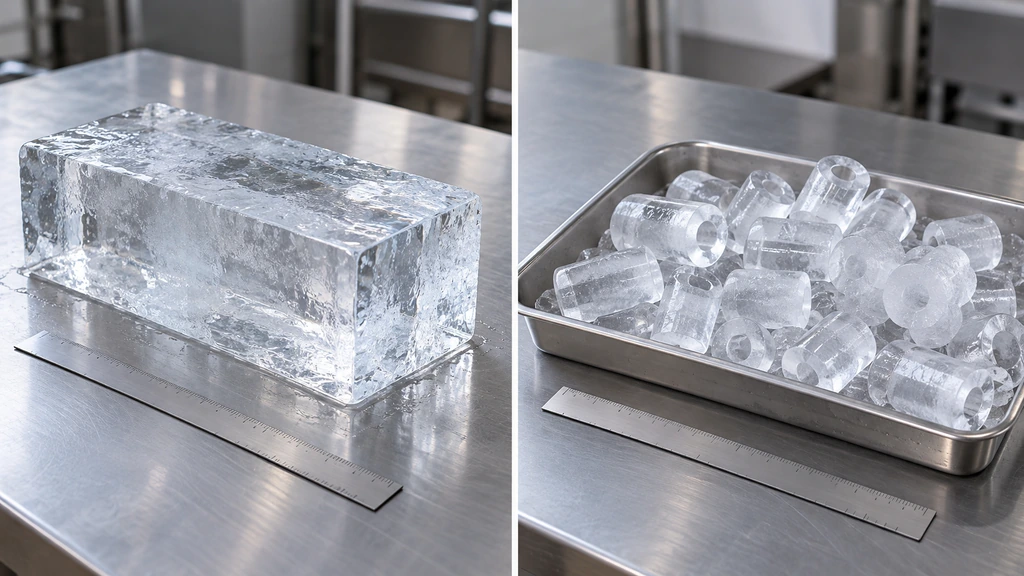
Check the largest pieces you expect to feed into the crusher and the condition they will arrive in. The machine must be able to handle both.
Record:
- Ice shape, maximum dimensions, and individual block weight.
- Ice temperature and visible surface moisture.
- Whether stored ice arrives loose or frozen into clusters.
- Whether you will feed it manually, through a hopper, or by conveyor.
For blocks, check weight and dimensions together. A block within the weight limit may still be too large for the feed opening. For tube ice, record the diameter, length, and size of the largest clusters you expect.
A tube ice crusher is designed for tube ice. Before using one for blocks, confirm that the opening, crushing mechanism, and drive can handle them. Do not force oversized pieces through the inlet or assume the machine accepts every form of hard ice.
How to Choose Crushed Ice Size for Seafood
Choose ice that packs around the seafood without leaving large fragments that could damage it. Specify a measurable size distribution so the supplier knows what you mean by “fine ice.”
Ice Size for Seafood Handling
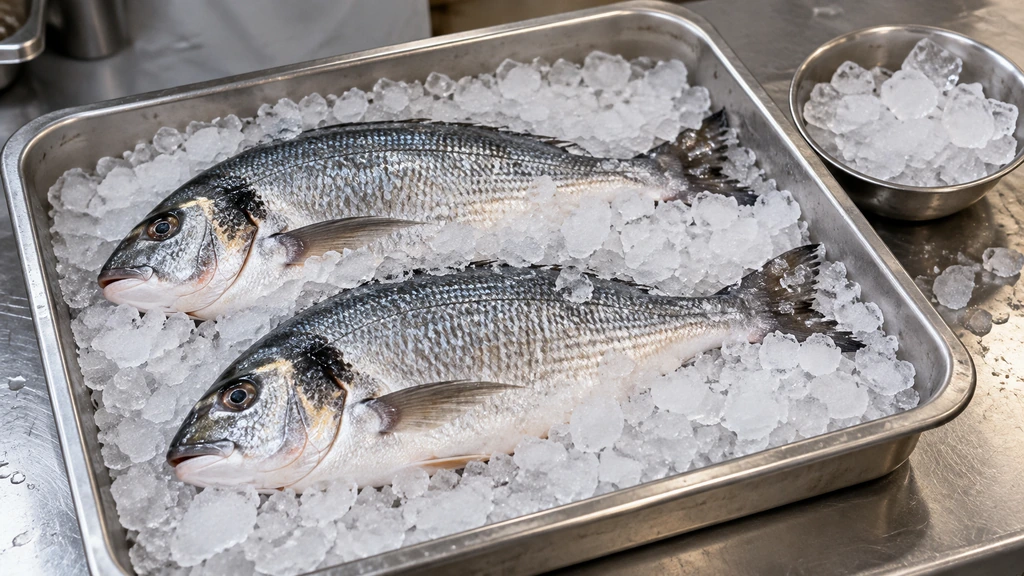
For whole fish packed directly in crushed block ice, start trials with pieces around 10 × 10 mm or smaller. FAO describes this size in its guidance on storing fish aboard fishing vessels. The guidance applies to that setting and does not establish a size requirement for every seafood product. Try the sample in your actual packing arrangement. Check for gaps around the seafood, pressure from large fragments, and surface marks after normal handling.
For delicate fillets or shrimp, start with a finer sample and check coverage and damage. If hard fragments still leave marks, further crushing may not solve the problem. You may need another ice form or packing method. Small pieces can improve coverage, but excessive fines, the smallest particles, can melt quickly during warm handling. Assess the ice where it will be used before choosing a finer setting.
Particle Size Distribution
Particle size distribution shows how much of a sample falls within each size band. An average alone can hide large fragments and excessive fines.
Specify:
- The target size band.
- The maximum permitted particle size.
- The permitted mass percentage below the lower limit.
- The permitted mass percentage above the upper limit.
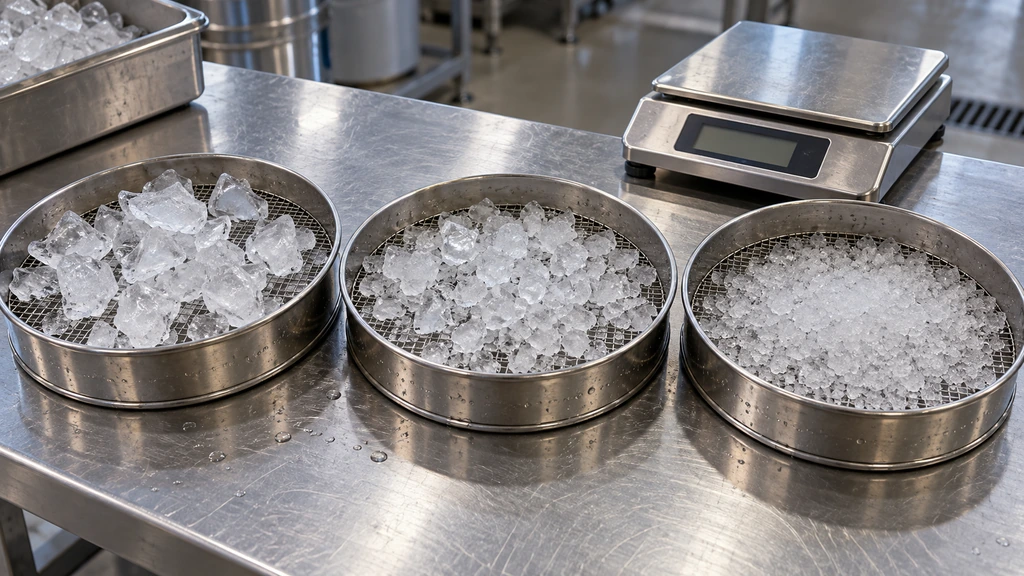
Agree on a quick sampling method, such as weighing the portions retained on selected screens. Use the same sampling location, drainage time, and handling procedure each time, since melting changes the results. Photos with a scale help show particle shape; use measurements to establish the distribution.
How to Determine the Required Crushing Capacity
Base capacity on the usable crushed ice you need within a specific time. Allow for any crushed ice already in storage, then compare the remaining requirement with the machine’s output under your operating conditions.
Peak Ice Demand
Use the busiest receiving, processing, or packing period as the basis for sizing. Daily average consumption can hide a shortage during that period.
Determine ice demand from measured production use or a documented cooling assessment. Include the ice needed to cool the seafood, keep it cold during holding, and cover handling losses. The required ice-to-seafood ratio changes with product temperature and storage conditions.
If you have no usable crushed ice in reserve:
Required effective throughput = usable crushed ice needed ÷ available crushing time
For example, delivering 600 kg in 20 minutes requires:
600 ÷ (20/60) = 1,800 kg/h
The machine must deliver that rate in practice, even if its nameplate lists the same figure.
Preparing crushed ice in advance gives the crusher a longer operating window. Check that storage can release ice fast enough and refill before the next peak. Industrial ice capacity planning explains how daily output, stored inventory, and peak withdrawal work together.
Actual Operating Throughput
Actual operating throughput is the usable crushed ice delivered over the full operating period, including normal pauses in feeding.
Ask for performance data using your feed dimensions, ice condition, and target particle setting. A short run with uninterrupted feeding will not show what the machine can sustain when operators load it manually.
Keep separate records for:
- The rate of ice entering the crusher.
- Usable output that meets the particle specification.
- The delivery rate at the seafood workstation.
Check whether published capacity is in kg/min, kg/h, or metric tons per day. Also distinguish the crusher’s processing rate from the ice maker’s production rate and the amount the bin can store.
The surrounding ice storage and handling equipment must keep pace with the crusher. A restricted bin outlet or conveyor can limit delivery even when the crusher has enough capacity. Include allowances for identified losses or interruptions, and count each allowance only once.
Check Hygienic Design and Cleaning Access
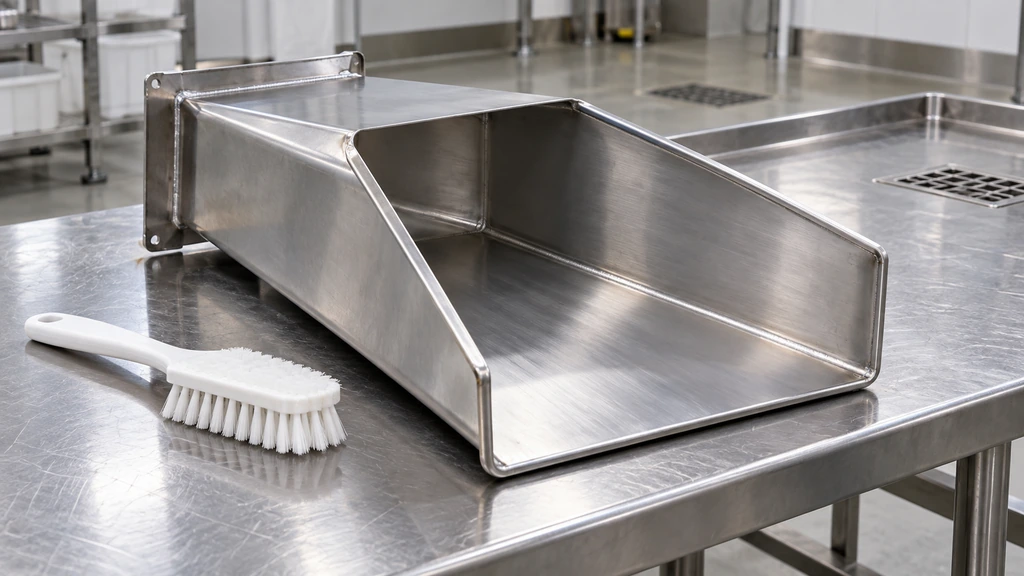
You should be able to clean, inspect, and drain every surface the ice touches. Check the design and access as well as the stainless steel construction. Inspect the hopper, crushing chamber, blades or teeth, discharge chute, and transfer connections. Look for smooth joints and accessible corners. Check for places where water or debris could collect.
Confirm that:
- Contact materials withstand the intended ice and cleaning chemicals.
- Bearings and lubricants cannot contaminate the ice.
- Covers or removable parts give access for cleaning.
- There is room to clean beneath and around the installed machine.
Have the supplier demonstrate the cleaning procedure and show which parts need to come off. Before using a hose or pressure washer near motors, controls, or bearings, check which washing methods the manufacturer permits. Use a clean ice supply, too. Crushing will not remove contamination already in the ice.
Test Capacity and Ice Size Before Ordering
Test the proposed machine with ice that represents your normal feed. Measure throughput and particle size during the same run, using a test duration, sampling method, and numerical acceptance limits agreed in advance.
| Test Item | Test Conditions | What to Record | Acceptance Requirement |
| Feed compatibility | Largest planned pieces and expected ice condition | Dimensions, feeding behavior, rejected pieces | Feed enters and processes within approved limits |
| Effective throughput | Target size setting and normal feeding method | Usable output mass, elapsed time, interruptions | Meets the required usable kg/h |
| Particle distribution | Samples taken throughout the throughput run | Mass in each size band and largest fragments | Meets agreed size and fines limits |
| Discharge performance | Planned chute, conveyor, and receiving arrangement | Delivered rate and blockage events | Maintains required delivery without unresolved blockages |
| Cleaning access | Supplier’s demonstrated cleaning procedure | Parts removed, access, drainage, cleaning time | All contact surfaces are accessible through the approved method |
| Controls and guarding | Manufacturer’s approved functional test procedure | Guard interlocks, stop functions, restart behavior | Performs as documented without bypassing safeguards |
A test of the crusher alone establishes its performance under the test conditions. Any conveyor or storage outlet left out of the trial will need testing during system commissioning. Particle measurements establish ice size. Use a separate packing trial to check how well the ice covers the seafood and whether it leaves surface marks.
To review a configuration, submit your operating specifications, including feed ice dimensions, the quantity needed during your peak period and its duration, target particle requirements, and available power supply. These details help establish compatibility and the basis for a quotation.
Frequently Asked Questions
How Do You Prevent Crushed Ice from Clumping?
Crush ice shortly before use and keep holding time short. Use insulated storage, rotate stock, and control moisture. Lowering ice storage temperature alone will not prevent wet ice from clumping.
When Should Crusher Blades Be Replaced?
Replace cracked, chipped, or excessively worn blades according to the manufacturer’s guidance. Inspect blades regularly and investigate persistent changes in particle size or output. Replacement intervals vary by machine.
What Happens If Ice Jams the Drum?
A jam can stall the crushing mechanism or trip overload protection, if fitted. Stop feeding and shut down. Before clearing the jam, an authorized person must isolate and lock out hazardous energy, control stored energy, and confirm isolation. Restore guards before restarting.