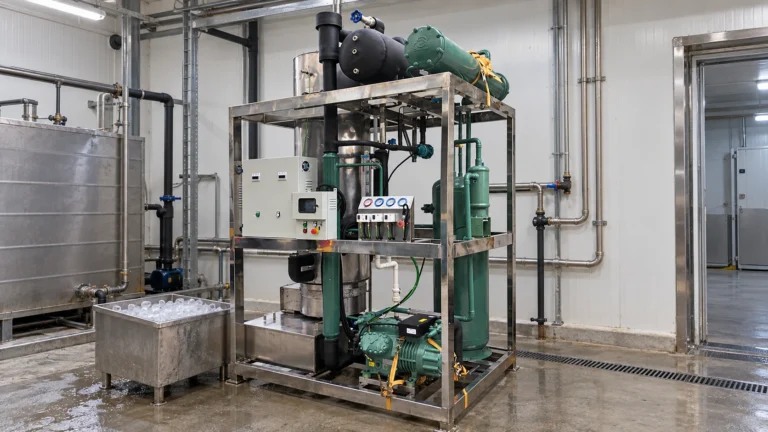
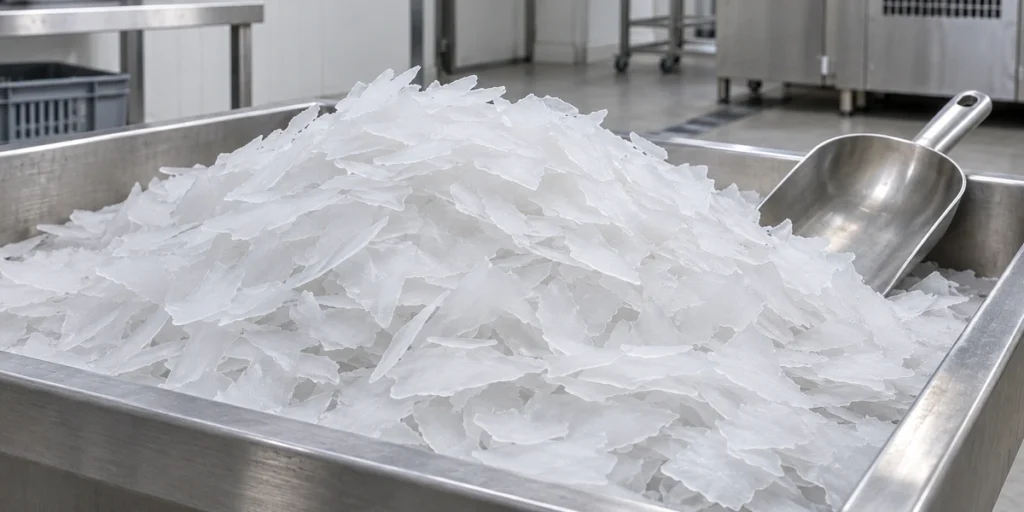
Flake ice consists of thin, flat, irregularly shaped pieces that mold around products to provide immediate, uniform thermal contact. Industrial flake ice machines produce these dry flakes continuously on refrigerated surfaces, eliminating the need to crush solid blocks.
This guide focuses specifically on dry industrial flake ice produced from freshwater. Some suppliers loosely apply the term to wetter granular ice, so always verify the exact physical output of a given machine. For saltwater applications, see the FAQ on seawater ice below.
How Is Flake Ice Made?
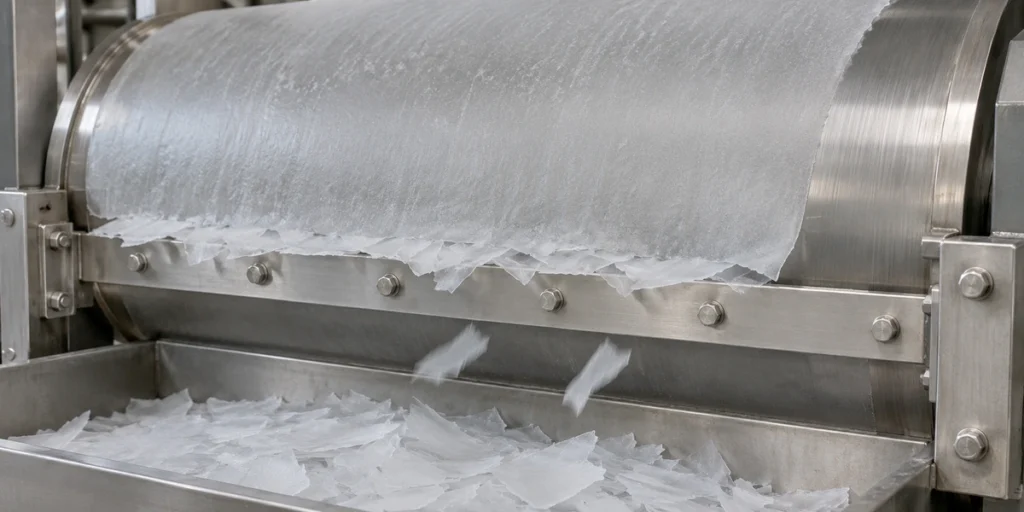
Flake ice forms when water freezes onto a refrigerated surface and is mechanically sheared away by a harvesting blade. The manufacturing process operates in a continuous cycle:
- Water distribution: Water sprays or cascades over the evaporator, the primary heat-exchange surface that removes heat from the liquid.
- Sheet freezing: A thin ice layer solidifies rapidly across the cold metal drum.
- Mechanical harvesting: A scraper blade separates the ice sheet from the drum surface, fracturing it into flat, dry flakes.
- Discharge: The flakes fall by gravity through the base into an integrated collection bin, cold room, or conveying system.
Depending on machine design, either the evaporator drum or the scraper blade rotates. In both configurations, the freezing surface and harvesting mechanism work in tandem to release ice continuously without requiring a heated defrost cycle.
Key Properties of Flake Ice
The following characteristics describe freshly harvested industrial flakes. Storage duration, ambient temperatures, and handling methods will gradually alter these properties.
Thin, Irregular Shape
The flat, uneven geometry allows flakes to nest closely around products and fill air voids between them. Thickness varies based on drum temperature and blade speed settings; consult the specific machine’s engineering datasheet when evaluating ice thickness for your process.
Large Surface Area
Thin flakes expose a large surface area relative to their volume. This geometry accelerates conductive heat transfer from a warmer product into the ice, resulting in rapid cooling. While this high surface area speeds up chilling rates, it does not change the total amount of heat each kilogram can absorb.
Low Surface Moisture
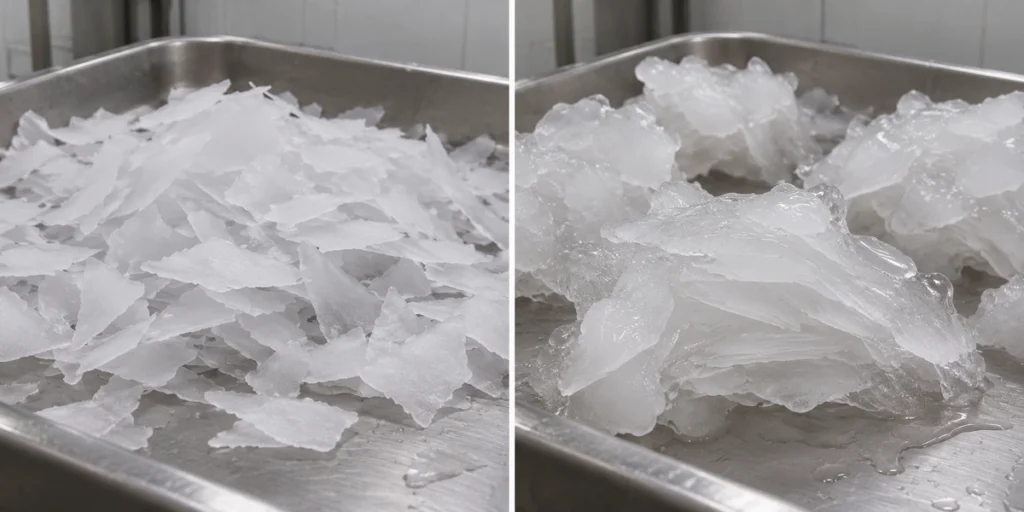
Freshly produced industrial flakes carry minimal free liquid water on their exterior. This surface dryness keeps the pieces loose and free-flowing for shoveling, dosing, and pneumatic conveying. As flakes warm toward the melting point, liquid water forms on the surface, increasing adhesion and changing how the ice packs.
Subcooled Temperature
Industrial flake ice discharges from the evaporator below the melting point. For example, the 3-ton flake ice machine lists an ice discharge temperature of minus 5 degrees Celsius under standard rating conditions of 30 degrees Celsius ambient air and 20 degrees Celsius inlet water. Note that evaporator operating temperature, ice discharge temperature, and the equilibrium temperature of the cooled product are separate measurements.
What Is Flake Ice Used For?
Flake ice machines supply ice for direct product chilling and precise batch temperature control. Operators can bed products directly in the ice or distribute flakes evenly through liquid and solid mixtures.
Fish and Seafood Chilling
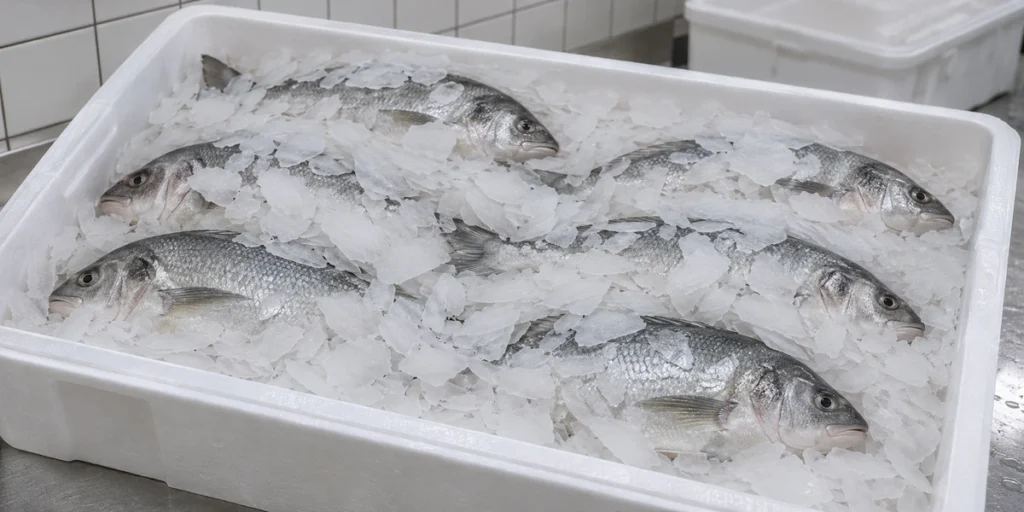
Flake ice settles into the cavities between and around seafood. Placing ice beneath, between, and over the catch creates continuous contact that cools far more evenly than resting a few large chunks on top. Freshwater icing aims to bring the catch down toward 0 degrees Celsius without freezing the cellular structure. Total ice demand calculations must factor in both the initial pulldown load and melt loss during transit and holding, as outlined in the fish and seafood icing guide.
Food Processing
In high-speed meat chopping, blending, and commercial dough mixing, mechanical friction generates substantial heat. Adding flake ice dissipates this thermal energy while melting smoothly into the mixture without damaging equipment blades. The ice melts directly into the batch, so its full weight must be counted as part of the recipe’s liquid water allowance.

Fresh Food Displays
Flake ice forms a soft, moldable bed for seafood counters and open food displays. Market staff can shape the display easily and replenish it throughout service. Direct contact must suit the food and its packaging. Display cases must incorporate clear drainage channels so meltwater drains away continuously rather than pooling around products.
Concrete Cooling
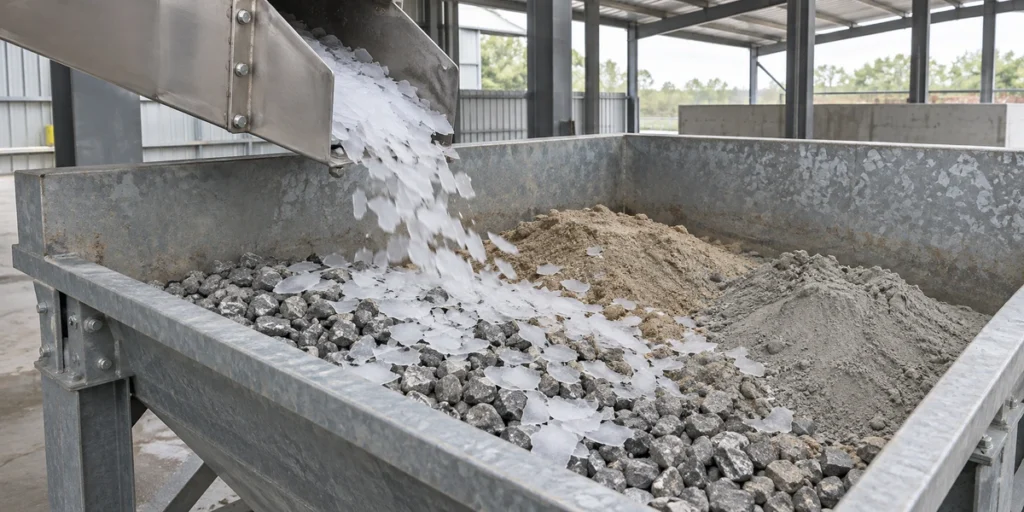
In large concrete pours, hydration heat can cause thermal cracking as the concrete sets. Flake ice replaces a portion of the batching water to lower the initial mix temperature before placement. The thin flakes melt completely during mixing without leaving structural voids. The replacement ratio depends on raw aggregate temperatures, cement content, and maximum allowable pour temperatures; it complements, but does not replace, subsequent curing practices.
Limitations of Flake Ice
While high surface area accelerates cooling, it also dictates how the ice must be stored, transported, and handled over time.
Faster Melting Than Block Ice
Under identical ambient conditions, flake ice melts noticeably faster than uncrushed block ice due to its expansive exposed surface area. Consequently, uninsulated transport over long distances leads to high melt losses. Insulated bin construction, ambient exposure, and pile depth dictate these loss rates; a dense, insulated mass retains its temperature far better than a thin, exposed layer.
Greater Storage Volume
The air gaps between loose flakes give the material a lower bulk density, or mass per unit of volume, than solid block ice. Flake ice storage bins and silos must therefore be sized for greater physical volume to hold the same weight of usable ice.
Clumping Risk
If stored in unchilled bins or exposed to fluctuating humidity, surface meltwater can refreeze across adjacent flakes, causing bridging and clumping. Over long holding periods, compacted flakes become difficult to shovel or discharge through screw conveyors. Facilities with large storage volumes often require automated orbital rakes or bin agitators to maintain a workable supply.
Flake Ice Compared With Other Ice Types
Selecting the proper ice profile depends on contact requirements, storage duration, and final application.
| Ice Type | How It Is Formed | Typical Uses | Main Trade-Off |
| Flake Ice | A thin frozen layer is scraped from an evaporator drum | Seafood packing, dough and meat processing, concrete cooling | Ready for close-contact cooling, but bulky in storage |
| Crushed Ice | Solid blocks or large cubes are broken mechanically | Fish preservation, display beds, selected drinks | Flexible particle sizes, but requires secondary crushing and handling |
| Nugget Ice | Shaved ice particles are compressed into small pellets | Fountain beverages, blended drinks, healthcare service | Chewable texture, but shape and moisture differ from dry flakes |
| Block Ice | Water freezes into a large solid mass | Long-haul transport, remote fishing vessels, storage reserves | Compact and slow-melting while whole, but often needs crushing |
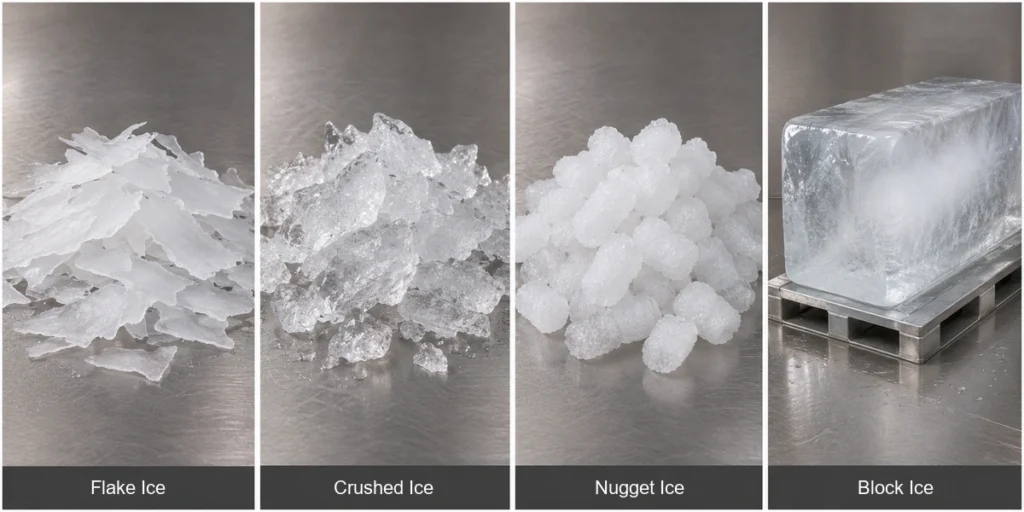
Crushed ice varies in particle size depending on the crushing mechanism. Nugget ice has a compressed form distinct from loose, dry flakes. For beverage service requiring slow dilution, solid cubes are generally a better choice than thin flakes.
When Is Flake Ice the Right Choice?
Flake ice is the ideal choice when your operation requires fast heat extraction, comprehensive product contact, or smooth integration into dry or wet blends without mechanical shock.
To determine equipment requirements:
- Calculate both average daily demand and peak hourly usage.
- Request production capacity derating data based on real-world summer ambient air and supply water temperatures, as nominal factory ratings assume ideal baseline conditions.
- For long transit periods without mechanical refrigeration, evaluate whether block ice with on-site crushing is more economical.
To configure an installation for your site, discuss your operating conditions with Mikeicemachine. Providing your target application, daily tonnage, peak pull periods, site ambient temperatures, and storage requirements will ensure proper compressor, drum, and bin sizing.
FAQs
Is All Flake Ice Food-Grade?
No. Ice geometry alone does not determine sanitary compliance. Ice intended for direct food contact or consumption must be produced from potable water sources inside hygienic, food-contact-approved equipment. Storage bins and handling tools must also be sanitized regularly to prevent cross-contamination; equipment approved purely for concrete cooling or industrial chemistry may not meet food-safety criteria.
Can Flake Ice Be Made From Seawater?
Yes, provided the machine is engineered specifically for marine environments. Seawater evaporators require specialized corrosion resistance and operating settings suited to saltwater freezing. Seawater ice retains residual salt and releases brine as it warms, making it unsuitable as a direct substitute for freshwater ice in drinks or food recipes.
How Much Water Is Needed to Produce Flake Ice?
As a general baseline, approximately 1 liter of freshwater becomes ice for each kilogram of freshwater flake ice produced. Total plant consumption must also account for routine bleed-off, water treatment backwashing, and system sanitization. If the plant uses a water-cooled condenser, distinguish closed-circuit evaporative cooling water from direct ice-making feed water.