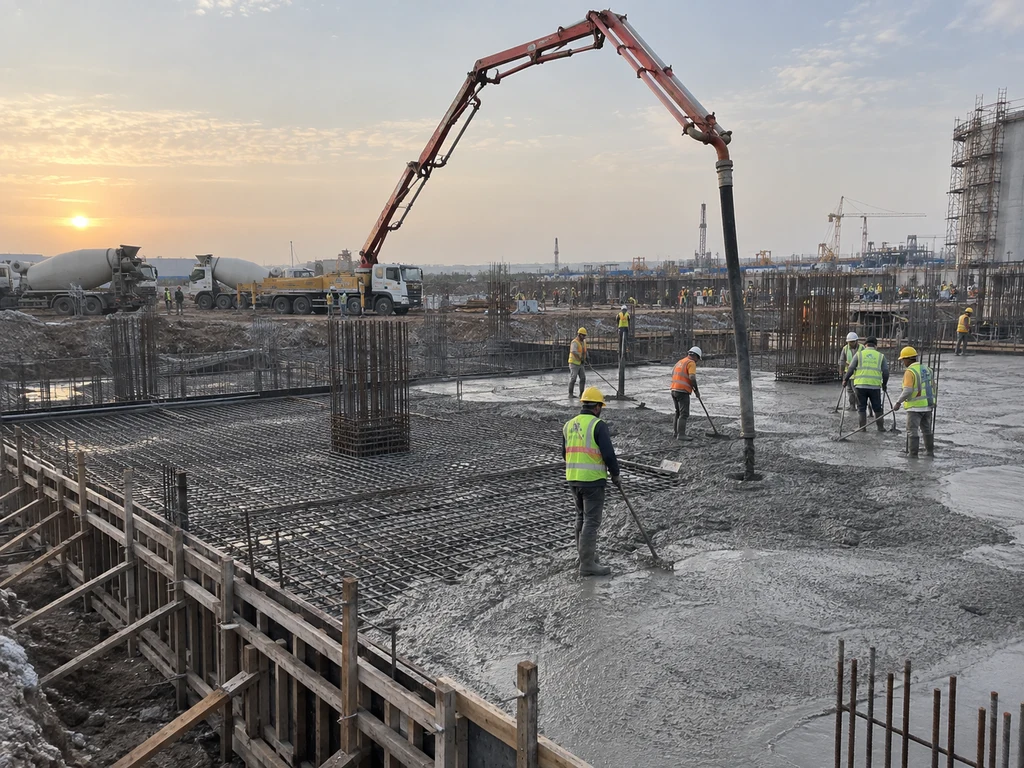
Mass concrete is any volume of concrete whose dimensions, mixture, boundary conditions, and environment can allow hydration heat to cause harmful temperatures, thermal stress, cracking, or long-term performance loss. It is defined by its thermal behavior—not by one fixed thickness.
Common examples include dams, thick mat foundations, large footings, bridge piers, and pile caps. However, the name or size of a structural element does not determine the classification by itself. The project team must evaluate how much heat the concrete will generate, how quickly that heat can escape, and how temperature-driven movement will be restrained.
What Makes Concrete Mass Concrete?
Concrete becomes mass concrete when its combined design and placement conditions create thermal risks that require specific controls.
Every portland-cement concrete mixture releases heat during hydration. Hydration heat alone does not make a placement mass concrete. The classification applies when heat accumulation and subsequent temperature change could produce harmful internal temperatures, thermal stress, cracking, undesirable reactions, or reduced long-term performance.
Thermal Risk, Not One Fixed Thickness, Defines Mass Concrete
There is no universal minimum thickness that separates mass concrete from conventional placements.
A thick section is more likely to retain heat because its center is farther from an exposed surface. However, a thickness threshold used in one specification or organization should not automatically be applied to every project.
A smaller section may still require mass-concrete controls when it uses a high-heat mixture, loses heat unevenly through different surfaces, or is strongly restrained by foundations and adjoining concrete. Conversely, a relatively large element may present a lower thermal risk if its mixture, geometry, initial temperature, and heat-loss conditions have been appropriately evaluated.
Geometry, Mixture, Boundaries, and Restraint Must Be Evaluated Together
The project team should consider:
- Element dimensions and placement volume
- Cementitious-material types and quantities
- Expected placing temperature
- Ambient temperature and weather
- Formwork and insulation
- Contact with soil, rock, water, or existing concrete
- Internal and external restraint
- The sequence and timing of adjacent placements
These factors determine how quickly heat develops, where it can escape, and how much temperature-driven movement is converted into stress.
For uncertain or high-risk placements, thermal modeling can compare predicted interior and surface temperatures with the applicable project limits. Contract documents may directly designate an element as mass concrete, but the control strategy should still reflect the actual mixture, structural geometry, construction sequence, and boundary conditions.
Why Does Mass Concrete Get Hot?
Mass concrete gets hot because cement hydration releases heat faster than a large or insulated placement can dissipate it. The resulting temperature history depends on both heat generation and heat loss.

Cement Hydration Generates Heat
Cementitious materials release heat as they react with water. The amount and timing of that heat depend on the cementitious system, material temperatures, mixture proportions, fineness, and chemical admixtures.
Reducing heat generation is different from cooling fresh concrete. A lower-heat mixture changes the amount or rate of heat produced during hydration. Precooling lowers the starting temperature before hydration causes the concrete temperature to rise.
These approaches may be used together, but they perform different functions and should be evaluated separately.
Large Concrete Sections Lose Heat Slowly
Concrete has relatively low thermal conductivity. In a thick placement, heat near the center must travel farther before reaching an exposed surface. As a result, the core may continue warming or remain warm after the outside begins to cool.
Heat loss is also affected by the conditions at each boundary. Formwork, soil, water, existing concrete, insulation, air temperature, wind, rain, and solar exposure can cause different faces of the same placement to cool at different rates.
Restrained Temperature Change Can Produce Thermal Stress
The warmer interior and cooler surface attempt to expand or contract by different amounts. Because the regions remain connected, they cannot move independently.
Internal restraint develops between regions of the same placement at different temperatures. External restraint can come from foundations, piles, reinforcement, existing concrete, or adjacent placements.
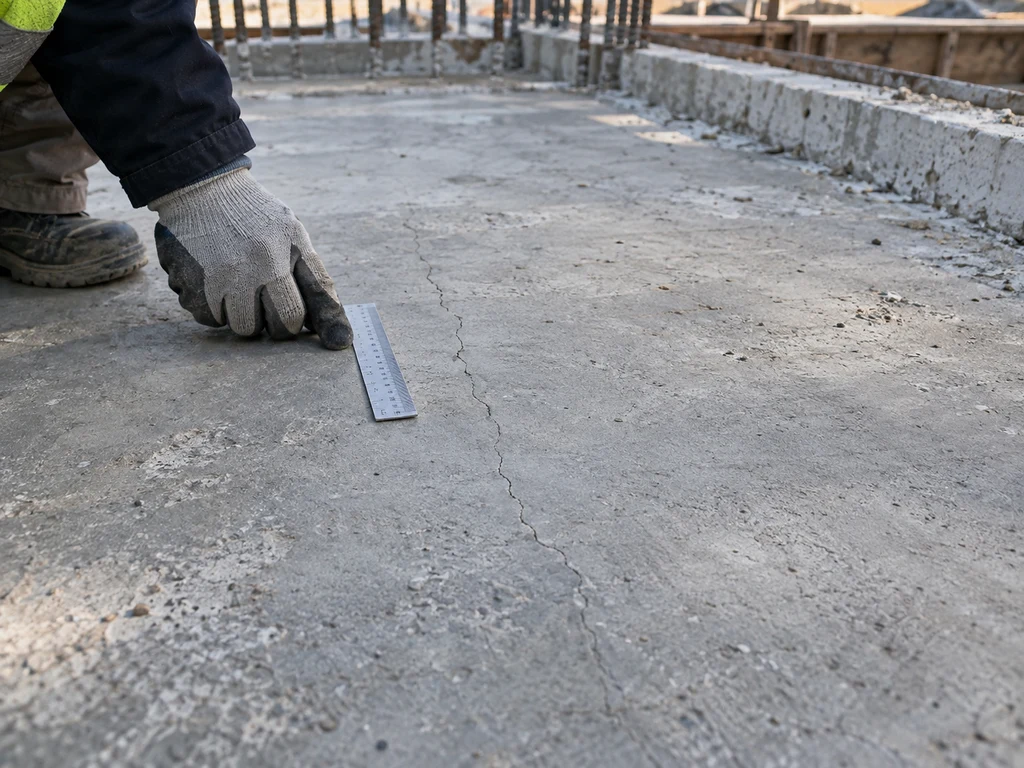
Thermal cracking becomes possible when restraint converts temperature-driven movement into tensile stress that exceeds the concrete’s early-age tensile capacity. Temperature difference is therefore an important risk indicator, but it is not a complete crack prediction by itself. Concrete strength development, stiffness, creep, geometry, and degree of restraint also affect the result.
Where Is Mass Concrete Used?
Mass concrete is used in structural elements that can retain enough hydration heat to require dedicated thermal assessment and control. The following are common examples, but their names alone do not determine whether a particular placement is mass concrete.
Dams and Hydraulic Structures
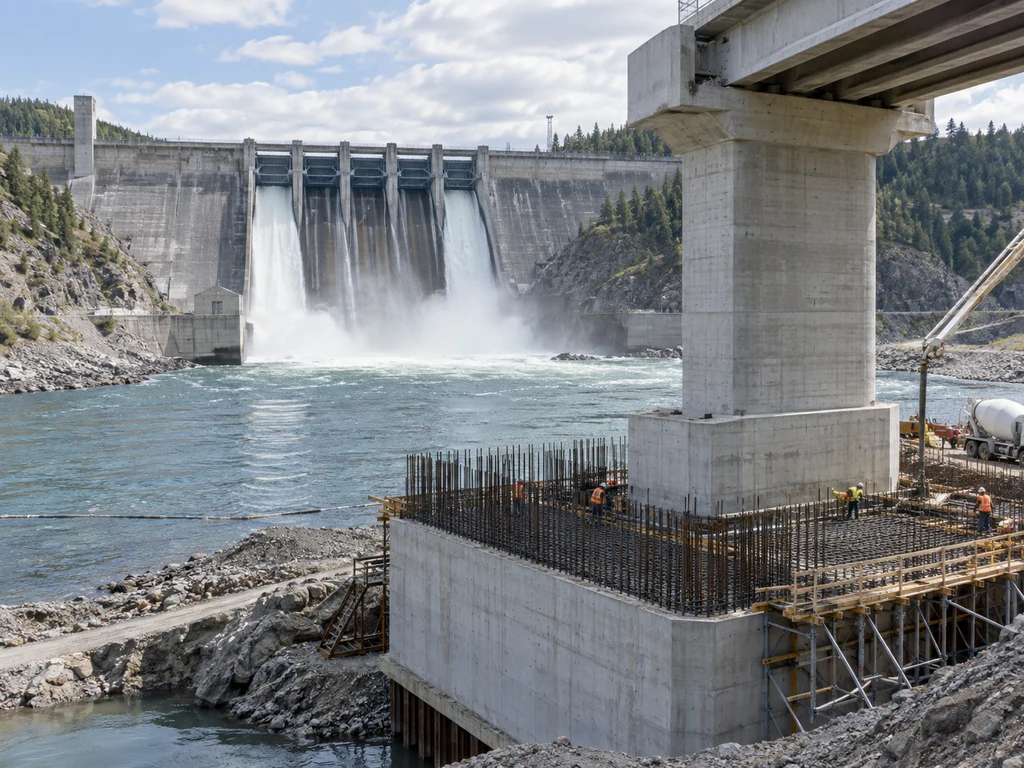
Gravity dams, dam blocks, spillways, navigation locks, and other thick hydraulic structures are established mass-concrete applications.
Their large dimensions and staged lifts require coordinated mixture design, construction sequencing, temperature control, monitoring, and protection. Boundary conditions may change as successive lifts are placed or as surfaces are exposed to air or water.
Mat Foundations and Large Footings
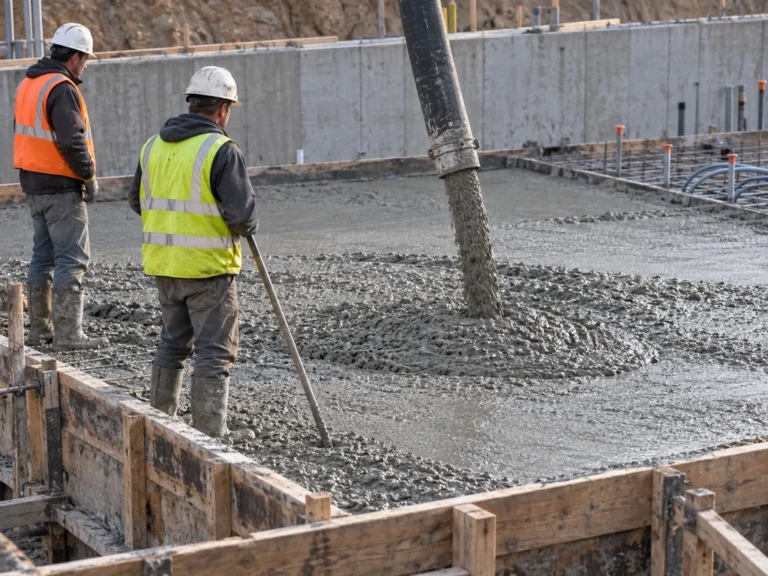
Thick mat foundations and large footings can develop high core temperatures, particularly when high early strength or rapid construction increases cementitious-material demand.
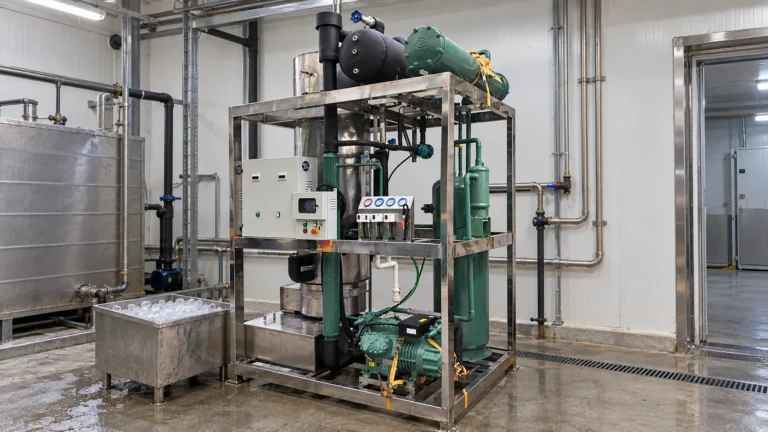
If the approved mixture uses ice to reduce its placing temperature, the batch plant should calculate the required ice per batch and the peak production rate before comparing available flake ice machines. A nominal daily capacity does not by itself confirm that the system can supply the busiest batching period.
Bridge Piers and Pile Caps
Large bridge piers and pile caps can behave as mass concrete when their geometry limits heat loss.
Water contact, soil interfaces, formwork, and previously placed concrete may create different thermal boundaries around the same element. Sensor locations, insulation, and other controls therefore should not be selected from nominal thickness alone.
How Is Mass Concrete Different from Conventional Concrete?
Mass concrete and conventional concrete are not fundamentally different material classes. Both are cementitious materials that must meet their specified structural and durability requirements.
In this context, a conventional placement is one that does not require mass-concrete-specific thermal controls. A mass concrete placement requires additional thermal-risk assessment and, where specified, temperature prediction, monitoring, protection, and documented response procedures.
The distinction therefore changes how the placement is planned and verified. It does not mean that mass concrete is automatically unreinforced, low-strength, or made from a completely different type of concrete.
What Problems Can Mass Concrete Cause?
The main thermal concerns are early-age cracking and temperature-related material or durability risks. These concerns are related, but they are controlled by different temperature quantities.
Early-Age Thermal Cracking
The center of a placement may remain warm while exposed surfaces begin to cool and contract. If the cooler surface is restrained by the warmer interior, tensile stress may develop near the surface.
Additional stress can occur later when the entire element cools and contracts against a foundation, adjoining placement, reinforcement, or another external restraint.
The allowable core-to-surface temperature difference is a practical control value. It should not be treated as a universal physical boundary between cracked and uncracked concrete because restraint and early-age tensile capacity also matter.
Excessive Internal Temperature
Excessive early-age temperatures can increase the risk of delayed ettringite formation in susceptible concrete and may adversely affect later-age strength development.
The relevant risk depends on the cementitious system, qualification data, exposure, temperature history, and governing project requirements. A temperature considered acceptable for one qualified mixture should not automatically be applied to another.
Peak Temperature and Temperature Differential Are Separate Risks
Peak internal temperature and the core-to-surface temperature differential must be evaluated separately.
The highest internal temperature addresses risks associated with excessive heating. The differential is used to manage cracking risk caused by unequal temperatures and restrained movement.
Keeping one quantity within its limit does not establish compliance with the other. The two maximum values may also occur at different times during heating and cooling.
What Are the Common Temperature Limits for Mass Concrete?
For projects adopting ACI SPEC-301-20, the commonly cited default post-placement limits are:
- A maximum concrete temperature of 160°F (70°C)
- A maximum center-to-surface temperature difference of 35°F (19°C)
The 160°F limit applies to the highest temperature reached after placement, not simply to the concrete temperature at discharge. The 35°F limit applies between the defined interior and near-surface measurement locations.
These values are separate controls and are not universal worldwide limits. The contract documents and applicable project specification should identify the controlling values, measurement locations, monitoring period, acceptance responsibility, and any approved alternatives.
Before selecting cooling equipment, the project team must establish the required placing temperature and the approved amount of batch water that may be replaced with ice. Our guide to concrete cooling with flake ice explains how ice quantity and peak delivery requirements affect batch-plant operation.
How Is Mass Concrete Temperature Controlled?
Mass concrete temperature is managed through a project-specific combination of mixture design, precooling, insulation, monitoring, and approved responses. No single method controls every thermal risk.
Reduce Heat Generation Through Mixture Design
Mixture design can reduce or delay heat release by controlling cementitious content and selecting suitable cementitious materials and admixtures.
Any change must still satisfy the project’s strength, durability, workability, setting, pumping, and construction requirements. Trial data, calorimetry, or thermal-property testing may be required to predict how the proposed production mixture will behave.
Lower cement content alone is not a complete thermal-control strategy. Initial material temperatures, geometry, boundaries, restraint, and construction sequence still affect the temperature history.
Lower the Initial Temperature Through Precooling
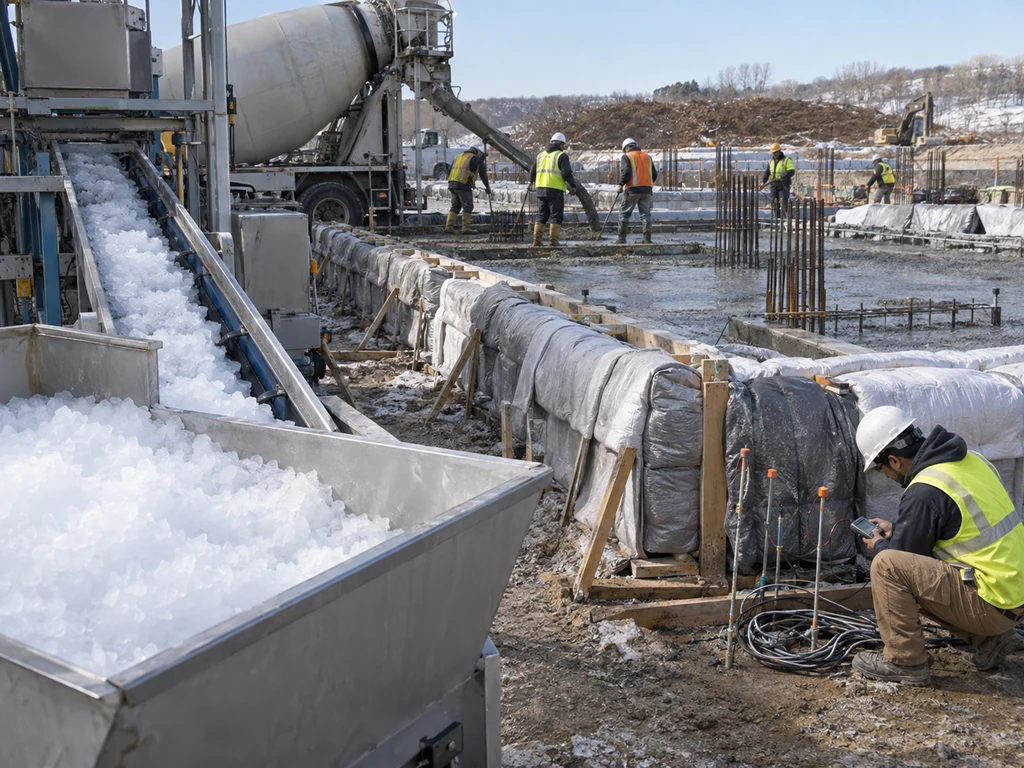
Precooling lowers the temperature of concrete ingredients or fresh concrete before hydration causes further heating. Common methods include cooled aggregates, chilled mixing water, and ice used as an approved replacement for part of the mixing water.
Ice must be included in the total mixing-water calculation. It is not additional water that can be added without adjusting the batch.
Our concrete cooling application guide explains how an ice system can support a batching project when precooling is part of the approved strategy.
For example, the 20-ton flake ice machine has a nominal capacity of 20,000 kg per 24 hours under the manufacturer’s stated conditions of 30°C ambient temperature and 20°C inlet-water temperature. Actual equipment selection must also consider the approved ice dose per batch, peak batches per hour, storage, recovery time, conveyance, utilities, and site conditions.
Control Surface Cooling With Insulation
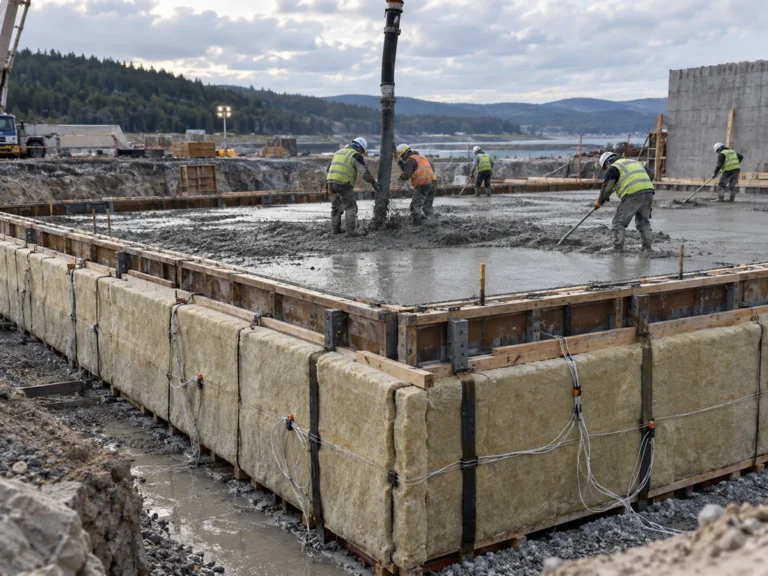
Surface insulation slows heat loss from exposed faces and helps keep the surface temperature closer to the warmer interior temperature.
Removing insulation or insulated forms too early can cause the surface to cool rapidly and increase the temperature differential. Insulation type, thermal resistance, coverage, installation time, joints, edges, and removal sequence should therefore correspond to the approved analysis and measured field temperatures.
Insulation can also retain heat. It does not necessarily reduce the peak internal temperature, so it must be coordinated with mixture selection, precooling, and any active internal cooling.
Monitor Temperatures and Follow Approved Responses
Temperature sensors should represent the expected warm interior and the critical near-surface regions. The approved plan should define reading intervals, temperature-difference calculations, warning levels, records, and responsible personnel.
Monitoring should report maximum temperature and core-to-surface temperature difference separately. A questionable reading should be checked against sensor location, operation, and related measurements before it is treated as a concrete temperature event.
Approved responses may include adjusting insulation, protecting an exposed surface, delaying form removal, changing the timing of a later placement, or operating an engineered cooling system. Field personnel should not improvise aggressive cooling measures that could create a new thermal gradient.
If an approved mixture uses batch ice, provide the required ice replacement per batch, peak batching rate, expected material temperatures, available utilities, storage needs, and delivery arrangement when you contact Mike Ice Machine. These inputs support equipment-feasibility and quotation checks; they do not establish the project’s engineering limits or replace the approved thermal-control design.
Frequently Asked Questions
Is Mass Concrete Always Reinforced?
No. Mass concrete may be reinforced or unreinforced.
The term “mass concrete” describes thermal behavior and the need for temperature control. “Reinforced concrete” describes how steel or other reinforcement carries structural forces and helps control cracking. A placement can belong to both categories, but the terms describe different characteristics.
Is Mass Concrete the Same as High-Strength Concrete?
No. Mass concrete is classified by thermal risk, whereas high-strength concrete is classified by specified strength and mixture performance.
A high-strength mixture may create mass-concrete concerns if its cementitious system and placement conditions produce substantial heat. However, high strength does not automatically make a placement mass concrete, and mass concrete does not have to be high-strength concrete.
Does Every Mass Concrete Placement Require Cooling Pipes?
No. Some placements can meet their temperature requirements through mixture design, precooling, placement planning, surface insulation, and monitoring.
Embedded cooling pipes are used when an approved thermal analysis determines that active postcooling is necessary. They are not a default requirement for every mass-concrete element.