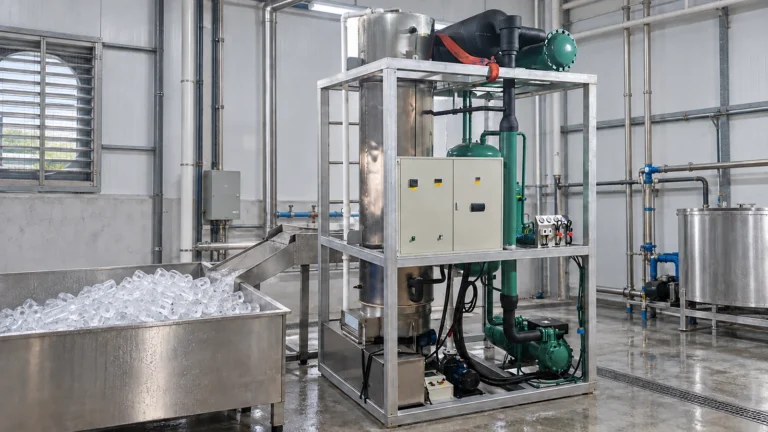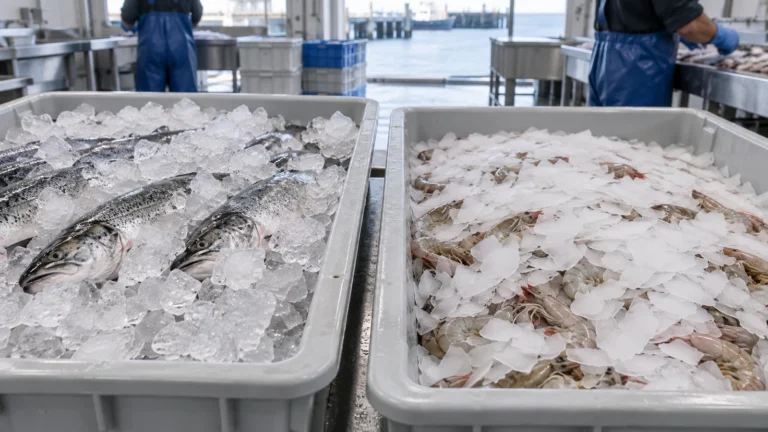
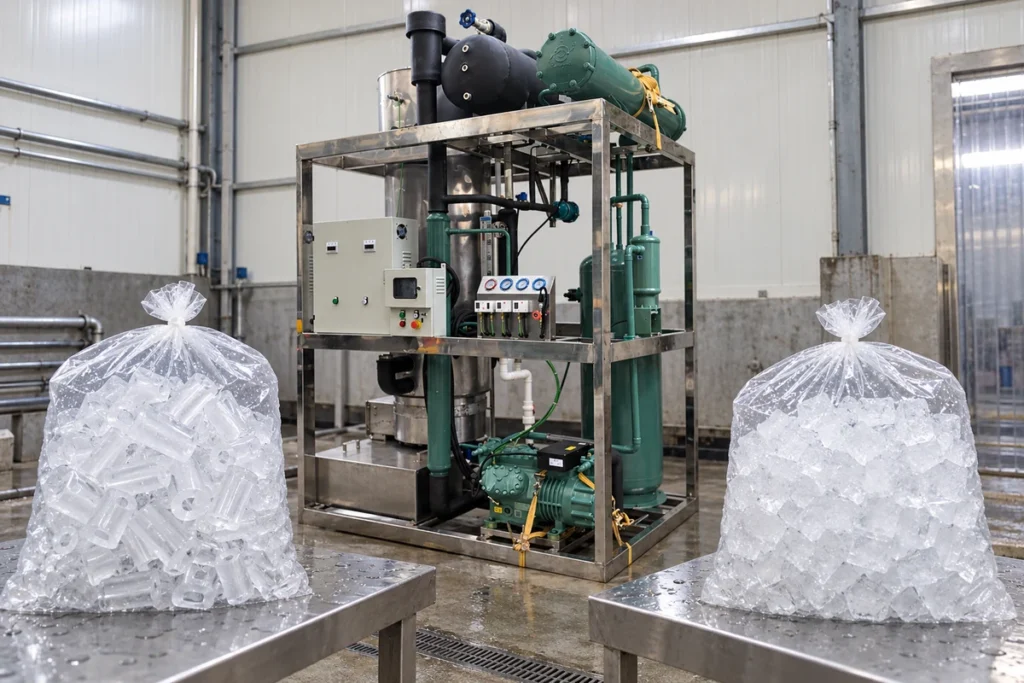
Tube ice often works well in high-output packaged ice plants, while cube ice may be a better fit where buyers expect a regular, uniform shape. Neither option suits every business. The choice depends on local demand and the design of the complete production system.
Appearance is only one part of the comparison. Rated output, cooling behavior, packing, delivery loss, and cost per sellable kilogram all affect commercial performance.
5 Key Differences Between Tube Ice and Cube Ice
Tube ice and cube ice differ in shape, heat-transfer behavior, production equipment, handling, and system cost. Compare these characteristics under the same operating and market conditions.
Ice Shape and Size
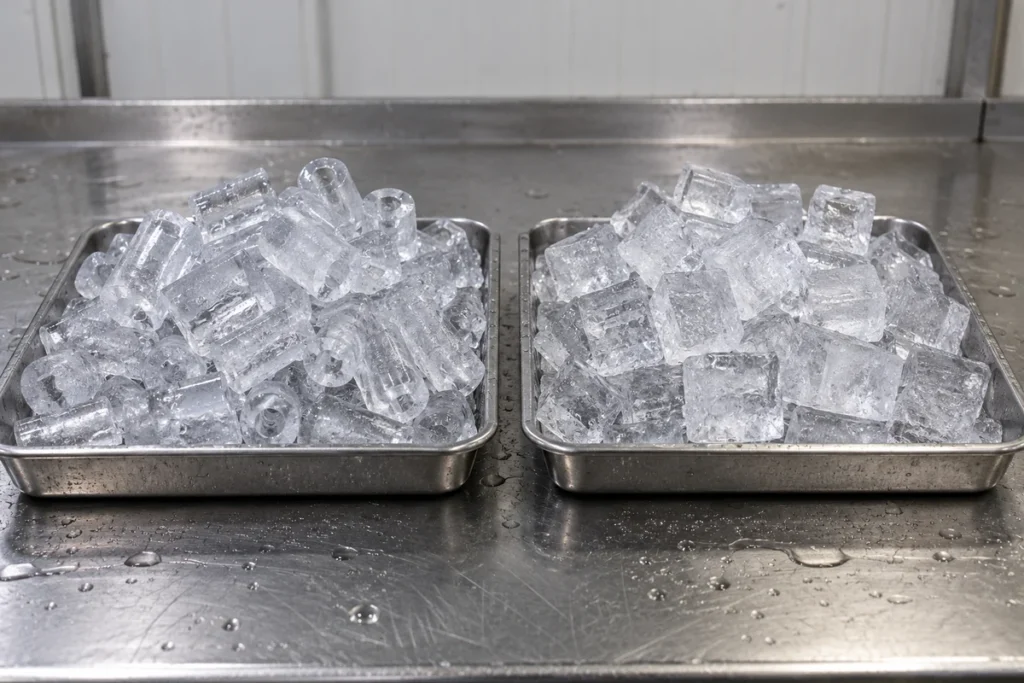
Tube ice is cylindrical and may have a hollow center, a small hole, or a nearly solid core. Its diameter, length, and center opening vary with the machine and freezing cycle. Cube ice forms in a grid or mold. The category includes full cubes, half cubes, dice, and other rectangular forms.
Shape affects how the ice looks in a bag or glass, how the pieces settle during filling, and whether customers recognize the product. Quality still depends on more than appearance. Define the required dimensions and acceptable variation, then compare samples with the ice buyers already purchase.
Cooling Speed and Melting Rate
More contact area can increase cooling speed under the same conditions. Hollow tube ice may expose more surface area per unit mass than a dense cube, allowing it to cool a drink quickly. A large solid cube may melt more slowly per piece because less of its surface is exposed relative to its mass.
Actual performance also depends on piece size, center-hole diameter, density, initial ice temperature, drainage, ambient temperature, and container insulation. A solid tube can last longer than a small cube, while a hollow tube may melt faster than a larger dense cube. Test equal masses under the same conditions before making a performance claim.
Production Capacity and Automation
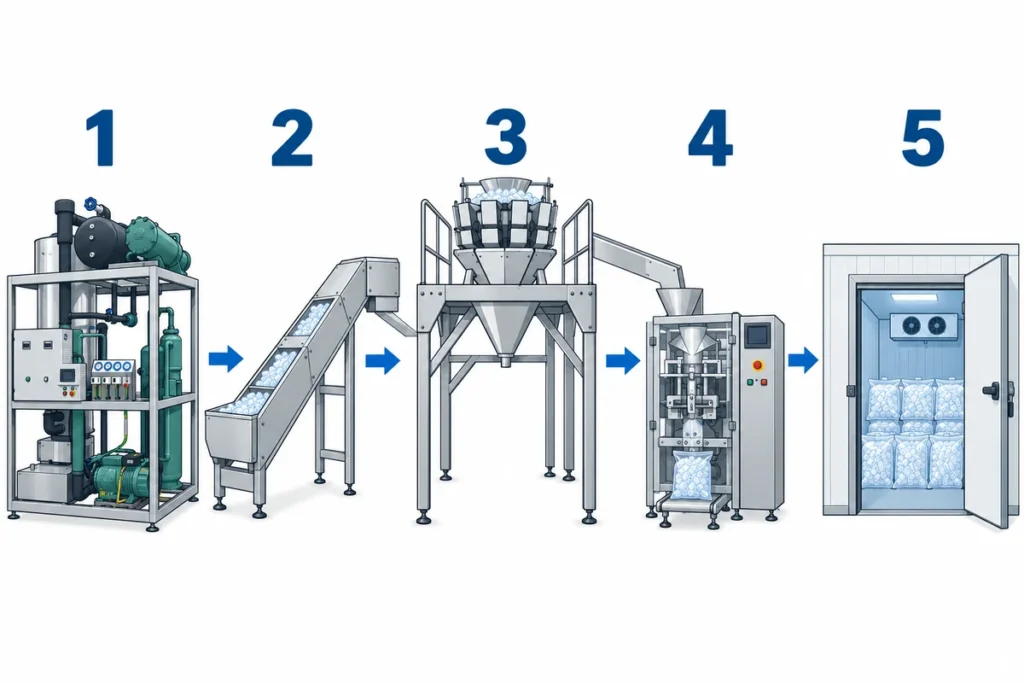
Tube ice equipment is commonly designed for continuous industrial production, with downstream conveying, storage, weighing, and bagging. Cube machines range from compact foodservice units to larger modular systems.
Capacity comes from the evaporator area, refrigeration duty, harvest cycle, and operating conditions. Rated output needs a stated ambient temperature and inlet-water temperature. Production may fall when site conditions exceed the rating basis.
Buyers comparing tube ice machine capacities also need to check production hours, peak dispatch demand, recovery time, and the output test method. Automation covers the complete route from ice harvest to sealed bag. A large ice maker can still miss dispatch targets if transfer or bagging equipment limits the flow.
Ice Storage and Delivery
Both ice types require controlled storage and clean handling. Hot-gas harvest may leave tube ice with surface moisture. Drying, subcooling, or prompt transfer into suitable cold storage can reduce pieces freezing together. Cube ice may also clump if wet ice warms and refreezes.
Storage planning needs to consider usable volume, stock rotation, cleaning access, and the quantity withdrawn before production replaces it. Delivery losses are influenced by bag thickness, loading time, vehicle temperature, trip length, and handling exposure. Record the weight loaded and the saleable weight delivered. This gives a more reliable comparison than assuming either shape will have lower losses.
Equipment and Operating Costs
Compare the total installed system. A quotation may include or exclude water treatment, the condenser, storage, conveyors, weighing, sealing, controls, freight, installation, and commissioning. Differences in supply scope can be more important than the price of the ice maker.
An industrial ice machine cost guide can help buyers compare project scope on a consistent basis.
| Cost Factor | Tube Ice Machine | Cube Ice Machine | What to Verify |
| Ice-making equipment | Depends on output and refrigeration design | Depends on output and machine format | Rated output, refrigerant, condenser, and controls |
| Storage and handling | May use bins, cold rooms, or automated transfer | May use integral bins or separate storage | Usable storage volume and discharge method |
| Packing system | Depends on ice size and line design | Depends on ice size and line design | Bag weight, hourly rate, and sealing method |
| Utilities | Model- and site-specific | Model- and site-specific | kWh and water use under stated conditions |
| Maintenance | Includes the water circuit, tubes, cutter, and refrigeration system | Includes water distribution, evaporator grid, harvest system, and refrigeration system | Cleaning access, service intervals, parts, and local support |
| Delivery loss | Depends on ice and cold-chain conditions | Depends on ice and cold-chain conditions | Test route, loaded weight, and delivered saleable weight |
Comparable quotations use the same operating conditions and supply boundary. A lower price may simply indicate that the supplier has excluded part of the required system.
Key Decision Factors for a Packaged Ice Business
A sound decision starts with evidence from the target market and installation site. Each factor should produce a number, specification, or documented requirement that suppliers can use in their proposals.
Local Ice Demand
Identify the ice form, piece size, bag weight, and price already accepted in the market. Speak separately with retailers, foodservice buyers, distributors, and direct customers because their preferences may differ.
A short sales trial with real samples provides better evidence than a general assumption about regional taste. Separate stable daily demand from weekends, events, and seasonal peaks. A familiar product may be easier to launch even if another ice type appears more efficient to produce.
Required Daily Output
Calculate demand from the number of bags sold and the net weight of each bag. Include committed wholesale orders, expected retail sales, process losses, and a justified operating reserve. Use the actual production window for the calculation. A machine rarely has all 24 hours available every day once cleaning, maintenance, and operational interruptions are considered.
Check the proposed output at the site’s expected ambient and inlet-water temperatures. Storage can cover short peak withdrawals, but it cannot correct a persistent production shortage. The guide to industrial ice machine sizing provides a more detailed calculation method.
Packaging Requirements
Define the target bag weight, acceptable weight tolerance, bag dimensions, closure method, and required bags per hour. Filling trials are necessary because ice geometry affects how the pieces settle and how much headspace the bag needs for sealing.
Treat the ice maker, transfer equipment, weigher, bagger, and cold room as one production flow. The guide to matching bagging capacity with ice plant output explains how to calculate the required rate from the busiest packing window. The complete line must sustain that rate without crushing the ice or leaving it exposed to warm conditions for long periods.
Delivery Distance
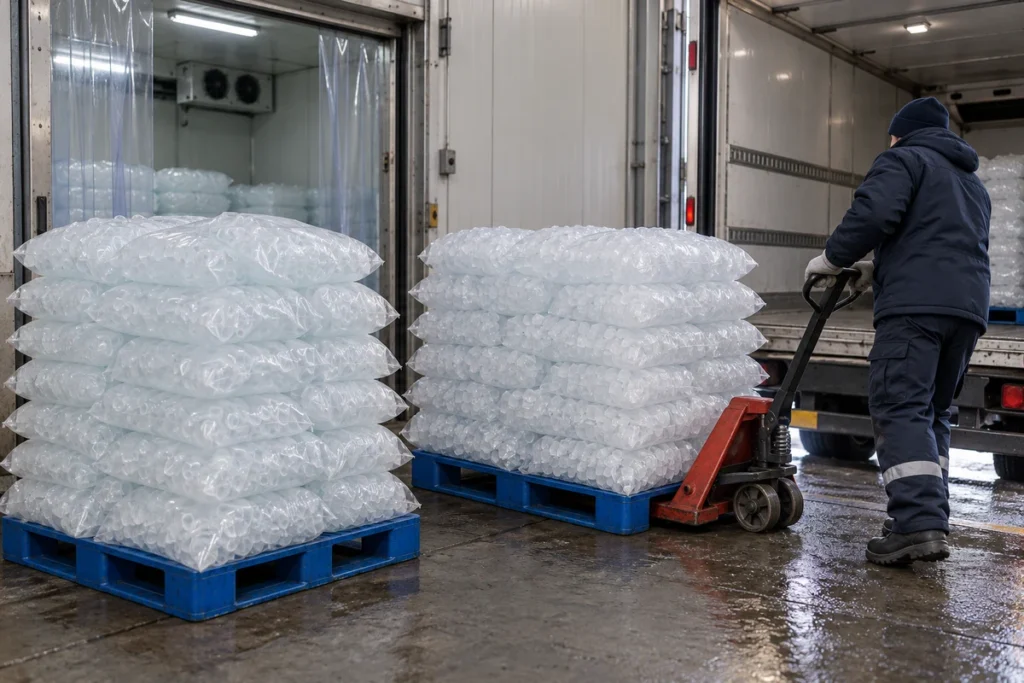
Longer routes expose ice to more heat and handling. Record loading time, vehicle conditions, trip duration, unloading time, and returned or unsaleable ice. These records show whether the operation needs colder storage, insulated transport, stronger bags, a different schedule, or a revised ice specification. Compare tube and cube ice on the same route under the same load conditions.
Cost per Sellable Kilogram
Use saleable output as the denominator. Include electricity, water, filtration, labor, packaging, maintenance, cleaning, storage, delivery, and measured handling or melting loss. An investment model may also include finance costs and depreciation.
Calculate:
Cost per sellable kilogram = total cost ÷ saleable kilograms for the same period
Use the same accounting period, utilization rate, and system boundary for both options. This calculation can reveal cases where low production cost is offset by slow packing, excess storage, or delivery loss.
How to Choose the Right Ice Type for Each End Market?
Choose the ice type that matches the buyer’s product requirements and the plant’s verified operating cost. Use the following recommendations as starting points, then confirm them through local samples, route tests, and written customer requirements.
Consumer and Event Ice
Direct buyers often judge packaged ice by visible cleanliness, piece appearance, cooling performance, and price. Tube ice can work well where cylindrical pieces are familiar and customers use the bags for drinks, parties, and coolers. Cube ice may be easier to sell where buyers expect a uniform beverage ice shape.Test both products in the bag sizes customers normally buy. Compare repeat orders, packing speed, and delivery loss before choosing a format.
Foodservice Supply
Restaurants, cafes, bars, and hotels may consider glass fit, drink presentation, dispensing, and dilution. Cube ice often suits buyers who want consistent portions and a conventional beverage appearance. Tube ice can work for high-volume drink service where it is already accepted and delivered in bulk. Ask each account about glass sizes, daily consumption, storage, and preferred piece dimensions. Also check compatibility with dispensers and narrow-neck containers.
Packaged Ice Retail
Retailers need consistent bag weights, clean packaging, reliable replenishment, and an ice format their customers will buy. Tube ice can suit bulk production, while some markets may prefer cube ice.
Place trial bags in representative stores before committing to equipment. Track sales, breakage, clumping, returns, and delivery losses. The chosen format must work for consumers and for the retailer’s storage conditions.
Wholesale Ice Distribution
Wholesale operations need repeatable output, fast loading, durable packaging, and controlled losses over longer routes. Tube ice works with industrial storage and packing systems. Cube ice remains suitable where distributors require that format.
A complete edible ice plant should be sized around peak dispatch rather than average sales. Confirm the ice specification, actual output, buffer storage, bags per hour, and route loss before choosing the production line.
Get the Right Ice Machine for Your Business
Send Mike Ice Machine your target market, daily demand, ice dimensions, bag weights, ambient and inlet-water temperatures, power supply, storage plan, and delivery distance to discuss the required production system. These details allow tube and cube ice proposals to be compared under the same operating conditions.