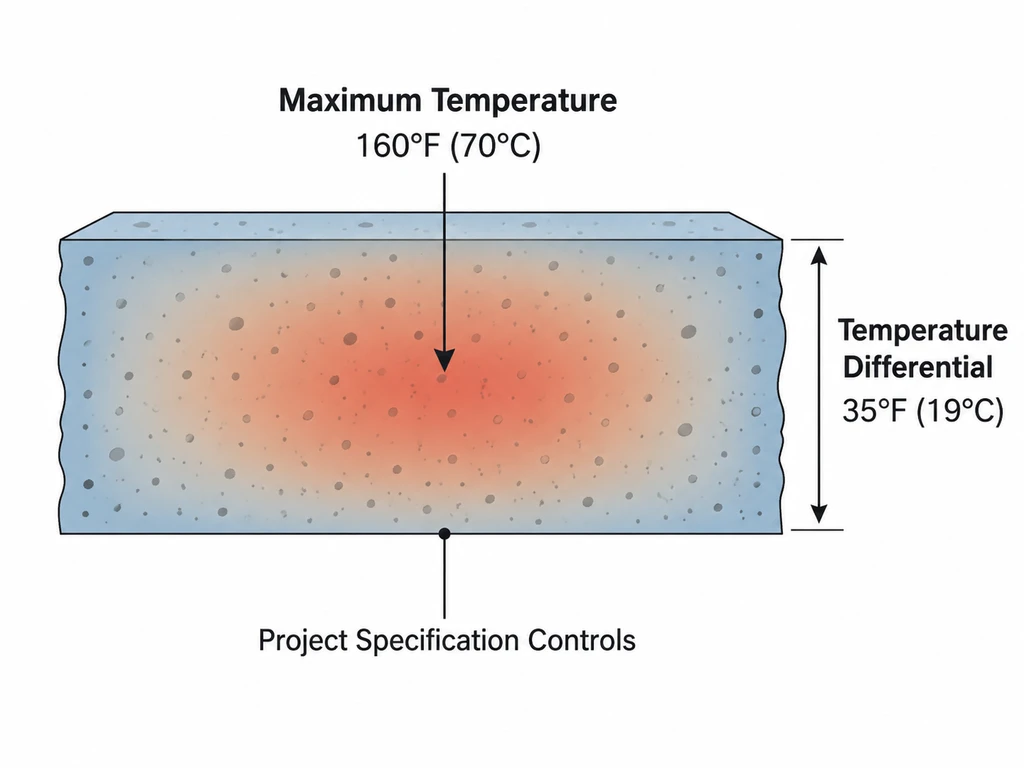
Mass concrete temperature must be controlled as two separate quantities: the highest temperature reached after placement and the temperature difference between the interior and surface. Under ACI SPEC-301-20, the commonly cited default limits are 160°F (70°C) and 35°F (19°C), but the governing project specification controls.
This article assumes the placement has already been classified as mass concrete. It focuses on heat development, thermal cracking, temperature monitoring, and the main control methods rather than mass concrete definitions, size criteria, or applications.
What Are The Temperature Limits For Mass Concrete?
Mass concrete commonly has limits for both maximum concrete temperature and the core-to-surface temperature differential. The project must define the applicable limits, measurement locations, monitoring period, and acceptance procedure for the actual mixture, member geometry, environment, and restraint conditions.
Default Maximum Concrete Temperature
ACI SPEC-301-20 uses 160°F (70°C) as the default maximum temperature in mass concrete after placement.
This is not the same as the discharge-temperature limit used for general hot-weather concreting. It applies to the maximum temperature reached inside the mass concrete as hydration heat accumulates after placement.
The limit is intended to reduce the risk of temperature-related durability problems, including delayed ettringite formation under susceptible material and exposure conditions. Predictions support planning, while installed temperature sensors verify actual performance.
Default Core and Surface Temperature Differential
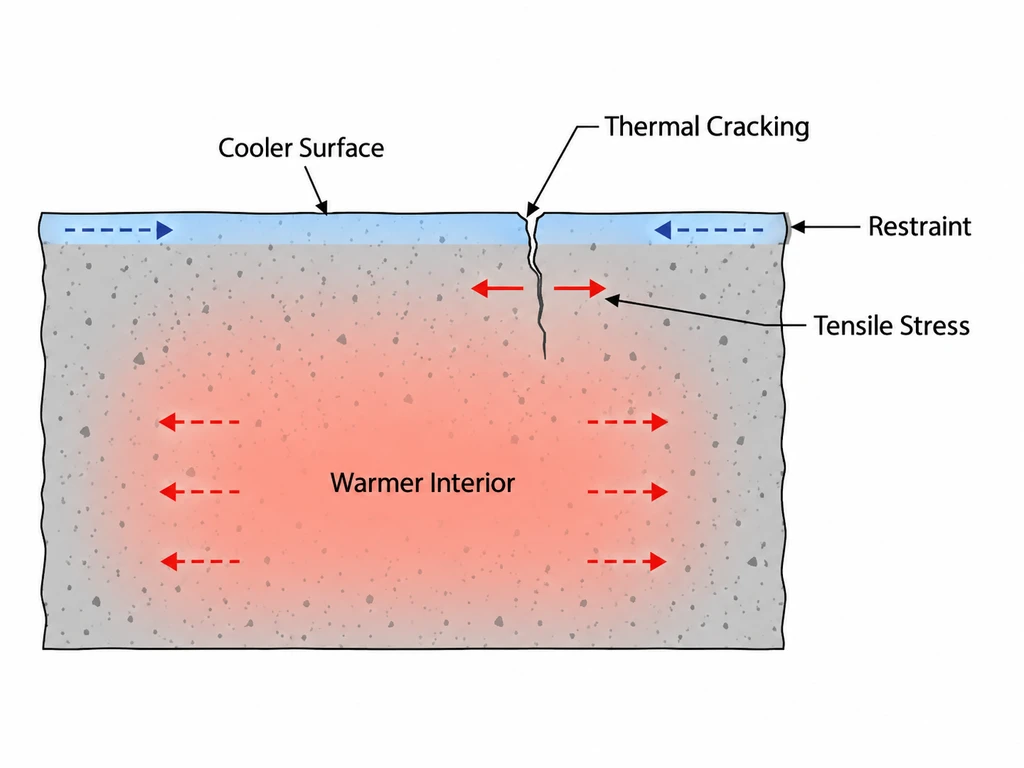
The common default limit is 35°F (19°C) between the center and surface of the placement. This limit addresses thermal-cracking risk when the surface cools and contracts faster than the warmer interior.
The value is a general control threshold rather than a universal material constant. A project-specific thermal analysis may support a different limit when it considers the actual mixture, geometry, restraint, tensile-strength development, elastic behavior, and creep.
Temperature Limits in Project Specifications
The contract documents should identify the controlling temperature limits, measurement locations, monitoring frequency, reporting requirements, and completion criteria.
The approved thermal control plan explains how the contractor will meet those requirements. It should not replace or revise a specified limit unless the contract documents establish an approved process for doing so.
Why Does Mass Concrete Temperature Rise?
Mass concrete temperature rises when cement hydration generates heat faster than the placement can release it. The resulting temperature history depends on heat generation, member geometry, initial concrete temperature, and heat transfer through each boundary.
Hydration Heat Generation
Cementitious materials release heat as they react with water. In a large placement, heat generated near the interior must travel farther before it can escape through an exposed surface.
The internal temperature therefore continues to rise after placement. Peak temperature occurs when heat loss begins to exceed the remaining heat generated by hydration.
Cementitious Content and Mixture Composition
Higher cementitious contents can increase total heat generation. Cement type, supplementary cementitious materials, material fineness, chemical admixtures, and mixture proportions also affect the rate and timing of heat release.
Strength alone does not define the temperature curve. Where required, mixture selection should be supported by calorimetry, trial batches, thermal-property testing, or validated project data.
Member Size and Heat Dissipation
Thicker members generally contain more heat-generating volume relative to their exposed surface area. They also create longer paths for heat conduction, allowing the interior to remain warm after the surface begins cooling.
Nominal thickness is not the only consideration. Corners, lift interfaces, embedded items, construction joints, foundations, soil contact, water exposure, and previously placed concrete can create different temperature patterns within the same member.
Initial Placing Temperature
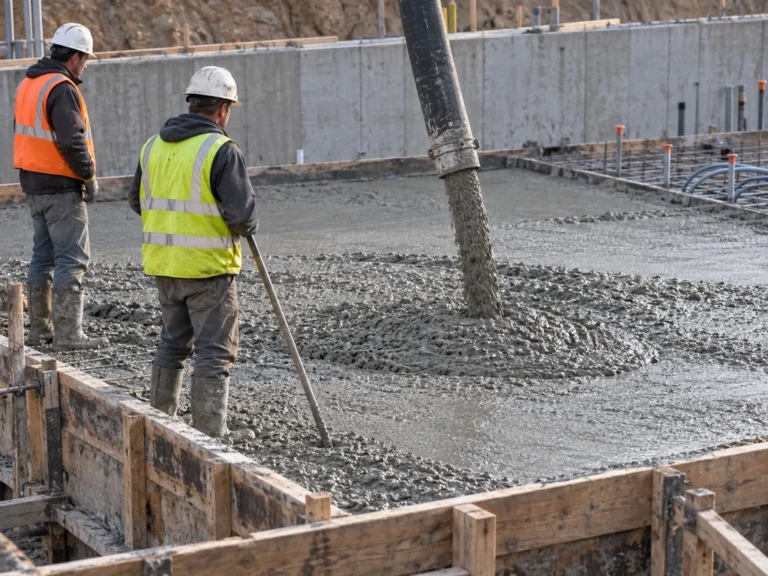
Lowering the placing temperature reduces the starting point of the thermal cycle and will generally lower the expected internal peak.
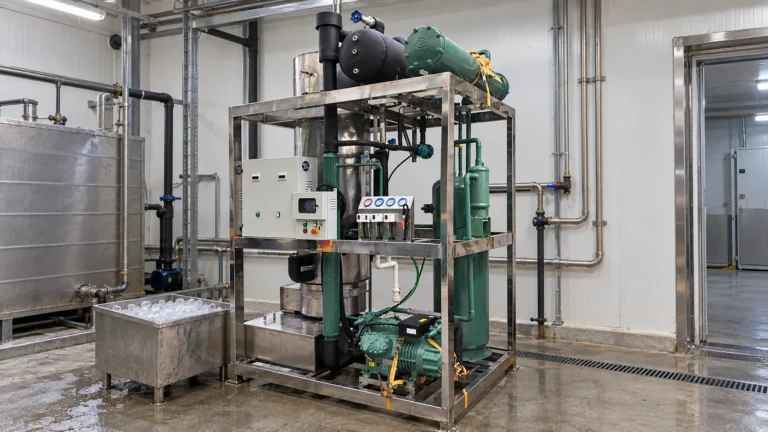
Precooling may use chilled mixing water, cooled aggregates, ice that replaces an approved portion of the mixing water, or a qualified combination of methods. When ice is specified, available flake ice machines should be evaluated against the approved ice quantity per batch and the peak batching rate—not daily production capacity alone.
Formwork, Insulation, and Boundary Conditions
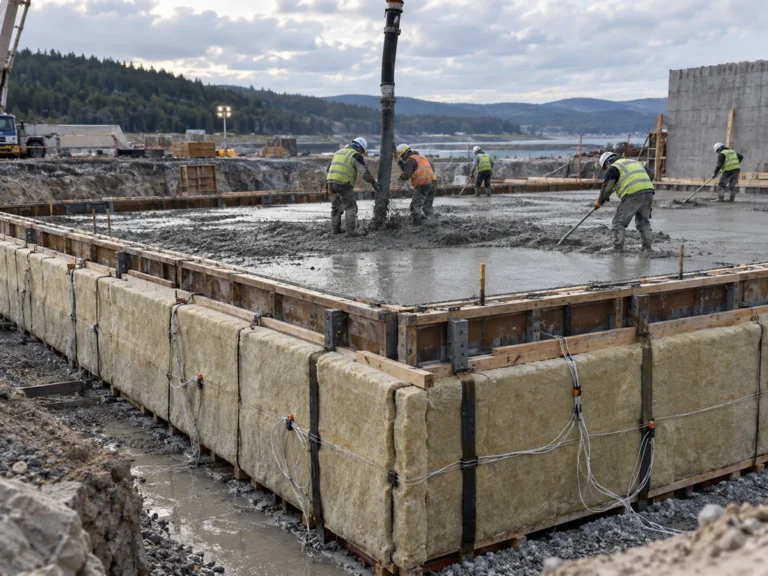
Forms, insulation, ground contact, air temperature, wind, rain, and solar exposure affect how quickly each surface loses heat.
Insulation may keep the concrete warm for longer, but it can reduce rapid surface cooling and limit the core-to-surface temperature differential. Uneven insulation or exposed edges can produce localized gradients even when average temperatures appear acceptable.
How Does Temperature Differential Cause Thermal Cracking?
A temperature difference becomes a cracking risk when different parts of the placement attempt to expand or contract by different amounts and that movement is restrained. Thermal cracking occurs when the resulting tensile stress exceeds the concrete’s tensile capacity at that time.
Unequal Thermal Strain
The warmer interior expands more, or contracts later, than the cooler surface. Because the core and surface remain connected, the two regions cannot deform independently.
This incompatibility produces self-induced stress within the concrete, even when the member is not externally restrained by another structure.
Internal and External Restraint
Internal restraint develops between regions of the same placement that have different temperature histories. External restraint may be created by foundations, piles, reinforcement, adjoining placements, or other connected elements that resist overall movement.
The resulting stress depends on more than temperature difference. It is also affected by the degree of restraint and by the concrete’s changing stiffness, tensile strength, thermal expansion, and creep.
Tensile Cracking in Early Age Concrete
Early-age concrete has limited tensile capacity while its strength and stiffness are still developing. As the surface cools or the entire member later contracts, restrained movement can create tension.
A crack may form when the tensile stress at a location exceeds the available tensile strength. Temperature differential is therefore an important risk indicator, but it is not a complete crack-prediction criterion by itself.
How Is Mass Concrete Temperature Monitored?
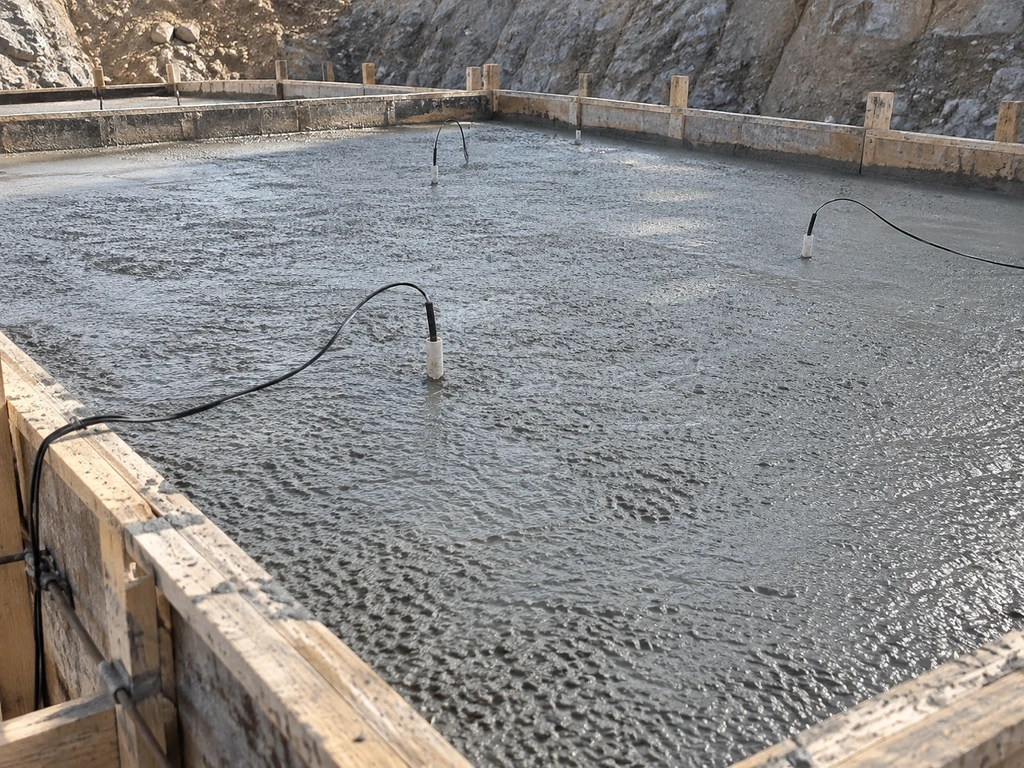
Mass concrete temperature is monitored by measuring the expected hottest internal locations and the corresponding near-surface locations at synchronized times.
The records must report maximum temperature and temperature differential separately because the two controlling values may occur at different times.
Critical Temperature Monitoring Locations
Sensor locations should follow the approved thermal analysis and monitoring layout. Typical coverage includes the predicted hottest interior location, a corresponding near-surface location, and additional areas affected by irregular geometry or different boundary conditions.
A near-surface sensor is commonly placed several inches below the concrete face to avoid measuring only the immediate surface condition. However, the project-defined location and depth control.
Core and Surface Temperature Differential Calculation
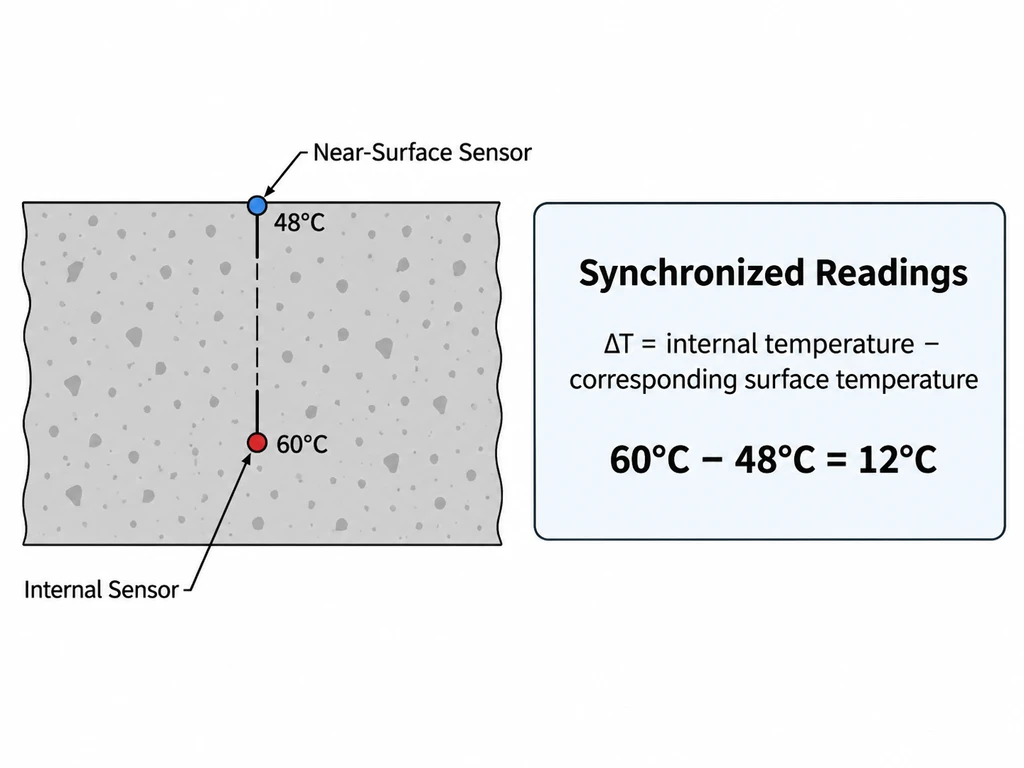
Calculate the temperature differential using synchronized readings:
ΔT = internal temperature − corresponding surface temperature
For example, if the internal temperature is 60°C and the corresponding near-surface temperature is 48°C:
ΔT = 60°C − 48°C = 12°C
The two readings must represent the same heat-flow path and the same point in time. Combining unrelated locations or timestamps can overstate or understate the controlling differential.
Maximum Temperature and Differential Tracking
Track both the highest temperature recorded by each sensor and the largest synchronized core-to-surface difference.
The internal peak commonly occurs during the heating phase. The largest differential may occur later when the surface begins cooling more quickly than the interior. A monitoring dashboard or log should therefore retain the complete temperature history rather than report only the latest reading.
Monitoring Records and Duration
Records should identify each sensor, its verified location, timestamp, reading interval, functional or calibration checks, relevant weather conditions, and any control action taken.
Monitoring must continue for the period defined by the project requirements. ACI guidance connects protection removal to the difference between the internal temperature and average daily ambient temperature rather than relying on a fixed number of monitoring days.
Temperature Thresholds and Response Procedures
Warning thresholds should provide time to investigate and apply an approved response before a specified limit is reached.
A suspect reading should be checked against nearby sensors, recent trends, equipment status, and actual site conditions. An exceedance requires documented technical evaluation; a single unverified reading should not automatically determine acceptance or rejection.
Detailed alarm responsibilities, approval authority, and corrective-action procedures belong in the project’s thermal control plan.
How Do You Control Mass Concrete Temperature?
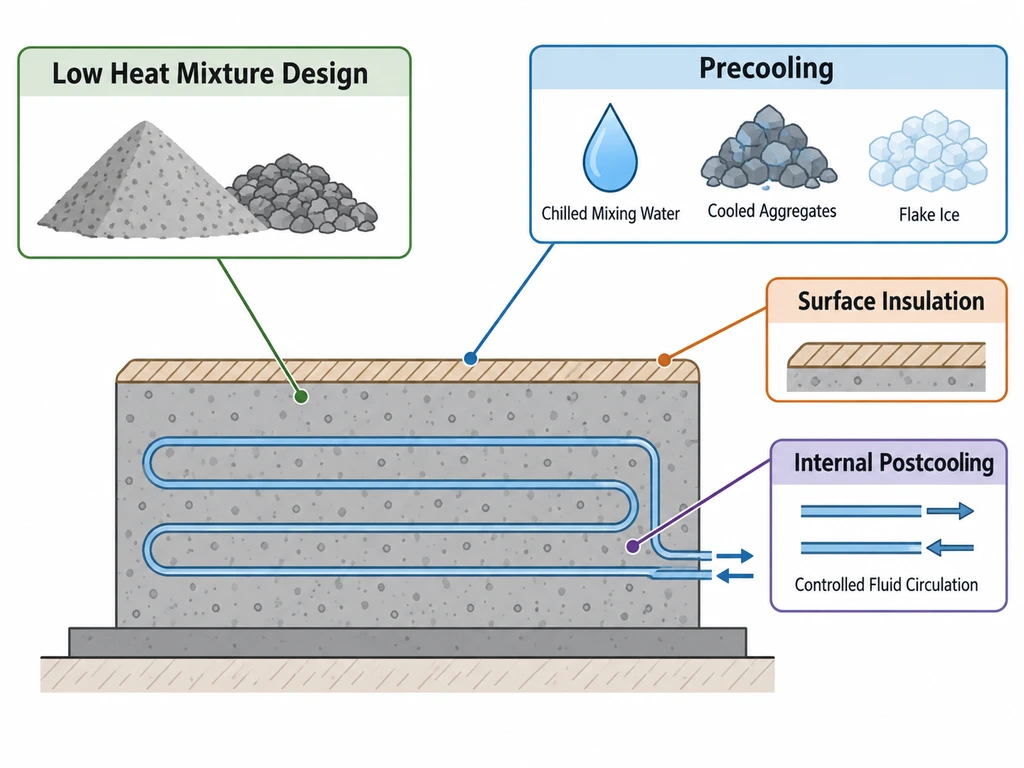
Temperature control normally combines measures that reduce heat generation, lower the placing temperature, manage surface cooling, or remove heat from the interior.
The appropriate combination depends on the mixture, member geometry, weather, construction sequence, and project limits. Guidance on using flake ice for concrete cooling explains how approved water replacement and ice delivery affect batching operations.
Low Heat Concrete Mixture Design
Mixture design can reduce or delay heat release by controlling cementitious content and selecting suitable cementitious materials and admixtures.
Any change must still satisfy strength, durability, setting, workability, pumping, and construction requirements. Reducing cement content alone does not constitute a complete thermal-control strategy.
Concrete Precooling
Precooling lowers the temperature of the concrete ingredients or the fresh concrete before placement. Common methods include chilled mixing water, cooled aggregates, ice that replaces an approved portion of the mixing water, and other engineered cooling systems.
The ice must be included in the total water balance and should melt completely during mixing. Production capacity must satisfy the approved ice quantity per batch and the peak number of batches per hour.
For example, a 20 ton flake ice machine has a nominal daily rating under stated operating conditions. Its suitability for a specific project still depends on hourly ice demand, storage, delivery, inlet-water temperature, ambient conditions, and available utilities.
Surface Insulation
Insulation slows heat loss from exposed surfaces and limits abrupt surface cooling, especially during cold, windy, or rapidly changing weather.
It does not remove hydration heat or necessarily reduce the internal peak. Coverage and removal timing must follow the approved analysis so the surface is not exposed while the interior remains much warmer.
Internal Postcooling
Postcooling removes heat by circulating a controlled fluid through pipes embedded in the concrete.
It can reduce internal temperature when passive measures are insufficient, but it requires engineered design and temperature feedback. Excessive or uneven cooling can create new local gradients, so pipe layout and operation must follow the approved plan.
Placement Scheduling and Weather Protection
Placing concrete during cooler periods can reduce starting temperatures, but scheduling alone cannot control every thermal risk.
Shade, temporary enclosures, wind protection, insulation, and controlled form removal may be required when weather could cool one surface much faster than the interior. Any field adjustment should remain within the approved thermal-control procedure.
For equipment feasibility, provide the approved ice replacement per batch, peak batches per hour, pour duration, material temperatures, storage requirement, site utilities, and delivery arrangement when you contact Mike Ice Machine. These inputs allow the equipment team to review production and delivery capacity; they do not establish the project’s temperature limits or replace review by the responsible engineer.
Frequently Asked Questions
Mass concrete temperature controls work as a system. Compliance with one temperature value or use of one cooling method does not by itself verify overall thermal performance.
When Do Peak Internal Temperature and Maximum Temperature Differential Occur?
They do not necessarily occur at the same time.
Peak internal temperature develops when accumulated hydration heat reaches its maximum. The largest temperature differential may occur later, after exposed surfaces begin cooling faster than the interior.
Their timing must be determined from continuous project measurements or a validated thermal model.
What Role Does Reinforcement Play in Thermal Crack Control?
Properly designed reinforcement can distribute thermal cracks and limit their width.
It does not stop hydration heat, equalize core and surface temperatures, or replace temperature-control measures. Reinforcement requirements and acceptable crack widths remain structural design decisions based on restraint, exposure, and service conditions.
Can A Low Placing Temperature Replace Surface Insulation?
No. The two measures perform different functions.
A low placing temperature reduces the starting point of the temperature cycle and can lower the internal peak. Surface insulation limits rapid heat loss and helps keep the surface temperature closer to the warmer interior.
Even concrete placed at a low temperature may develop a large gradient if its surface is exposed to cold air or wind. Insulation may only be reduced or omitted when supported by the approved project analysis.