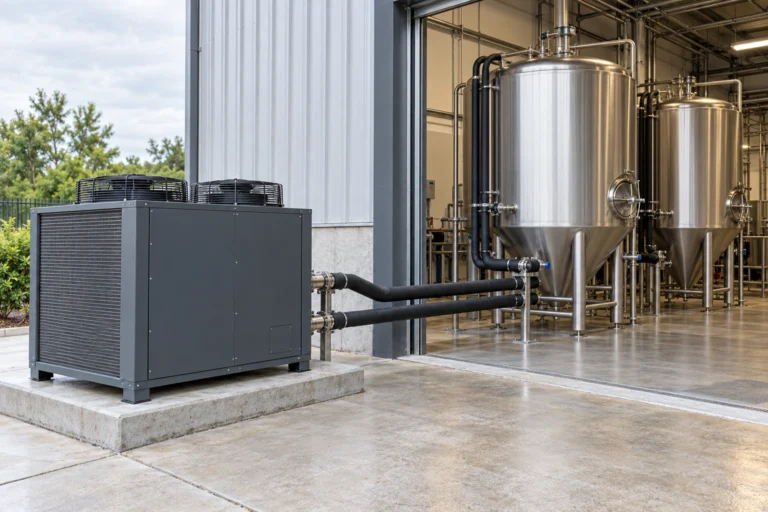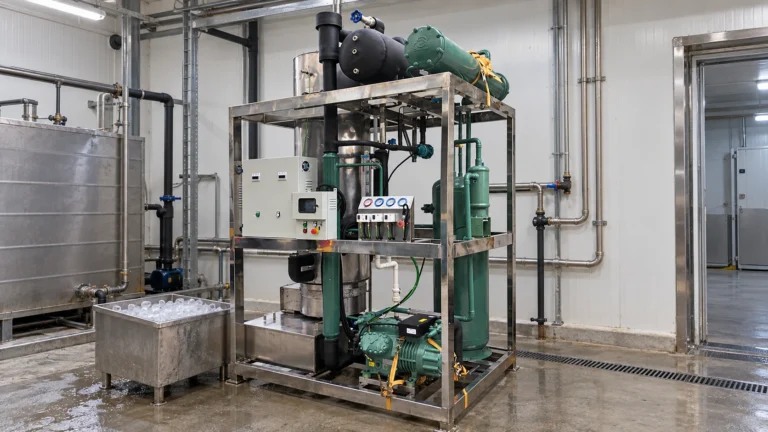

Top icing maintains low temperatures and high relative humidity around select fresh crops during transit and storage. The method succeeds only when the crop tolerates prolonged wetting, containers resist water degradation, and vehicle airflow channels remain open. Always deploy top icing alongside thorough precooling and mechanical refrigeration; ice alone cannot correct an unbroken heat load or a failed cold chain.
What Is Top Icing?

Top icing applies crushed or flaked ice directly over produce inside cartons (package icing) or across pallet tops (load topping). Alternatively, liquid icing injects an ice-water slurry through container vents to coat internal surfaces dry ice cannot reach. The chosen method dictates equipment setup, required ice volume, and facility drainage capacity.
How Top Icing Works
Top icing cools produce through latent heat absorption and gravity-fed meltwater flow:
- Phase-change cooling: As ice melts at 0°C, it absorbs latent heat directly from the produce surface.
- Wilting prevention: Runoff water maintains near 100% relative humidity and cools lower carton tiers as it drains downward.
- Ice selection: Thin flake ice prevents bruising on tender crowns, while denser crushed ice maintains bulk packing depth across longer haul routes.

Understanding these thermal dynamics allows operators to determine whether a specific crop’s physiology and transport window are genuinely suited for direct ice contact.
When to Use Top Icing
Successful deployment requires aligning crop physiology, container durability, and cold-chain drainage infrastructure.
Suitable Produce

Top icing suits select, water-tolerant, cool-season crops that withstand 0°C contact. Broccoli, sweet corn, carrots, and green onions represent standard applications in agricultural extension literature. Specific crop tolerance depends on crown density, maturity, and box design; general crop names alone must never greenlight an icing run.
| Produce | Suitability Considerations | Handling Requirements |
| Broccoli | High respiration rate requiring rapid cooling; protects tender florets | Wax-coated or RPC containers with open drainage holes |
| Sweet corn | Rapid sugar-to-starch conversion demanding rapid field heat extraction | Uninterrupted 0°C holding throughout transit |
| Carrots | Tolerates direct wet contact and benefits from surface saturation | Moisture-impervious packaging and tight pallet securement |
| Green onions | Vulnerable to dehydration and leaf softening | Bundled shoot protection with open meltwater runoff |
Suitable Handling Conditions
Deploying top icing requires strict facility, equipment, and cold-chain infrastructure:
- Drainage & Airflow: Staging areas and reefer floors must feature clean scupper drains and ribbed flooring to evacuate meltwater.
- Precooling & Refrigeration: Crops must reach target holding temperatures before icing; transport refrigeration must run continuously to prevent premature melting.
- Peak Ice Capacity: Commercial ice machine sizing must prioritize storage bin buffering for peak morning dispatch windows rather than simple 24-hour averages.
- Strict Exclusions: Never ice chilling-sensitive crops (e.g., tomatoes, peppers, squash) or ship to receiving facilities that lack drainage infrastructure.
Once these environmental and cargo preconditions are verified, packhouse teams can execute standardized application protocols to safeguard both package integrity and produce quality.
How to Apply Top Icing
Standard operating procedures must balance target cooling rates against packaging integrity and produce health.
Step 1: Check Produce Temperature
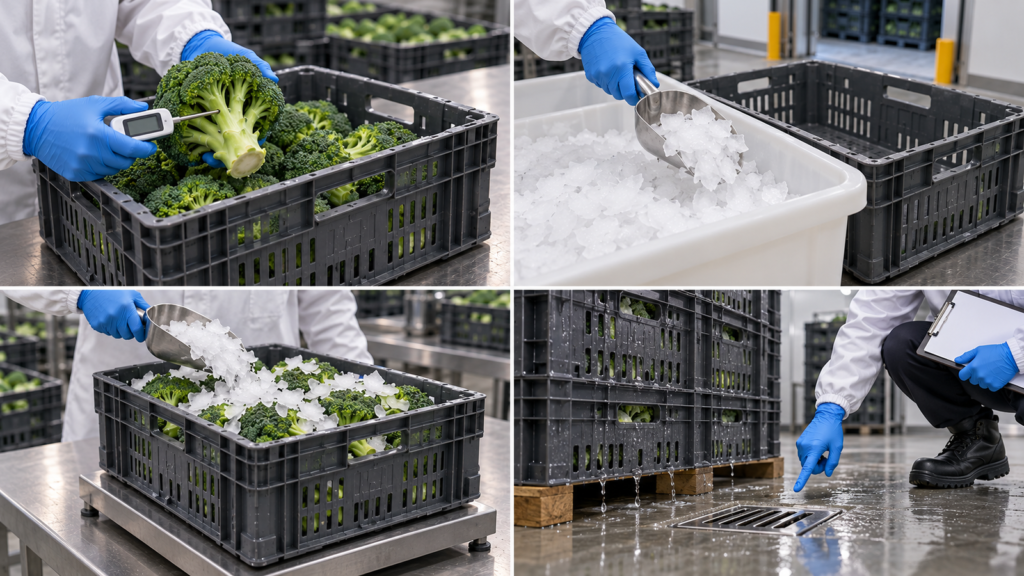
Measure core pulp temperatures across multiple pallet depths before applying ice, prioritizing center cartons that trap field heat. Top icing supplements hydrocooling or forced-air cooling rather than replacing them. Resolve precooling shortfalls prior to dispatch; transport thermostats measure circulating air, not internal produce temperature.
Step 2: Prepare Ice and Packaging
Generate ice using potable water compliant with direct food-contact sanitary rules, keeping all transfer tools sanitized. Avoid applying sub-zero ice taken directly from deep-freeze storage to prevent surface frostbite on foliage. Verify carton moisture resistance through wax saturation, polymer blends, or reusable plastic containers (RPCs) with clear drainage slots. For commercial flake ice machines, select sanitary evaporator designs rated for actual summer inlet water temperatures rather than ideal factory conditions.
Step 3: Apply Ice
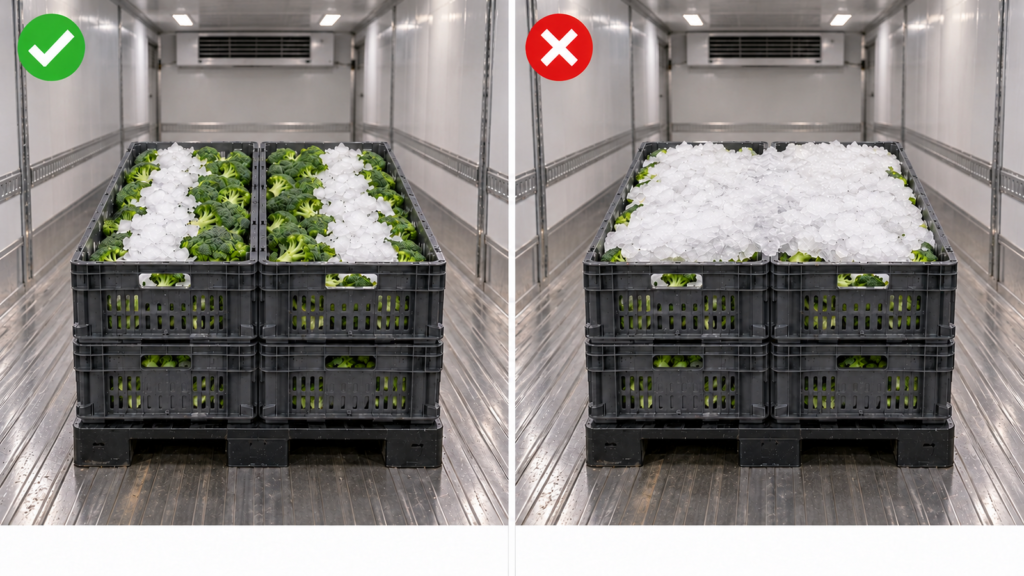
Dispense ice according to exact package formulas specifying target weight, placement zones, and unobstructed side vents. Never transfer dosage ratios across different crop lines without prior temperature testing. For bulk load topping, FAO guidelines advise laying ice in parallel ridges along pallet seams rather than spreading an airtight crust. When configuring automated delivery lines, engage specialized equipment configuration support to harmonize auger feeds, drop chutes, and line speeds with package strength limits.
Step 4: Monitor Temperature and Drainage
Log commodity core temperatures at fixed pallet positions throughout holding and receiving inspection. Inspect reefer floors for ponding water, softened carton sidewalls, or runoff entering dry cargo zones. Unmelted surface ice provides zero proof of internal temperature compliance; physical probe records govern final release.
Limitations of Top Icing
Adding top ice introduces structural, microbiological, and logistical variables that require active oversight.
Uneven Cooling
Top icing produces steep thermal gradients, cooling outer layers rapidly while carton centers remain insulated. Upper carton temperatures do not reflect overall pallet status. Map internal core readings across all tiers during trial runs to verify cooling uniformity.
Airflow Obstruction
Heavy ice sheets over pallet tops block chimney vents and ceiling air channels, shunting reefer air around perimeter walls instead of through carton centers. Stacking plans must balance ice coverage against open air loops.
Additional Shipping Weight
Ice adds significant dead weight without increasing sellable produce volume. Dispatch teams must calculate gross departure weight including ice, wet packaging, and pallets to prevent highway axle overloads. Heavy icing directly curtails payload volume in weight-restricted transport lanes.
Packaging Damage
Continuous meltwater exposure softens standard corrugated boxes, causing sidewall creep and pallet lean. Only wax-saturated boxes, polymer-coated materials, or rigid plastic crates maintain necessary stacking strength during wet transit.
Cross-Contamination Risks
Downward-draining meltwater carries surface contaminants across multiple carton tiers. Following International Association for Food Protection guidance, facilities must enforce incoming water testing, rigorous equipment sanitation, and dedicated runoff routing to mitigate cross-contamination.
Frequently Asked Questions
How Long Can Top-Iced Produce Be Stored?
Storage life depends on innate crop physiology, initial quality, and cold-chain stability, not ice volume. Remaining ice never justifies extending established shelf-life limits. Rely on physical senescence indicators, such as floret yellowing in broccoli or leaf limpness in green onions, alongside temperature records to direct inventory release.
Do Buyers Require Visible Ice at Delivery?
Select wholesale buyers, especially in traditional broccoli and sweet corn distribution, specify visible ice on arrival. North Carolina State University Extension notes that receiving inspectors often treat residual ice as proof of cold-chain continuity. Confirm buyer specifications in writing prior to dispatch to establish agreed delivery metrics.
Is On-Site Ice Production Worthwhile for Top Icing?
On-site ice production proves cost-effective when commercial ice procurement involves high freight expenses, seasonal shortages, or high per-ton delivered rates. Financial evaluations must weigh external purchase costs against full operational ownership, including electricity, water filtration, maintenance, and seasonal downtime. Reviewing flake ice pricing guides helps facility planners evaluate bare evaporator packages against turnkey systems with automated delivery augers.
References & Authoritative Sources
- North Carolina State University Extension: Cooling with Ice
- University of California, Davis Postharvest Research and Extension Center: Broccoli
- International Association for Food Protection: Evaluating and Managing Potential Risks Associated with Top Iced Produce
- Food and Agriculture Organization of the United Nations: Small-Scale Postharvest Handling Practices