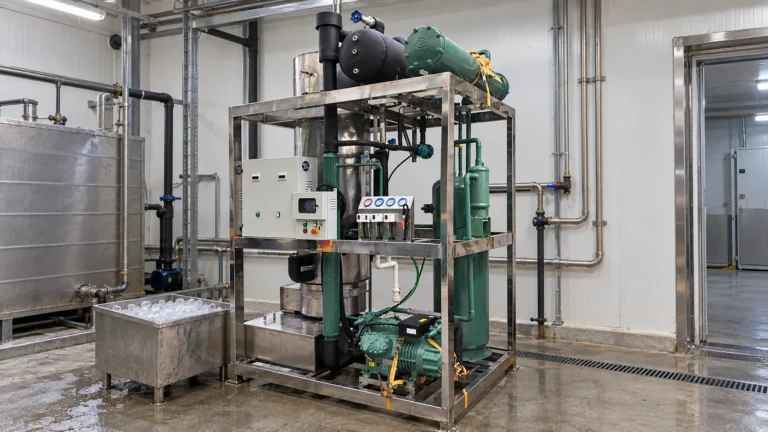
An ice machine evaporator shapes ice because it is the surface where water gives up heat and freezes. In a flake ice system, the freezing surface, water contact, freeze time, and harvesting action work together to produce removable flakes. This guide explains that industrial flake-ice process without treating it as a model-specific compatibility or performance claim.
What an Ice Machine Evaporator Does
An evaporator is the heat-transfer component that provides the cold surface for ice formation. Its role changes with the ice-making process, so readers should choose among the types of ice machines before treating a flake-ice component as the answer to every ice requirement.
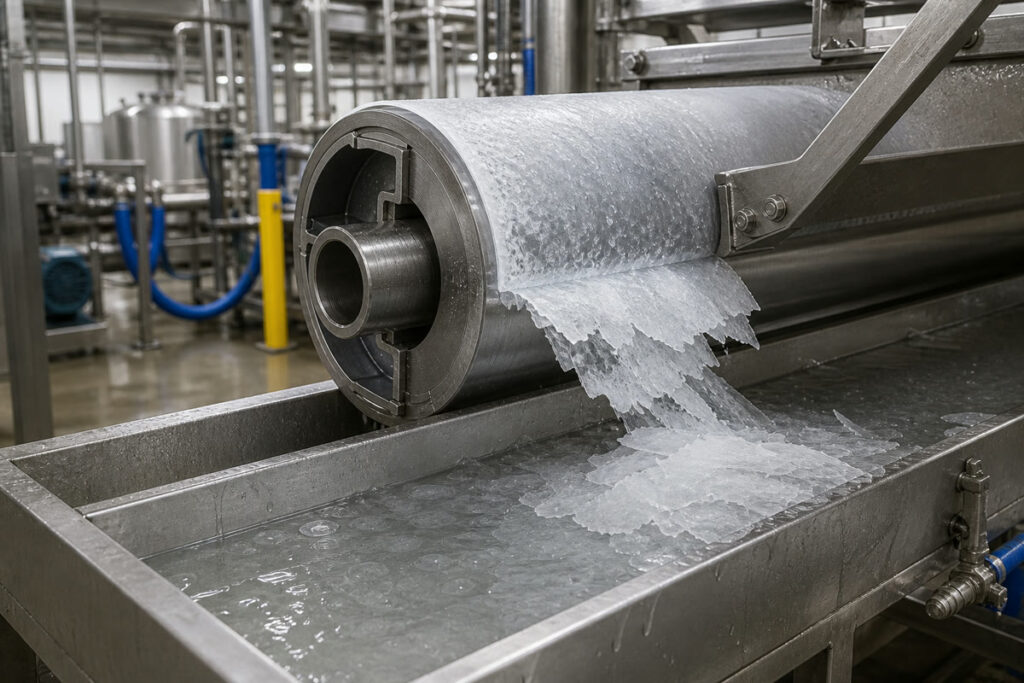
One published flake-ice-machine design uses a cylindrical evaporator roller that rotates through a water trough. Water freezes on the cooled roller jacket, and a stationary scraper removes the thin ice layer. This example shows a freezing surface and a harvesting step, not a universal design. Surface shape, water path, refrigerant circuit, and harvesting method depend on the machine.
How a Flake Ice Surface Builds and Releases Ice
Flake ice forms when water contacts a chilled evaporator surface long enough to create a layer, then a harvesting mechanism removes that layer as flakes. This sequence is a system process. It cannot confirm the dimensions, ice thickness, output, or replacement fit of a particular evaporator.
Water Contact Sets the Ice Layer
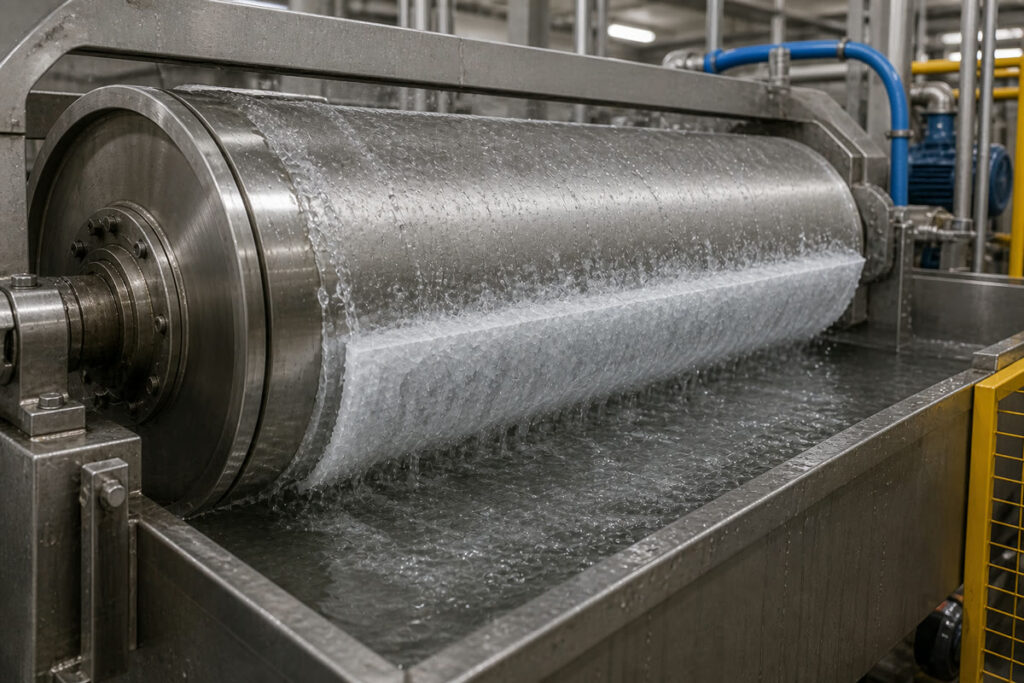
Water must reach the intended cold surface before ice can form there. In the published design, a rotating roller carries water from a trough onto its cooled jacket, where it freezes. Other flake-ice designs may use different water paths and surface geometries, so a product photo or a general diagram cannot confirm how a replacement drum handles water.
The Harvesting Point Turns the Layer Into Flakes
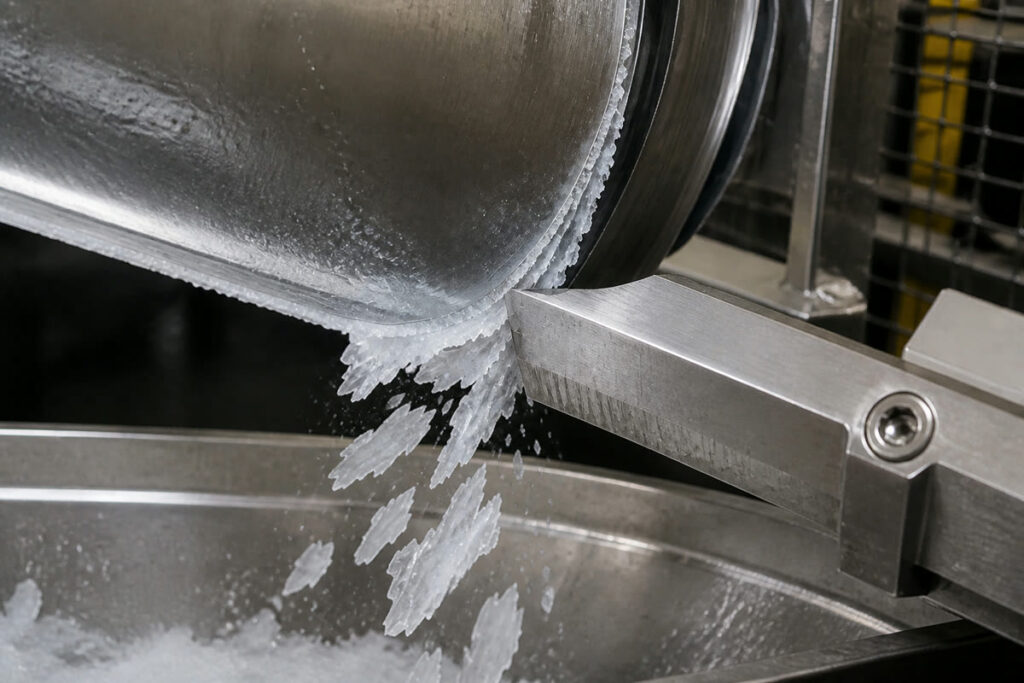
The harvesting mechanism removes the frozen layer from the surface and turns it into flakes. In the same published design, a scraper separates the ice layer before the cylindrical surface returns to the water. That removal step is part of the ice-forming process. It does not, by itself, prove the expected ice form or release behavior for a different machine.
Why Surface Conditions Change the Result
The evaporator surface is one part of a cycle that also includes water delivery, refrigeration, controls, and the harvesting mechanism. When ice form or release changes, a general explanation cannot identify the cause. Treat the condition as a system inspection question, confirm the machine’s documented design and operating data, and avoid assigning the problem to the evaporator without evidence.
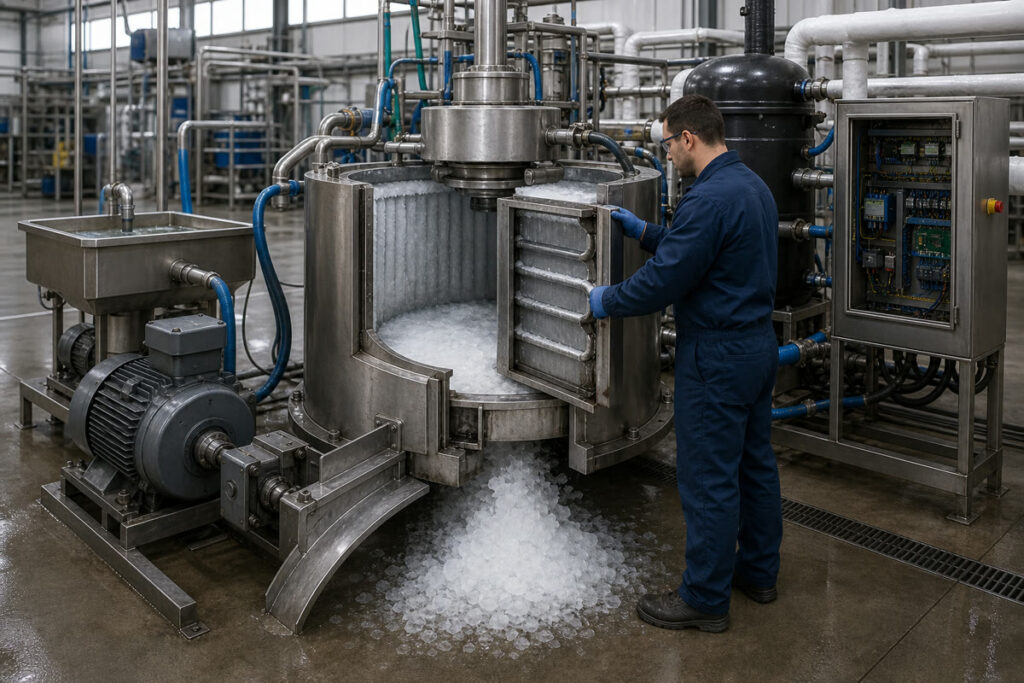
Use the machine’s service documentation to set the inspection boundary. A change can involve the water path, the refrigeration side, the control sequence, or the removal mechanism. The relevant evidence is the documented configuration and an actual inspection, not a general flake-ice explanation.
Specify the Evaporator Around Its System
Match an evaporator to the refrigeration and ice-making system, not by appearance. Mikeicemachine lists flake ice evaporators for OEM, replacement, freshwater, and seawater applications, but the appropriate configuration still depends on project information. The available product page does not verify universal interchangeability, so this article does not treat any evaporator as a like-for-like replacement.
For new equipment, assess the component within the flake ice machine range. That broader machine decision keeps an evaporator discussion from substituting for a review of ice production and downstream handling.
Use Configuration Data Before Ordering
To prepare a Mikeicemachine quotation, send us daily capacity, refrigerant, compressor model, water type, voltage, installation space, and target ice thickness. We use these inputs to frame the configuration discussion, but they do not establish compatibility by themselves. We still need to confirm the specific configuration against the existing or planned system.
Keep Ice Form Separate From the End Use
A flake-ice evaporator belongs in a system intended to make flake ice. Confirm the required ice form from the downstream cooling, handling, or storage task before selecting the component. If the project needs a different form of ice, use the tube ice versus flake ice comparison to start the machine-type decision instead of treating a flake-ice evaporator as a universal freezing part.
For fish and seafood handling, the same check includes how the ice will contact the product and move through the operation. The flake ice for fish and seafood guide addresses that application-level question; it does not replace an evaporator configuration review.
A Practical Check Before You Request a Quote
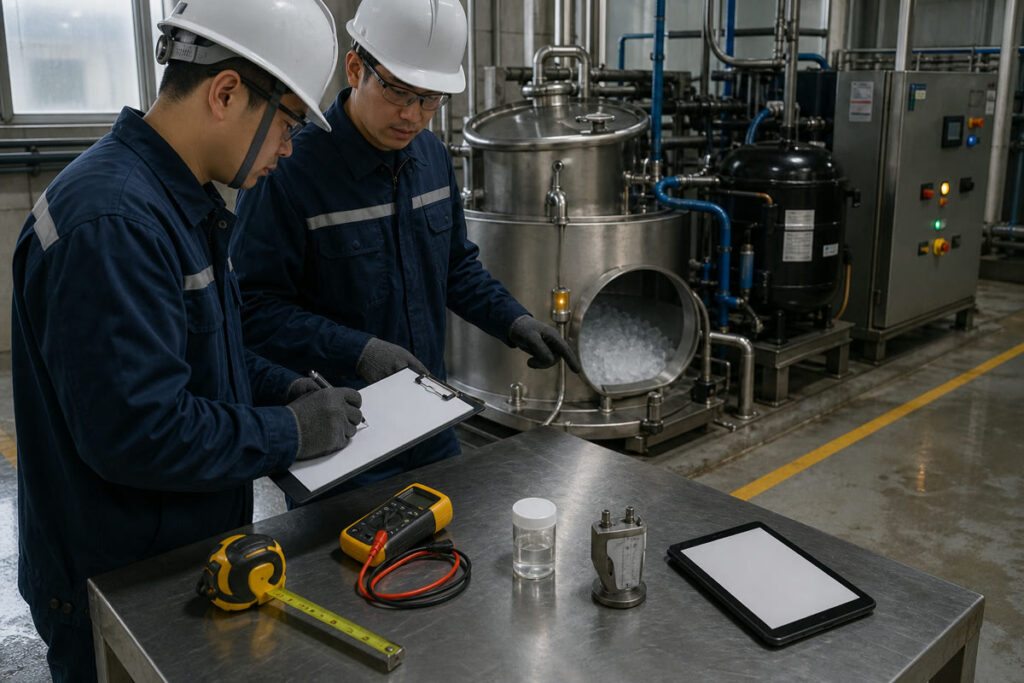
Use the quotation inputs listed on the product page. A product title, an image, or a general description does not verify a replacement or project configuration.
| Information to Provide | Why It Belongs in the Request |
|---|---|
| Daily capacity | Frames the production target for the quotation request. |
| Refrigerant | Identifies the refrigeration-circuit context for review. |
| Compressor model | Identifies the compressor context that needs confirmation. |
| Water type | Distinguishes the freshwater or seawater system context. |
| Voltage | Identifies the electrical configuration for review. |
| Installation space | Gives the supplier the installation context to review. |
| Target ice thickness | States the requested ice characteristic for the quotation. |
For an industrial flake-ice project, send us the system inputs once they are ready for review. At Mikeicemachine, we use them to focus the configuration discussion on the actual system instead of an assumed part match.
Frequently Asked Questions
Can Mikeicemachine Supply a Flake Ice Evaporator on Its Own?
Yes. We can supply evaporator drums for OEM ice-machine builders, replacement projects, and refrigeration contractors. We still need the project information above to review the configuration.
Can a Seawater Ice Machine Use a Flake Ice Evaporator?
Yes, provided that the supplier confirms a seawater-compatible configuration for the project. The current product page states that seawater-compatible evaporator options are available based on corrosion-resistance requirements, so a freshwater replacement does not confirm seawater suitability.
What Standard Working Condition Does the Product Page State?
The product page lists a standard working condition of 30°C ambient temperature and +20°C inlet water. Treat that stated condition as a page reference, not as a substitute for the quotation data or a confirmation of fit at a particular site.