Choose an ice machine by how the finished ice must perform, then size the system for peak demand and actual site conditions. Ice shape affects cooling contact, handling, storage, packing, and downstream equipment. Daily capacity alone cannot identify the right system.
Start with the product or process that needs ice. Define the ice form, food-contact status, daily volume, peak withdrawal rate, storage time, and delivery method before comparing models.
What Are the Main Types of Commercial and Industrial Ice Machines?
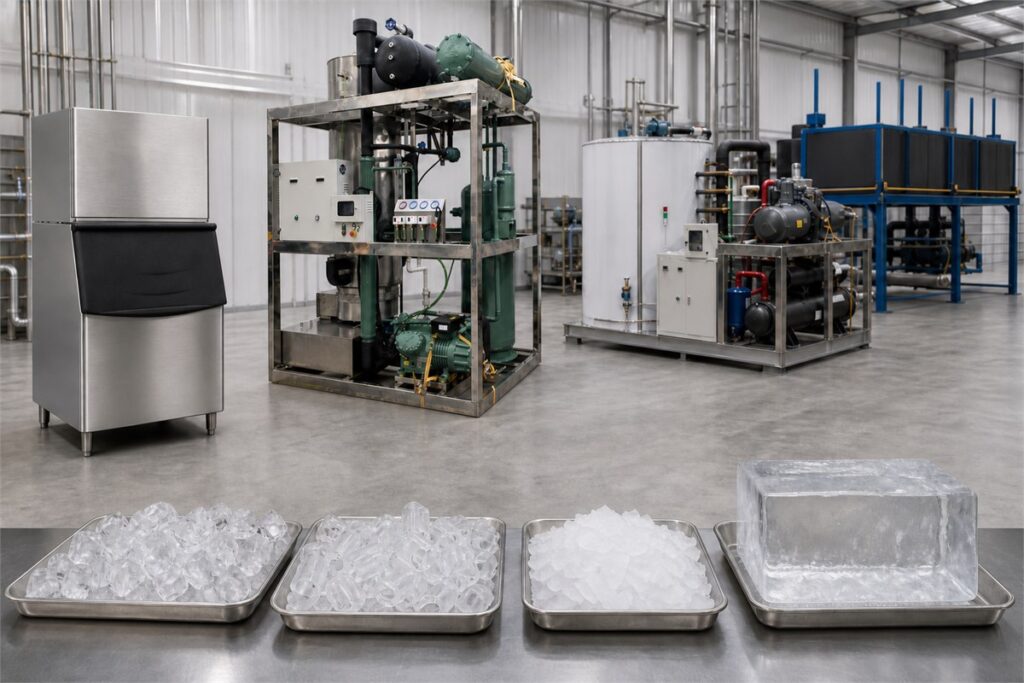
Common commercial and industrial ice machine types are cube, tube, flake, block, and slurry. Each type creates a different physical form and usually needs its own evaporator and handling setup.
| Ice machine type | Finished ice | Common business fit | Main buyer check |
|---|---|---|---|
| Cube | Individual cubes, which may be solid or partially hollow | Restaurants, hotels, bars, beverage service | Cube size, bin capacity, sanitation, peak draw |
| Tube | Cylindrical pieces, often with a center hole | Packaged edible ice, beverage supply, local ice distribution | Tube dimensions, water treatment, cutting, packing |
| Freshwater flake | Thin, irregular flakes | Seafood, food processing, retail display, concrete cooling | Water quality, storage, conveying, cleaning |
| Seawater flake | Saline flakes made from seawater | Fishing vessels, ports, marine catch cooling | Marine installation, feedwater, corrosion control, vessel space |
| Block | Large solid blocks | Bulk distribution, long holding periods, crushing before use | Block size, harvest method, lifting, crushing |
| Slurry | Pumpable mix of fine ice crystals and liquid | Seafood processing, pumped contact cooling, process cooling | Ice fraction, pumpability, piping, fluid compatibility |
Cube and Tube Ice Machines
Choose cube or tube ice when the operation needs separate pieces for dispensing, handling, or packing. Cube machines are common in foodservice because the ice works with glasses and beverage dispensers. The machine may sit above an insulated bin or connect to larger storage.
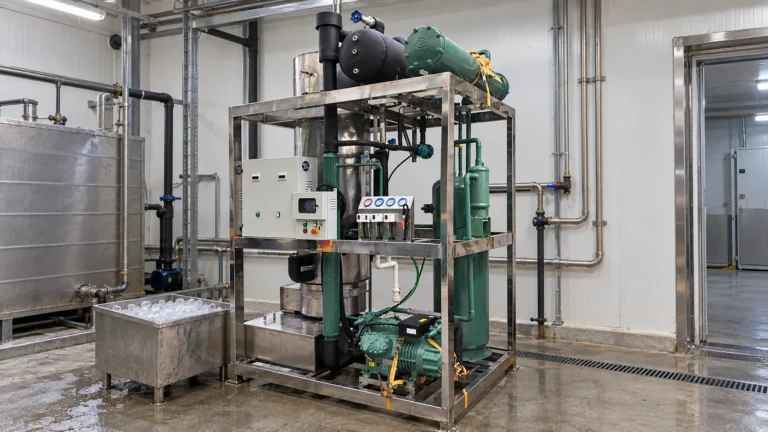
Tube ice forms on the inside surface of vertical freezing tubes and is harvested as cylindrical pieces. The center may be hollow, and a cutter controls piece length on applicable machines. Larger systems often support packaged edible ice plants.
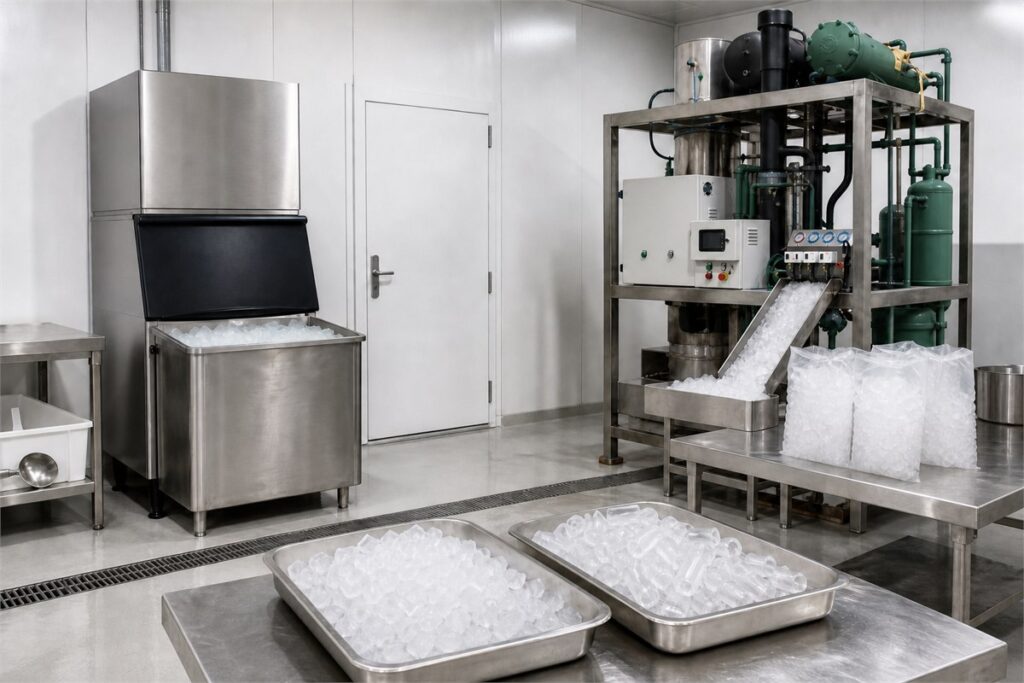
Buyers comparing tube ice and flake ice should focus on the task: tube ice suits portioning and bagging, while flake ice suits contact cooling. Edible-ice projects also need suitable source water, hygienic contact surfaces, clean storage, and compliant packing. Clear ice alone does not prove that the full line is safe for food contact.
Freshwater and Seawater Flake Ice Machines
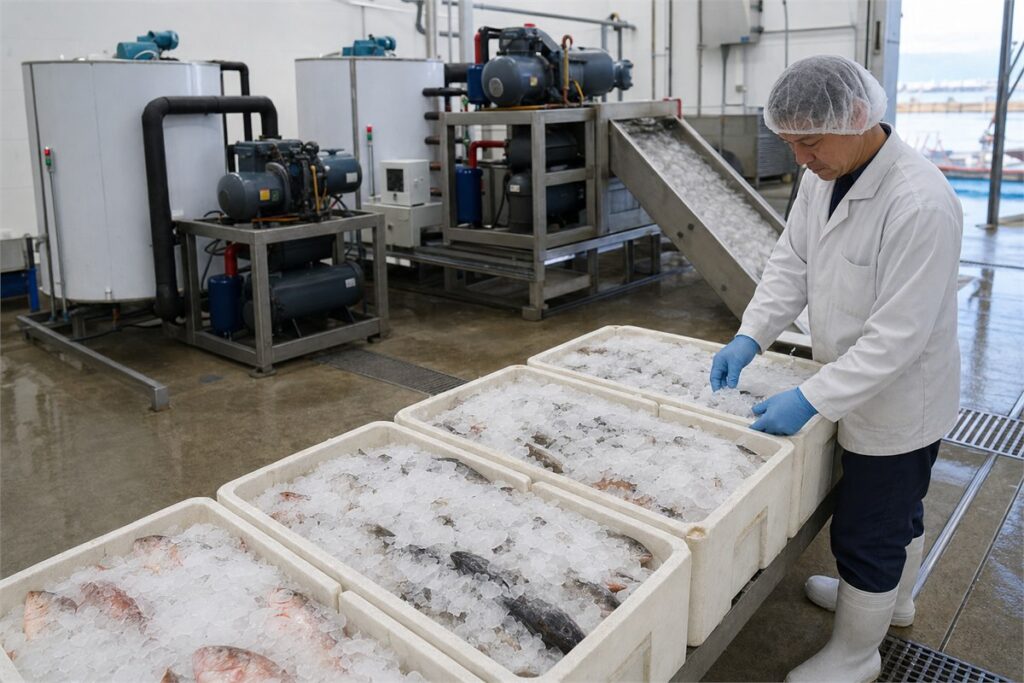
Flake ice machines produce thin, irregular pieces that spread across fish, meat, produce, display beds, or a process load. Flake ice fits tasks that need broad contact with an uneven surface or mixing into material.
Freshwater units use a suitable freshwater supply and commonly serve shore-based processing, markets, and industrial projects. Seawater units make saline ice for marine or coastal work. Buyers should not assume that a freshwater unit can handle seawater through a different inlet. We offer industrial flake ice machines in configurations for different output ranges and operating environments. Before selecting a unit, confirm feedwater salinity, wetted materials, installation conditions, handling method, and storage time.
Block Ice Machines
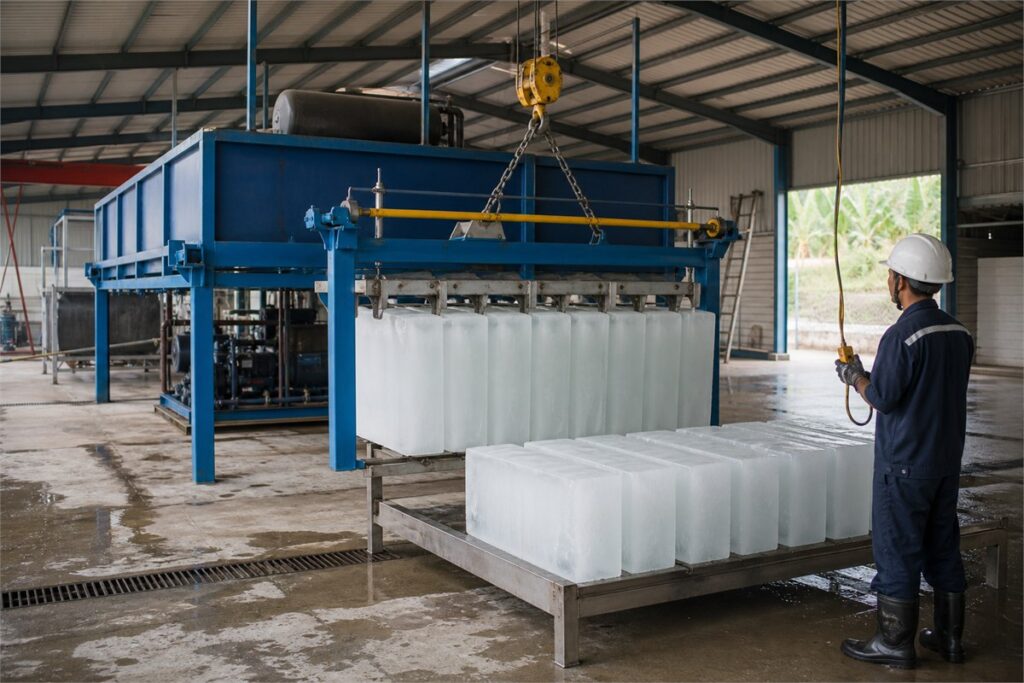
Block ice machines freeze water into large solid units for holding, transport, resale, or later crushing. A block has less exposed surface area per unit of mass than small loose ice, so it can melt more slowly under the same conditions. Loss still depends on dimensions, starting temperature, insulation, ambient heat, and handling time.
The machine may use brine tanks and ice cans or a direct-cooling design. This choice changes the floor plan, harvest process, labor, and maintenance. Define block weight, dimensions, lifting method, and whether the operation needs a crusher. Workers must be able to remove, move, and load each block on schedule.
Slurry Ice Machines
Slurry ice machines produce a flowing mixture of small ice crystals and a carrier liquid. Compatible pumps and piping can distribute the mixture across complex surfaces, which can help when loose ice is hard to spread evenly.
Specify the carrier liquid, target ice concentration, pumping distance, pipe layout, and contact materials because pumping behavior changes with concentration. Food-contact applications also need a sanitation plan for the generator, tank, pumps, and piping.
Which Ice Machine Type Fits Your Application?
Match the ice form to the required cooling, dispensing, packing, or handling task before comparing capacity or automation.
Beverage Service and Packaged Edible Ice
Cube ice usually fits direct beverage service, while tube ice often fits packaged edible ice and higher-volume distribution. The final choice depends on what customers expect, what dispensers or bags can handle, and how fast the business uses the ice.
A restaurant may need a machine and bin sized around short service peaks rather than daily sales. A bagged-ice business must account for treatment, cutting, storage, weighing, sealing, and cold holding. Tube size and bag weight affect packing equipment, so specify the machine and packing line together.
Fisheries, Seafood Handling, and Marine Operations
Flake ice fits many fisheries because the pieces spread through a catch and around irregular seafood. Freshwater systems suit sites with suitable water and power. Seawater systems can support vessels or marine sites when designed for those conditions.
Slurry ice may fit a process that needs pumpable ice or uniform contact cooling. The choice between flake and slurry depends on the product, handling method, space, and cleaning access. Buyers planning flake ice machines for fishery and seafood should calculate demand from catch volume, trip length, climate, hold insulation, and incoming product temperature.
Food Processing and Retail Display
Flake ice supports contact cooling, mixing, temporary holding, and fresh displays because it spreads over uneven surfaces. Slurry ice may suit enclosed or pump-fed steps, while cube ice is usually reserved for drinks in these facilities. The product and contact route determine the hygiene controls. Check whether ice touches food, packaging, or only a heat exchanger, then define water quality, drainage, foreign-material controls, cleaning access, and meltwater handling. Retail displays also need a planned ice depth, refill schedule, and drainage below the bed.
Bulk Ice Distribution, Concrete Cooling, and Industrial Processes
Match the ice form to the distribution method or process step:
- Use block ice when long holding periods and unit handling matter. The operation may sell whole blocks or crush them before use.
- Use tube ice for packaged distribution when customers and packing equipment require uniform pieces.
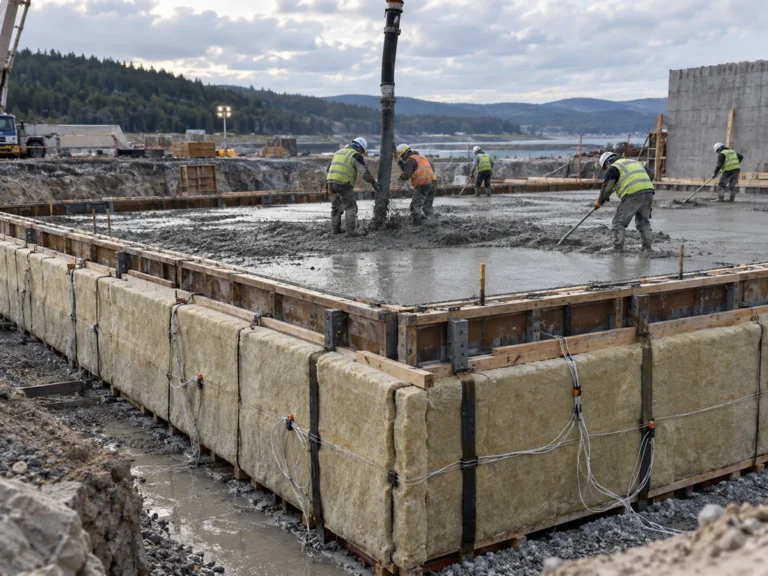
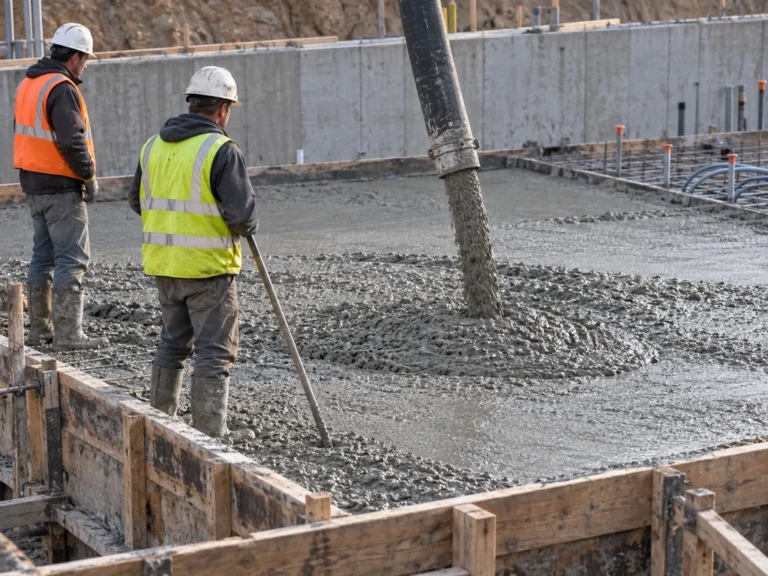
- Use flake ice when a conveyor must move loose ice or a concrete plant must weigh ice into a batch. For concrete cooling, define the ice mass, dosing rate, storage, mixer delivery, and how the ice replaces part of the mixing water.
- Consider slurry ice when a compatible system can pump the cooling medium. Confirm material compatibility, temperature control, target concentration, and separation behavior.
What Should Buyers Check Before Choosing an Ice Machine?
Check output, configuration, site conditions, and supplier evidence together. A machine-only quotation can understate installed cost when it excludes storage, utilities, packing, installation, or peak-demand requirements.
Required Output and Peak Demand
Set production targets from operating data instead of using a rough daily number:
- Record average consumption and the busiest day’s demand.
- Identify the largest short-term withdrawal from storage.
- Allow for seasonal changes and realistic growth.
- Include ice lost during storage, handling, or delivery.
- Subtract production time needed for cleaning and planned maintenance.
Manufacturers rate nameplate output under stated ambient and inlet-water conditions. Higher temperatures, condenser limits, fouling, and interruptions may reduce production, so ask for correction data that match the site. For tube-ice projects, a method to calculate tube ice machine capacity can separate daily production from peak storage needs. Storage can cover a short withdrawal, but it cannot correct undersizing during sustained demand. Confirm that the machine can refill storage before the next peak.
Machine Configuration, Storage, and Packing Needs
Map the ice path from the evaporator to its point of use. A small setup may need only an ice-making head over a bin. We configure a complete ice plant solution when the ice maker, storage, delivery, and packing equipment must work as one line. Separate included equipment from civil work, utilities, installation, spare parts, and local compliance because an ice-maker quote is not the total installed project cost. A distribution business may need:
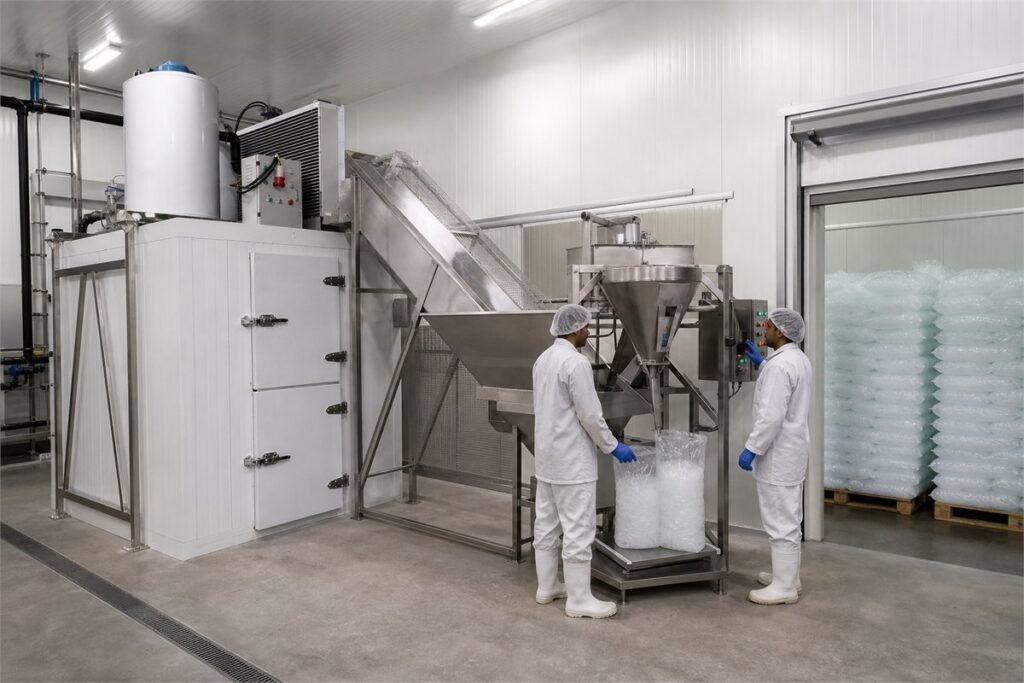
- A refrigerated room or other suitable storage
- Conveyors, pumps, carts, or a crusher
- Weighing, bagging, sealing, and pallet handling
- Controls that coordinate production, storage, and packing
- A transfer route sized for the required flow, cleaning access, and acceptable ice breakage
Site Requirements and Operating Conditions
Confirm site limits before ordering:
- State the available voltage, phase, and frequency. A voltage label alone does not confirm transformer capacity, starting current, protection, or local compliance.
- Document source-water quality, flow, inlet temperature, drainage capacity, and any treatment system.
- Plan heat rejection. Air-cooled equipment needs airflow and adds heat to the room, while water-cooled systems need suitable flow, treatment, and discharge or recirculation.
- Check floor loading, equipment access, lifting routes, ventilation, and service clearances against the proposed layout.
- Confirm that the refrigerant, condenser arrangement, and control system fit local rules and available service skills. Remote or evaporative condensers add site work.
For marine installations, provide vessel motion, salt exposure, room temperature, seawater conditions, footprint, and maintenance access. For hot sites, provide design-day ambient and inlet-water temperatures. When we prepare a project calculation, we use those values rather than a mild catalog rating point.
Supplier Evidence, Service Support, and RFQ Inputs
At Mikeicemachine, we use operating data to prepare project-specific configurations. Ask us to document the quoted model, rating conditions, utility requirements, layout, equipment scope, and controls. We can also provide a running video or available factory test records.
A video can show the machine producing the specified ice form, but it does not prove long-term output, energy use, food safety, or site performance. Test records should identify the model, conditions, measured values, and acceptance criteria. Send us these RFQ inputs for a clear, comparable project proposal:
- Ice type, mass per 24 hours, hourly peak, and application
- Feedwater, ambient temperature, inlet-water temperature, and power supply
- Condenser preference, refrigerant constraints, and installation location
- Storage time, transfer method, packing format, automation, and destination
- Commissioning, training, warranty, spare-parts support, service response, and exclusions
Frequently Asked Questions
What Is the Difference Between a Commercial and Industrial Ice Machine?
A commercial ice machine usually serves a foodservice or retail task in a packaged or modular configuration. An industrial machine is more often part of a higher-output production or process system. The boundary is not a fixed tonnage because automation, storage, heat rejection, controls, and downstream integration also matter.
Can One Ice Machine Produce More Than One Type of Ice?
Most machines produce one ice family because the evaporator, water circuit, harvest method, and controls create the shape. Some models adjust dimensions within that family, such as tube length or center-hole size. This does not mean the machine can switch from tube to flake or block ice. Require written confirmation for any multi-ice claim.
Does an Ice Machine Keep the Finished Ice Frozen?
An ice machine makes ice, but its receiving bin may be insulated rather than refrigerated. Ice can still melt while it waits. Confirm whether the quote includes a bin or refrigerated room, drainage, level controls, and a way to move older ice before newer production.
When Does a Business Need a Complete Ice Plant Instead of a Single Machine?
A business needs a complete plant when production must connect to storage, transfer, crushing or sizing, packing, and dispatch at a planned rate. A complete plant is usually justified when manual handling would limit output, increase food-contact handling, or cause inconsistent loading. The project plan should define interfaces, controls, utilities, installation responsibility, and acceptance testing.
When Should a Business Make Ice On-Site Instead of Buying Delivered Ice?
On-site production makes more sense when demand is steady, delivered ice is costly or unreliable, and the site can support water, power, sanitation, maintenance, and storage. Delivered ice may fit low or irregular demand, temporary work, or sites without service support. Compare total cost, delivery risk, melt loss, storage, product requirements, and downtime coverage.