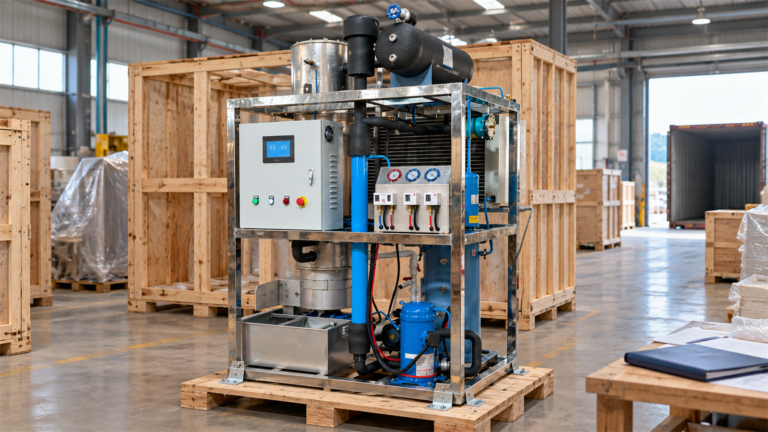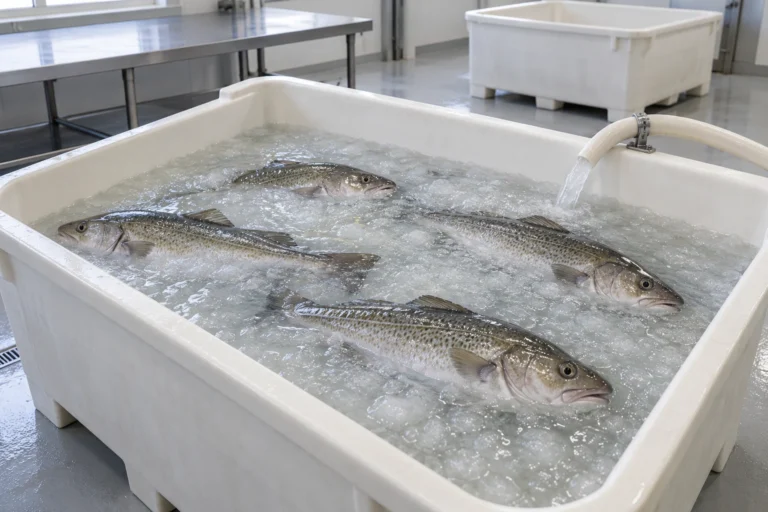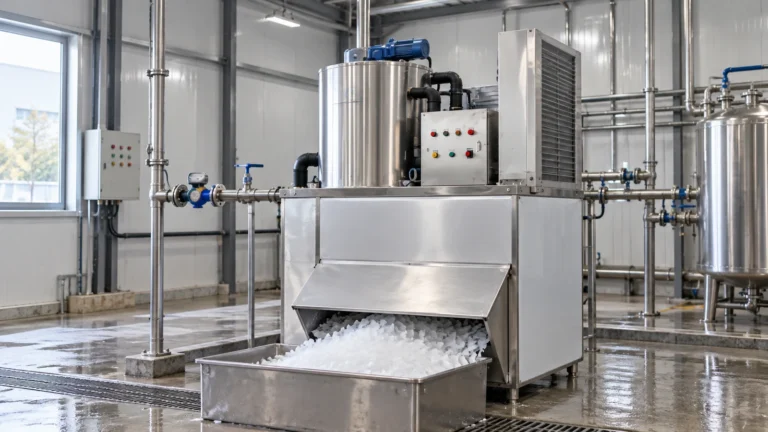
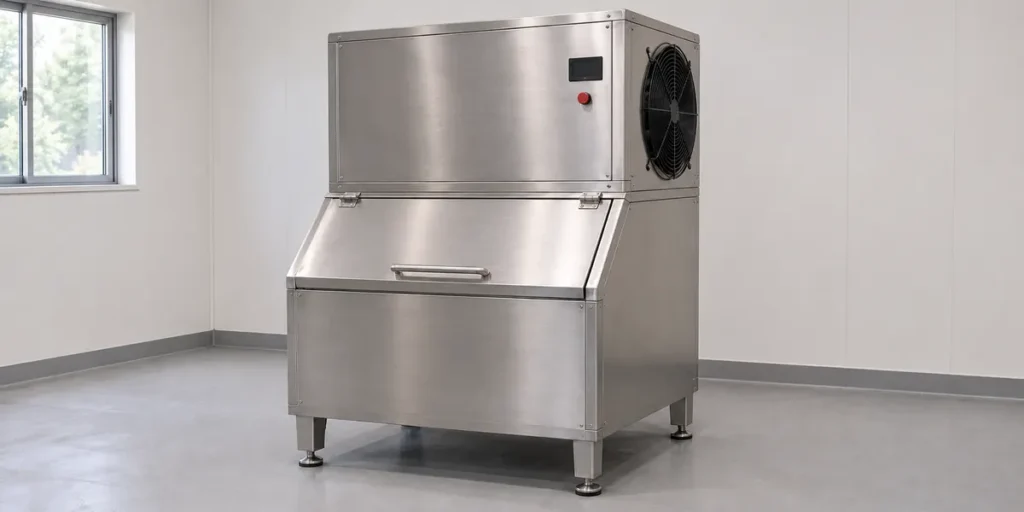
Installing a commercial or industrial flake ice machine requires a stable foundation, approved operating clearances, matched electrical service, a dedicated water line, and proper drainage. Water-cooled condensers and remote refrigeration packages require dedicated cooling connections and field piping prior to commissioning.
Site preparation parameters depend on the manufacturer submittal drawings and model manual rather than nominal ice capacity alone.
Flake Ice Machine Site Preparation Checklist
Assign designated project roles and verify site readiness before scheduling delivery. Mark each item Ready, Action Required, or Not Applicable based on approved drawings.
| Check Item | Model Requirement | Site Verification | Responsible Party | Status |
| Delivery route | Shipping dimensions, weight, lifting points | Measure openings and confirm unloading access | Logistics lead | To verify |
| Installation base | Loaded weight, support and fixing details | Verify floor or frame capacity and level | Structural contractor | To verify |
| Storage interface | Compatible bin, adapter and discharge arrangement | Match drawings and connection positions | Equipment supplier | To verify |
| Ambient conditions | Permitted temperature and exposure | Record expected extremes and nearby heat sources | Facility manager | To verify |
| Airflow and access | Intake, exhaust and service clearances | Check layout and panel removal space | Installer | To verify |
| Electrical supply | Voltage, frequency, phase and circuit rating | Compare supply measurements with equipment data | Electrician | To verify |
| Ice-making water | Quality, pressure, flow and temperature | Test supply at the planned connection | Plumbing contractor | To verify |
| Drainage | Outlet sizes, routing and discharge method | Verify elevations and receiving-drain capacity | Plumbing contractor | To verify |
| Cooling water | Required flow, temperature and pressure | Verify supply and return or discharge arrangement | Mechanical contractor | To verify |
| Remote refrigeration | Equipment location and approved piping design | Confirm route, supports and installation scope | Refrigeration contractor | To verify |
Define the contractor scope for supplying and connecting each utility point. The flake ice machine price guide outlines how piping, foundations, rigging, and commissioning terms establish overall project costs.
Installation Location and Space Requirements
The designated location for a flake ice machine must accommodate rigging access, total operating weight, and routine maintenance clearance. Equipment footprint dimensions do not indicate the working perimeter required to service mechanical components.
Delivery Access
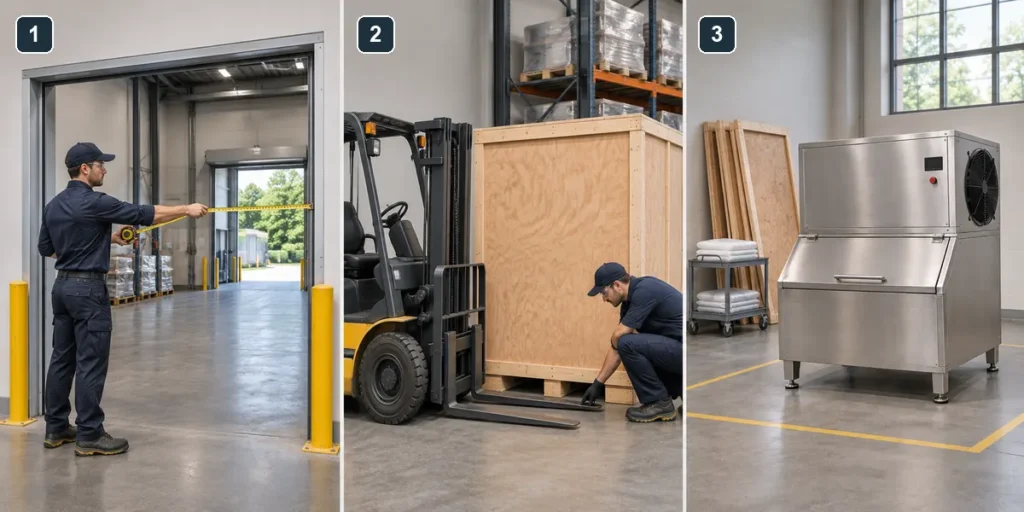
Measure all doorways, corridors, turns, and overhead heights along the transit path from the offloading area to the machine pad against crated dimensions. Rigging equipment must match total shipping weight and attach strictly to designated lifting points. When equipment must be uncrated to clear narrow access openings, establish staging locations and handling procedures prior to arrival.
Floor and Support Structure
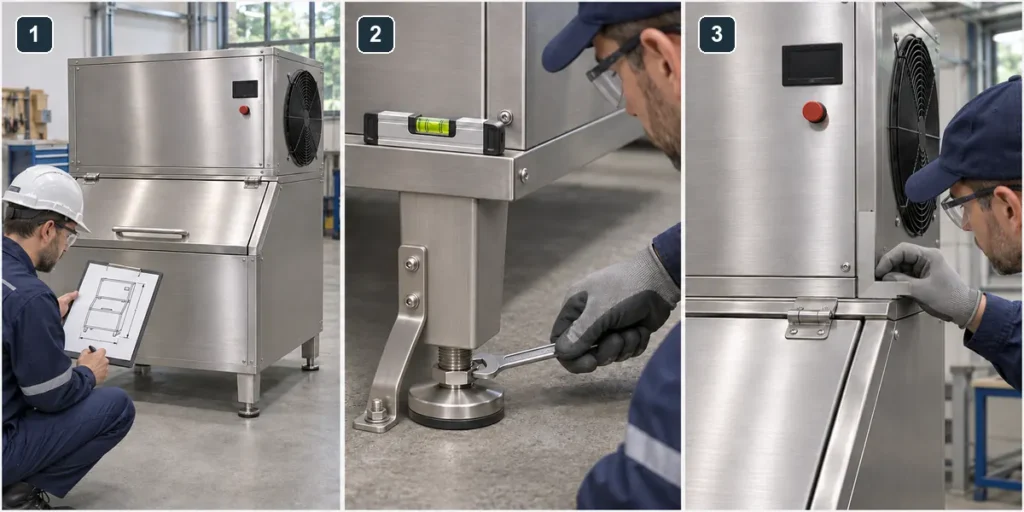
The floor slab or steel frame must carry total operating weight, calculated from the ice machine, collection bin, water reservoir volume, and full ice storage capacity. A structural contractor must verify point loads at designated equipment feet. Level and anchor the frame per manufacturer specifications, confirming alignment between bin adapters, drop chutes, and ice-level sensors. The industrial flake ice machine selection guide details how bin configuration and mechanical conveyance align with daily output.
Ambient Conditions
Operating room temperatures must stay within manufacturer limits during peak summer conditions, accounting for thermal output from adjacent equipment. Indoor machines require protection from rain, grease, dust, chemical vapors, and direct sunlight. Outdoor installations require factory-rated weatherproofing and coated components; an overhead shelter does not make indoor-rated equipment suitable for exterior use.
Ventilation and Service Clearance
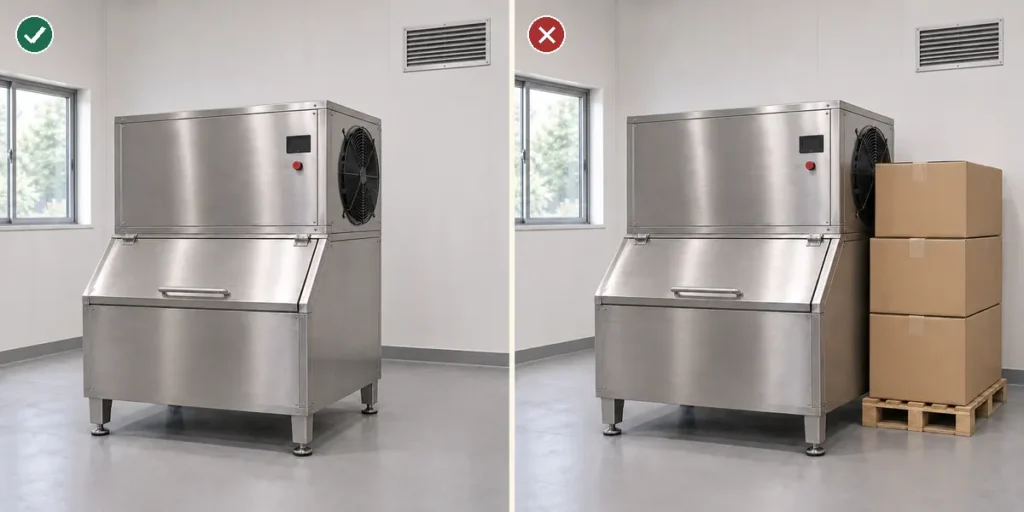
Air-cooled condensers require dedicated intake and exhaust pathways arranged to prevent thermal short-cycling. Enclosed rooms require mechanical ventilation to extract rejected condenser heat. Maintain published clearances around all cabinet panels for coil cleaning, refrigeration service, and component replacement.
Utility Requirements
Electrical service, process water, and drainage require separate utility rough-ins. Log measured field parameters against equipment nameplate data prior to final connection.
Electrical Supply
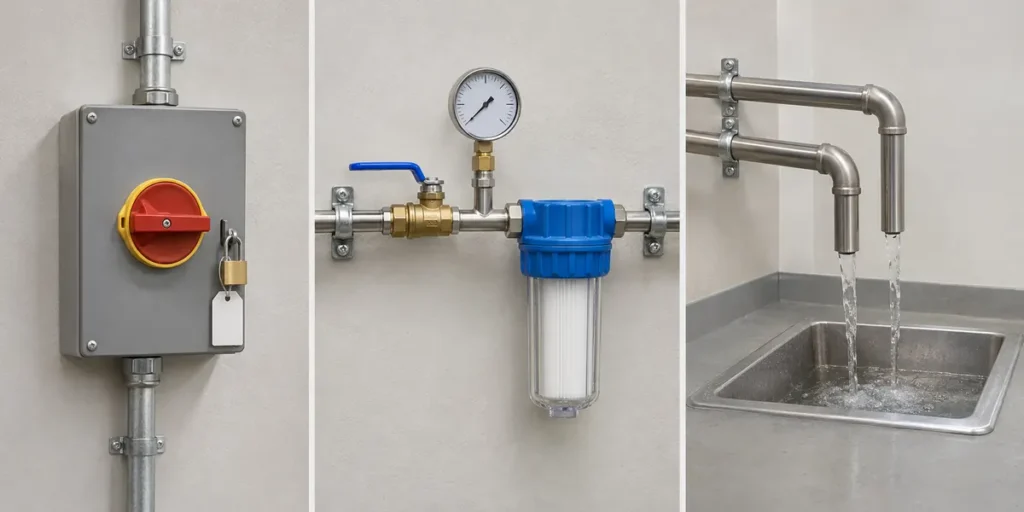
Site voltage, frequency, and phase configurations must match equipment nameplate ratings. Industrial units typically require three-phase power. The 3-ton flake ice machine, for example, specifies a three-phase supply requiring verified site voltage, frequency, and circuit protection before connection. A licensed electrician must size the dedicated circuit using equipment current and protection ratings rather than running kilowatt values. Install an accessible disconnect switch, complete equipment grounding, and verify that line voltage remains within operational limits during compressor startup.
Water Supply
Incoming water must satisfy manufacturer purity limits and relevant hygiene standards. Ice intended for direct human consumption or food contact requires a certified potable supply; alternative water sources require an independent sanitation evaluation. Measure dynamic water pressure and available flow during peak facility demand. Elevated inlet water temperatures increase internal refrigeration loads.
Install an accessible isolation valve near the machine. Water treatment equipment must match laboratory water test results and manufacturer limits. Standard sediment filtration does not remove dissolved mineral hardness, and reverse-osmosis systems require verified equipment compatibility before introduction.
Drainage
Drain piping must handle continuous operating discharge, cleaning flushes, and storage bin meltwater without backing up. Gravity drain lines require a continuous downward slope without low spots or upward loops.
Route machine and storage bin drains through separate lines when required by installation drawings. Terminate drain lines with an approved air gap above the floor drain to prevent wastewater backflow into the equipment. Verify receiving drain volume and approved discharge connections with the plumbing contractor. Where gravity drainage is unfeasible, specify and approve an auxiliary pump system prior to delivery.
Additional Cooling System Requirements
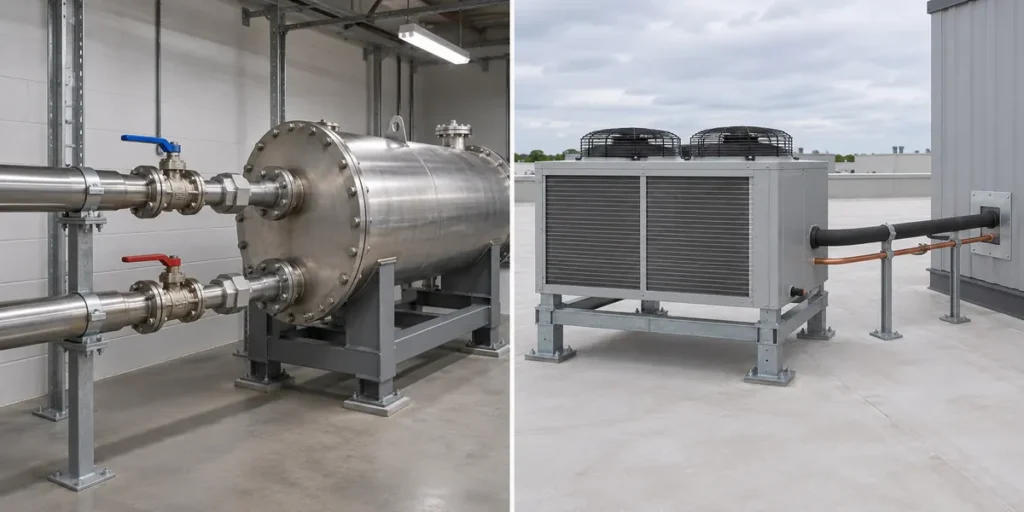
Water-cooled condensers and remote refrigeration packages introduce separate layout and piping requirements beyond standard packaged machines.
Cooling Water Connections
Water-cooled condensers require a cooling loop isolated from the potable ice-making water circuit. Confirm design inlet water temperature, flow rate, supply pressure, and connection pipe sizing. Cooling towers and circulation pumps on recirculating loops must maintain these parameters under peak thermal demand. Once-through water systems require an approved discharge point before final selection. The water-cooled ice machine guide details dual-circuit separation and operational risks associated with inadequate cooling water flow.
Remote Equipment and Refrigerant Piping
Remote condenser placement and line-set routing must be approved before structural construction begins. The refrigeration designer requires total line length, elevation changes, unit positioning, and refrigerant type. Line sizing, thermal insulation, and oil return provisions must follow that engineering submittal.
Structural supports and wall sleeves must maintain full service clearance. Assign contractor responsibilities for field brazing, pressure testing, deep system evacuation, and final refrigerant charging.
Final Site Readiness Check Before Delivery
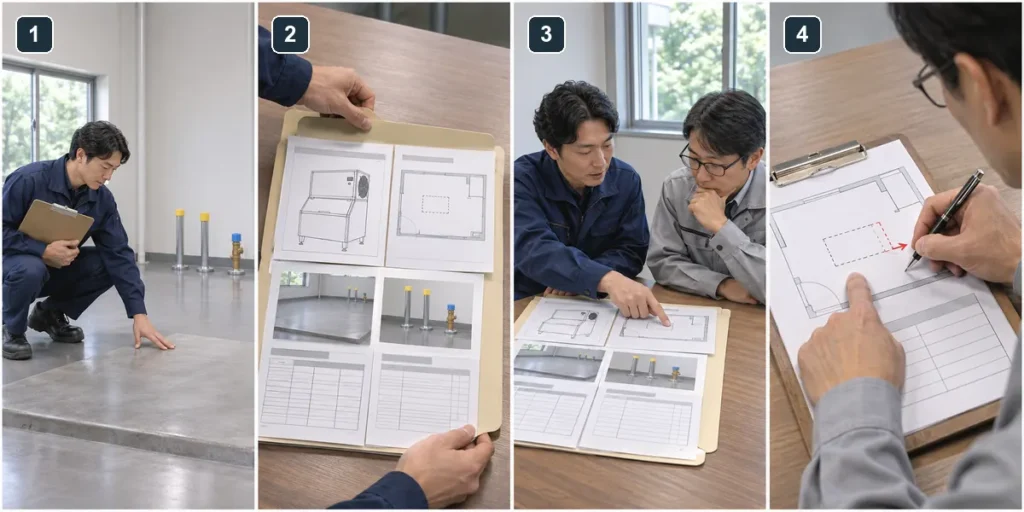
Authorize equipment delivery only after unloading access, mounting foundations, and utility connections are verified. Any remaining facility work must have committed completion dates that do not interfere with mechanical rigging. Assemble a pre-delivery review package containing:
- The final model, cooling arrangement, and equipment list.
- A dimensioned layout showing connections and service access.
- Photographs of the delivery route and installation area.
- Electrical measurements and water-test records.
- Confirmation of completed supports, drains, and cooling connections.
- Named parties responsible for unloading, installation, and startup.
Submit this documentation to both the equipment manufacturer and mechanical installer. Log any field adjustments to keep site work aligned with the shipped machine.
To review site compatibility with Mikeicemachine, submit your installation details, including the proposed model, layout, power supply, and water conditions.
Frequently Asked Questions
How Long Should a Flake Ice Machine Stand After Transport?
Follow the standing interval stated in the unit installation manual. Packaged units with integral compressors require upright standing prior to startup. Notify the supplier of any tilting during transit before applying power. Standalone evaporator drums without compressors do not require this resting period.
Does a New Flake Ice Machine Need Cleaning Before First Use?
Yes. Thoroughly clean and sanitize the evaporator drum and storage bin before commissioning. Follow factory sanitization procedures, use approved cleaning chemicals, and discard all ice batches produced during the cleaning process.
How Is Ice Production Verified After Installation?
Measure production by weighing harvested ice over a designated time period once the system reaches stable operating temperatures. Subtract tare container weight. In a 15-minute collection test, multiply net ice weight by 96 to extrapolate a 24-hour output rating. Results must be evaluated against ambient air and inlet water test temperatures.