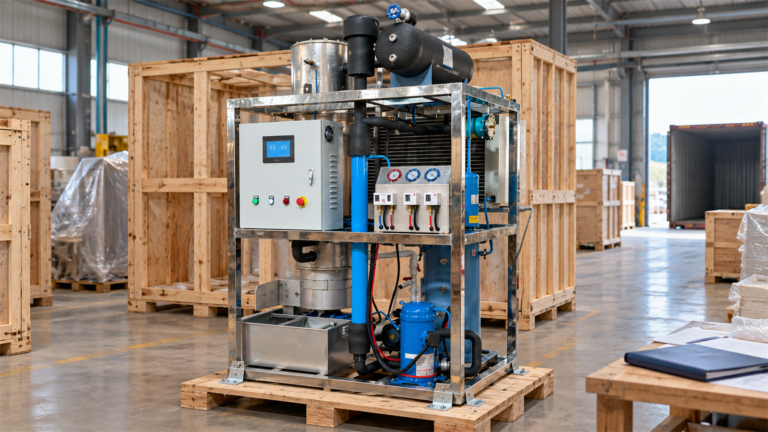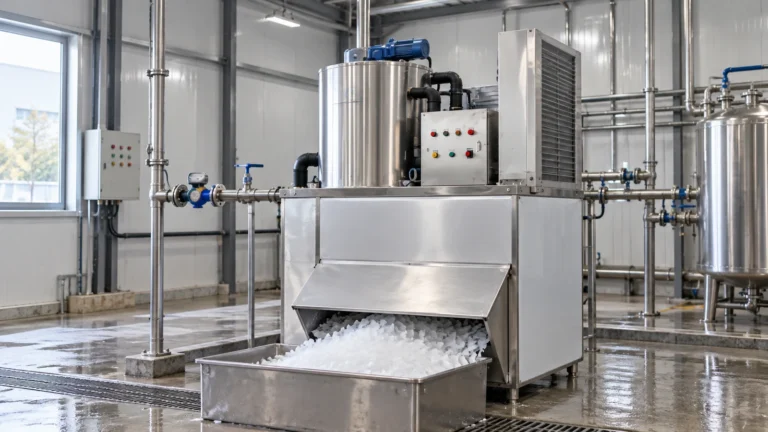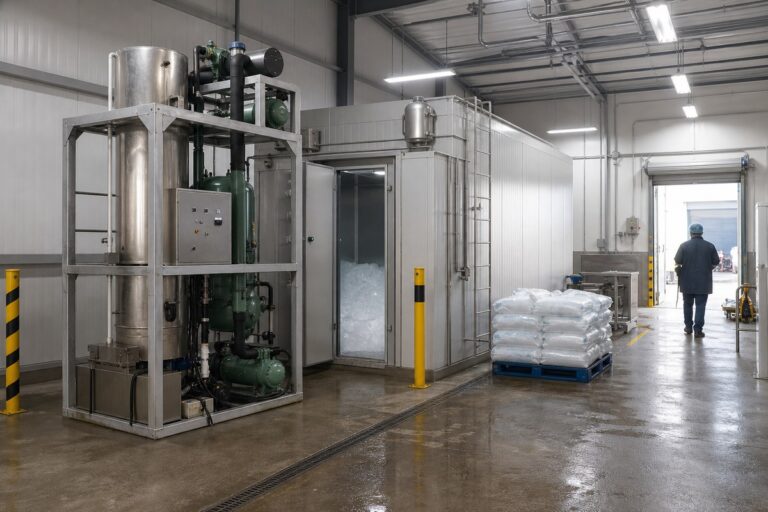

Fish ice slurry mixes fine ice crystals with water to surround fish during chilling. Commercial systems make it from clean seawater or food-grade brine and pump it into insulated tanks, pulling heat out rapidly as the ice melts.
This guide covers machine-made slurry for whole fish after harvest. The goal is fast initial cooling followed by steady cold storage; colder slurry and longer soak times do not automatically improve fish quality.
What Is Fish Ice Slurry?
Fish ice slurry is a pumpable, two-phase cooling medium made of fine ice crystals suspended in water. Marine systems usually contain dissolved salt to lower the freezing point below 0°C, allowing the melting ice to absorb heat while the liquid maintains full contact with the fish.
Comparing Fish Ice Slurry and Flake Ice
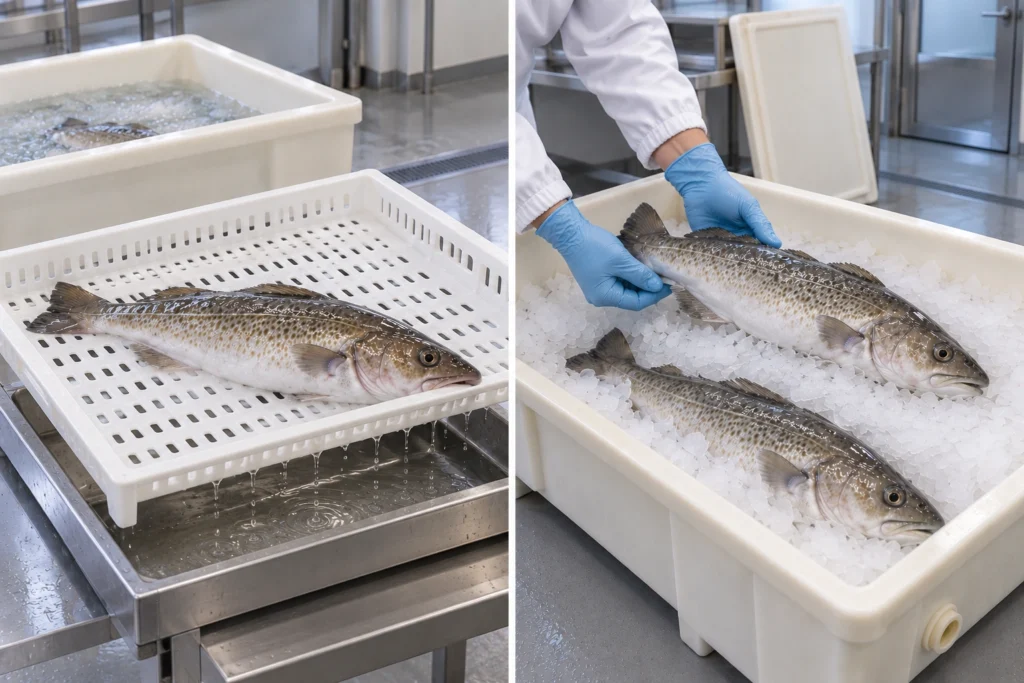
Slurry suits tank immersion and piped distribution, whereas flake ice fits layered crate packing, transport boxes, and retail displays where dry solid ice is easier to handle.
| Operating Feature | Fish Ice Slurry | Flake Ice |
| Product contact | Liquid and crystals surround immersed fish | Flakes touch fish where distributed |
| Delivery | Compatible pumps and piping | Manual loading, conveyors, or gravity chutes |
| Operating control | Ice fraction, salinity, temperature, and mixing | Ice quantity, coverage, melt rate, and drainage |
| Holding arrangement | Watertight, insulated tanks or containers | Insulated boxes, bins, or drained holds |
| Main limitation | Salt uptake and over-chilling need close control | Poor coverage leaves warm pockets |

Faster cooling does not guarantee better quality over multi-day storage. In a SINTEF study on cod and haddock, seawater slurry at roughly −2°C chilled fish faster than flake ice, yet yielded lower sensory scores and yellower fillets after eight days. Select your cooling method based on target shelf life and quality alongside cooling speed.
How to Make Fish Ice Slurry at a Commercial Scale
Commercial production requires a clean saltwater feed, an ice generator, and agitated storage or piped delivery. Calculate your expected catch load and chilling duty before setting the production rate.
Step 1: Prepare Clean Seawater or Food-Grade Brine
Start with food-safe seawater, or dissolve food-grade sodium chloride in potable water. Water must stay free of harmful microbes, chemicals, and toxic plankton. Since mechanical filters only trap particles, base your disinfection on lab testing and keep intakes clear of sewage, fuel, and bilge discharge.
Keep feed salinity within the generator’s rated operating window to control the freezing point and crystal formation. Log whether salinity readings come from incoming feedwater or the liquid phase of finished slurry; as pure water freezes into ice, salt concentrates in the remaining brine.

Step 2: Produce Slurry Ice with a Slurry Ice Machine
Feed the brine into a generator built for its salinity range. In a typical scraped-surface unit, refrigerant freezes water on an inner cylinder wall while rotating blades wipe the crystals into the liquid stream.
Pump the slurry to an insulated tank or straight to the chilling vats. Stored slurry requires mechanical mixing so buoyant ice crystals do not float and separate from the liquid below.
Verify actual output at your operating water temperature, as rated capacity only applies under specific test conditions and ice fractions. Inspect the generator, tank, pump, and pipes together as a single food-contact loop.

Step 3: Adjust Ice Concentration for Chilling and Pumping
Balance ice concentration to cover the heat load while keeping the mix thin enough to pump. Ice fraction is the weight percentage of solid ice: 1,000 kg of slurry at 30% ice holds 300 kg of solid ice and 700 kg of liquid (an arithmetic example, not a universal recipe).
More ice increases cooling reserve, though thick slurry resists pumping. Extra liquid aids flow while cutting cooling capacity per kilogram delivered. Test both ice fraction and flow rate at the tank outlet, since machine settings cannot detect ice separation inside the tank.
How to Use Ice Slurry for Commercial Fish Chilling
Pre-chill your slurry and tanks before the catch arrives, move fish quickly into the bath, verify core temperatures, and maintain the cold chain afterward.
Step 1: Prepare the Catch for Chilling
Clear fish off warm, dirty decks immediately and handle them gently. Bleed or gut the catch promptly when required without delaying immersion, then rinse away residue with clean water and keep offal out of the slurry circuit.
Sort fish by size whenever practical. Large fish cool much slower at the spine than small ones, so releasing a mixed batch as soon as the smallest fish hit target temperature leaves the biggest fish warm inside.
Step 2: Fill Chilling Tanks and Immerse the Fish
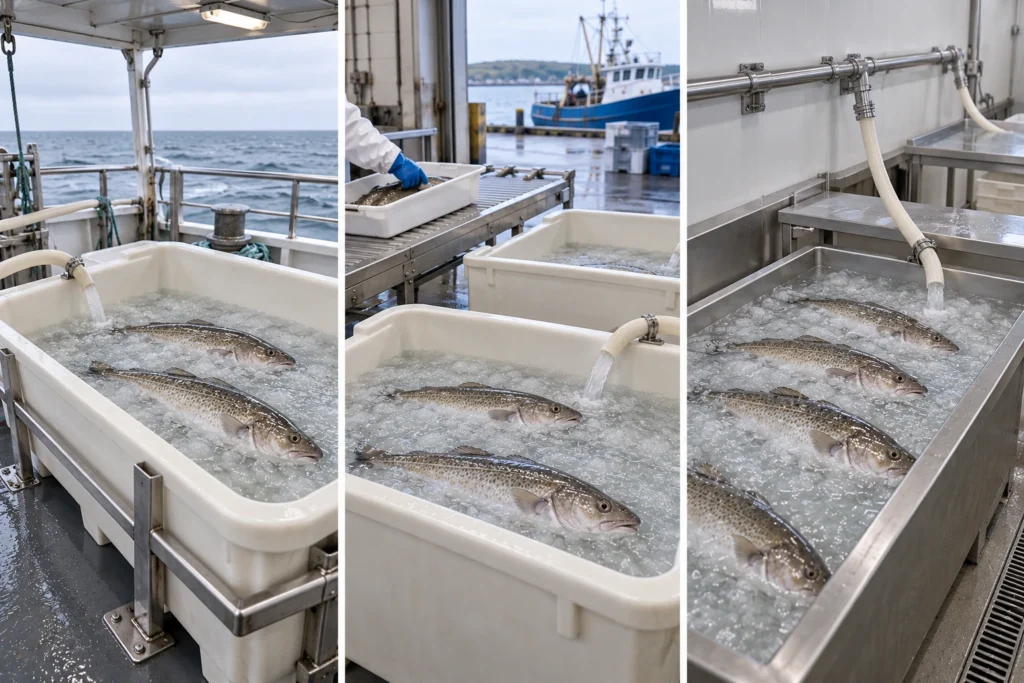
Pump slurry into clean, insulated, watertight tanks using compatible pumps and hoses positioned for even distribution. Slide fish in gently so slurry surrounds every fish, and avoid overpacking that blocks circulation or creates warm pockets. Add enough slurry to absorb the heat load and keep visible ice floating throughout the chill cycle. If all crystals melt while warm fish are still loading, replenish the tank immediately.
Step 3: Monitor Core Temperature and Maintain Uniform Cooling
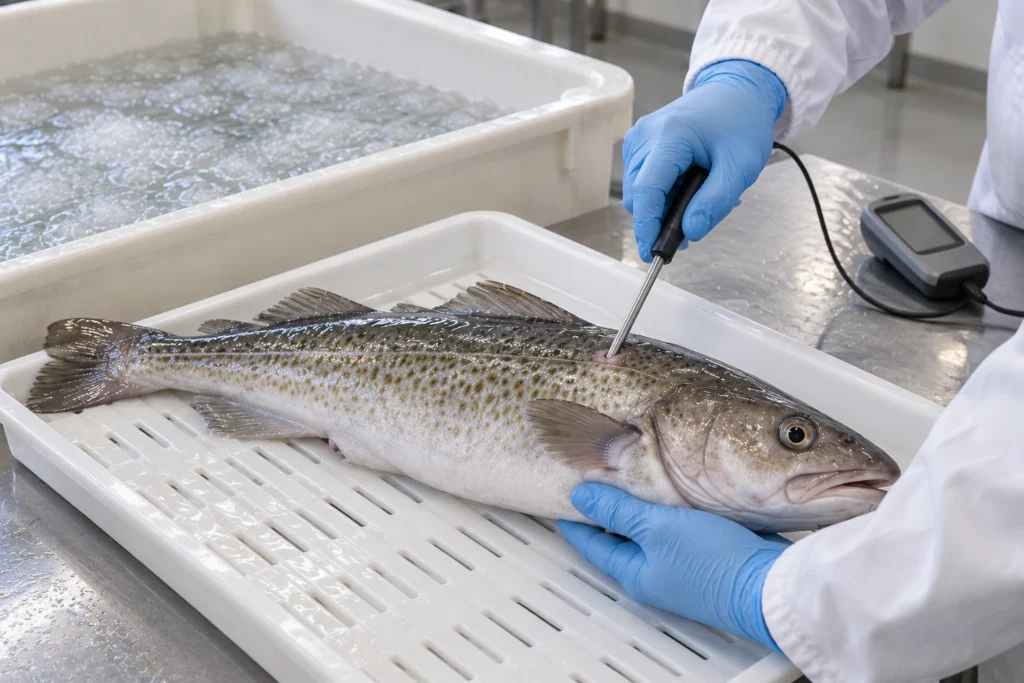
Push a calibrated probe into the thickest part of the largest fish and those in the slowest-cooling corners. A cold bath reading never proves fish centers are cold. Aim for core temperatures near 0°C, running trials with your actual fish sizes, starting temperatures, and loading density to establish the required soak time. Check slurry temperature at multiple points and use gentle circulation to prevent warm layers without damaging the skin. Log load times, core temperatures, and slurry top-ups every shift to spot slow-cooling batches early.
Step 4: Maintain Cold Storage After Chilling
Keep fish cold through holding, unloading, and transport. Fish may stay in slurry storage if temperature, salinity, soak time, and hygiene controls are validated for that species. When switching to layered flake-ice storage, drain the fish promptly and pack them in fresh flake ice inside clean, insulated containers.
Probe fish again after transfer and before dispatch, tracking salt uptake, water weight gain, appearance, and texture to set strict immersion limits. Never rely on a cold-room wall thermostat to confirm internal fish temperature.
When to Use a Commercial Slurry Ice Machine
Install an on-site machine when steady chilling loads justify dedicated production and your facility can support the power, space, cleaning, and piping. Operations with occasional demand often do better buying shore-made ice.
Fishing Vessels
Onboard generators pay off when catches arrive repeatedly and hauling shore ice would limit hold space or trip length. Check power capacity, footprint, seawater quality, corrosion resistance, and pitch-and-roll tolerance before selecting a unit. A seawater flake ice machine fits better when crews pack fish in boxes rather than flooded tanks, and remember that freezing saltwater on land does not automatically make a machine sea-ready.
Fish Receiving Centers
Slurry rapidly cools heavy landings when boats offload warm catch. Size both production and buffer storage for peak landing hours within your available operating hours, as systems sized only for daily averages will run short during peak unloading. Verify outlet ice fraction and pump flow at maximum draw, and keep clean slurry separate from used chill water.
Seafood Processing Plants
Slurry systems suit processing lines with continuous immersion chilling and multiple piped drop points, whereas plants receiving pre-chilled fish mainly need solid ice for packing.
Before installation, establish protocols for tank and pipe sanitation, brine disposal, and salt uptake limits. Validate the process on your exact fish species, then send Mikeicemachine your species and size range, peak batch weight, incoming and target temperatures, water source, and power supply to discuss operating conditions and equipment options.
Common Mistakes When Using Fish Ice Slurry
Most failures happen when crews mistake a cold-looking tank for a controlled cooling process.
- Treating filtered seawater as food-safe. Test the source and verify disinfection.
- Confusing salinity with ice fraction. Measure and log both separately.
- Reporting total slurry weight as pure ice output. State total mixture weight alongside its ice fraction.
- Checking only bath temperature. Probe the core of large fish before releasing a batch.
- Allowing ice separation or overpacking bins. Restore gentle circulation and reduce load density.
- Assuming colder brine or longer soaking improves freshness. Over-exposure increases salt uptake, clouds eyes, softens texture, or partially freezes the flesh.
- Reusing dirty liquid without validated water treatment. Adding ice restores cooling capacity while leaving blood and bacteria in the bath.
External Sources
- FAO — The Manufacture of Ice
- FAO — The Use of Ice and Chilled Seawater on Fishing Vessels
- FAO/WHO — Code of Practice for Fish and Fishery Products, Second Edition
- SINTEF — Evaluation of Cold Thermal Energy Storage in Fishing Vessels
- SINTEF — Cod and Haddock Chilled in Slurry or Flake Ice
- SINTEF — Atlantic Cod Chilled in Ice or Slurry and Effects on Quality