Evaluate an ice bag sealer on three core criteria before comparing prices: bag compatibility, closure durability in cold storage, and sustained packaging speed. The machine must handle filled bags reliably within your real workflow. For an ice plant, a successful installation means leak-free closures during continuous shifts, with predictable labor and low maintenance requirements.
Compare Ice Bag Sealing Methods
Selecting a closing method requires balancing film specifications, target closure strength, and labor requirements across your packaging line.
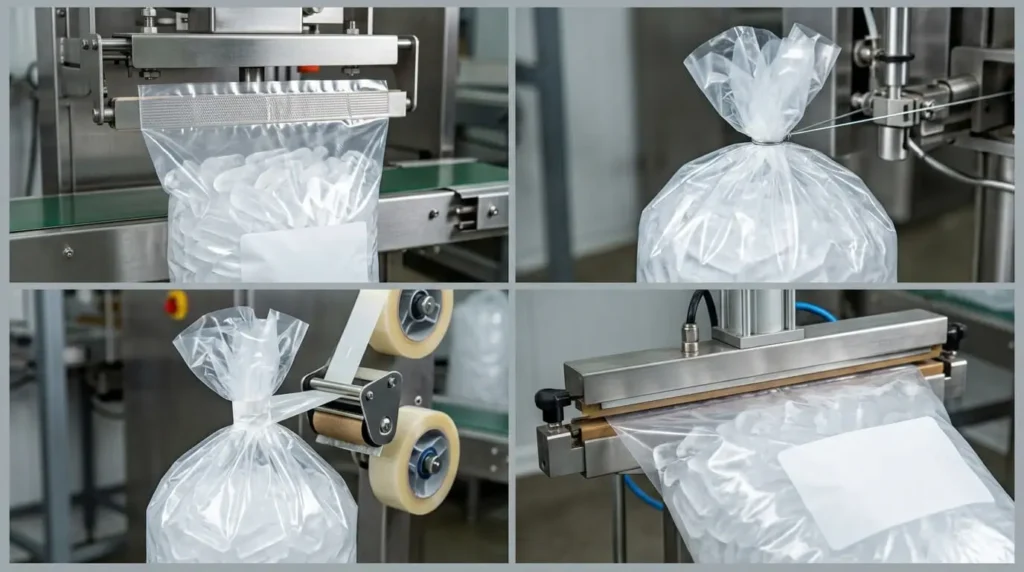
| Sealing Method | Suitable Application | Key Limitation |
| Tape closure | Manual bagging where a gathered neck closure is acceptable | Does not create a continuous fused seal |
| Wire closure | Mechanized closure of compatible bags in established ice packaging lines | Requires closure consumables and suitable bag neck presentation |
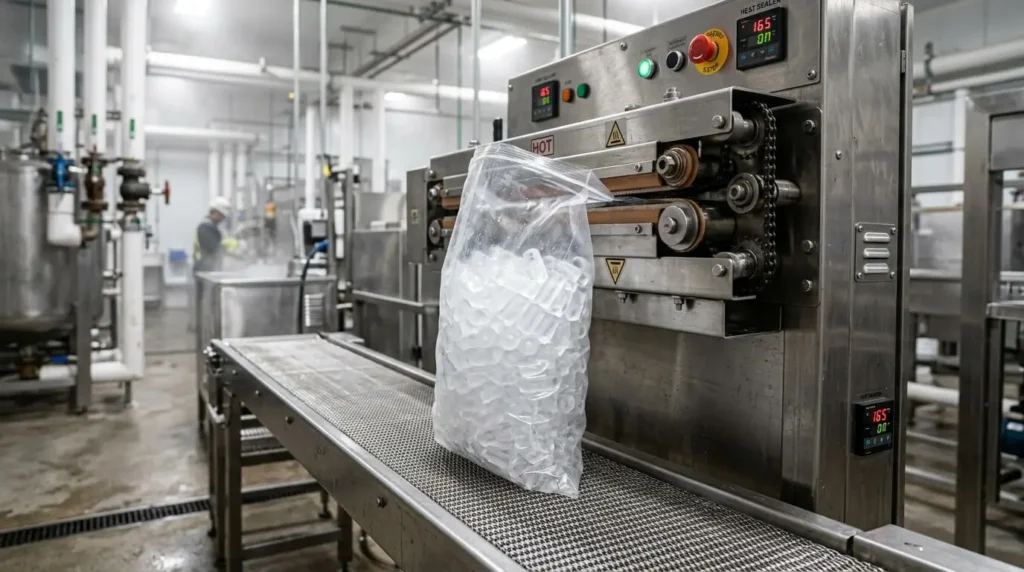
| Impulse heat sealing | Individual bags with compatible film and manageable operator handling | Positioning, sealing and cooling affect the complete cycle |
| Continuous band sealing | Repeated packaging with stable bag support and presentation | Requires compatible film, conveyor alignment and controlled feeding |
| Hot air sealing | Compatible polyethylene bags on industrial packaging lines | Requires suitable bag guidance and coordinated temperature, airflow and speed |
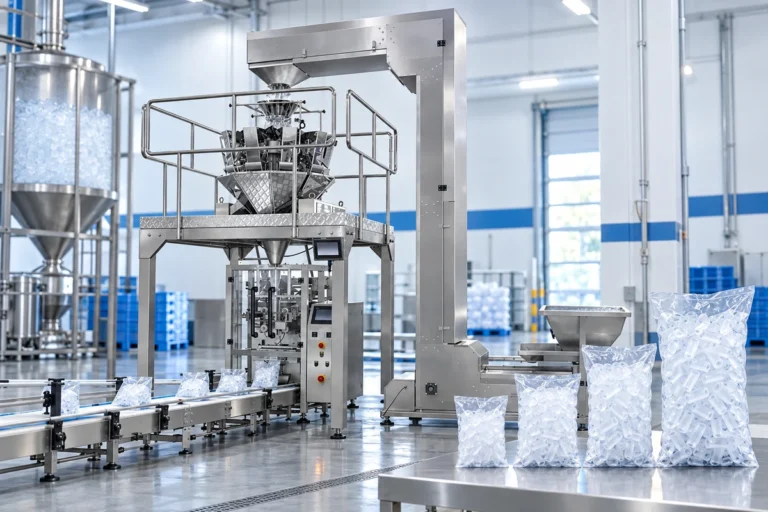
A standalone sealer only closes pre-filled bags. If upstream weighing and manual bagging create the primary line bottleneck, consider an automatic tube ice packing line that integrates weighing, forming, filling, and conveying. Upgrading the sealer alone will not resolve an inefficient filling process.
Check Compatibility With Your Ice Bags
Before evaluating hardware, verify how your bag film, physical dimensions, and fill weights interact with the sealing mechanism.
Bag Material and Thickness
Film composition dictates whether a heat sealer can achieve a reliable bond. Provide suppliers with exact film specifications, thickness ranges, and physical samples rather than generic descriptions like “plastic bag”. Because cold ice and condensation draw heat away from the sealing area, test the material to establish a verified operating temperature and dwell-time window. Excessive heat weakens the film boundary, while insufficient heat causes weak joints that burst under pallet weight.
Bag and Seal Dimensions
Match the machine’s sealing length to the flattened bag opening, accounting for side gussets. Gusseted bags double the film layers at the edges, requiring uniform pressure across both two-layer and four-layer sections to prevent unbonded leak channels.
Distinguish between seal length (the span across the opening) and seal width (the thickness of the fused band). While an adequate seal width improves burst resistance, it cannot compensate for trapped ice particles, wrinkles, or incorrect heater calibration.
Bag Weight and Headspace
Filled ice bags require firm bottom support during sealing so shifting weight does not distort the opening. Maintain sufficient headspace (the unfilled space above the ice) so the bag mouth can flatten cleanly into the sealing jaws without catching ice chunks.
Ergonomics also dictate sustained throughput. When using a semi automatic tube ice packing machine, the operator must lift and guide each filled bag from the chute to the sealer. Set the transfer height properly to minimize fatigue and prevent misaligned seals during long shifts.
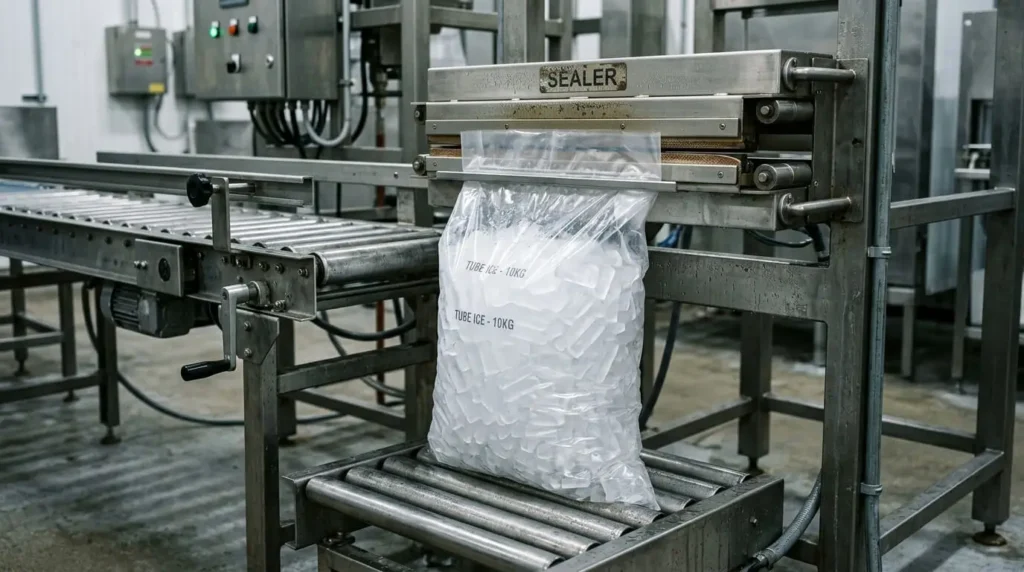
Calculate the Sealing Speed Your Plant Needs
Sizing a sealing station requires balancing daily ice harvest rates against compressed dispatch schedules and specific bag formats. Base throughput calculations on actual shipping windows rather than daily plant tonnage. Smaller retail bags require far more closures per ton than bulk bags, so calculate each SKU independently.
- Average bags per hour = Ice scheduled for packaging (kg) ÷ Kilograms per bag ÷ Available packaging hours
Peak demand frequently exceeds this average. Sizing a packaging station solely around rated 24-hour tube ice production capacity creates bottlenecks if a plant harvests continuously but packs the bulk of its volume during a short morning window.
Verify sealer speed as finished, acceptable bags per minute under actual staffing conditions. Nominal conveyor speed in meters per minute does not equate to packaging rate once bag spacing, operator handling, and format changeovers are factored in.
Fit the Sealer Into Your Existing Production Line
Successful line integration depends on seamless bag transfer, intuitive controls, reliable utility supply, and routine cleaning access.
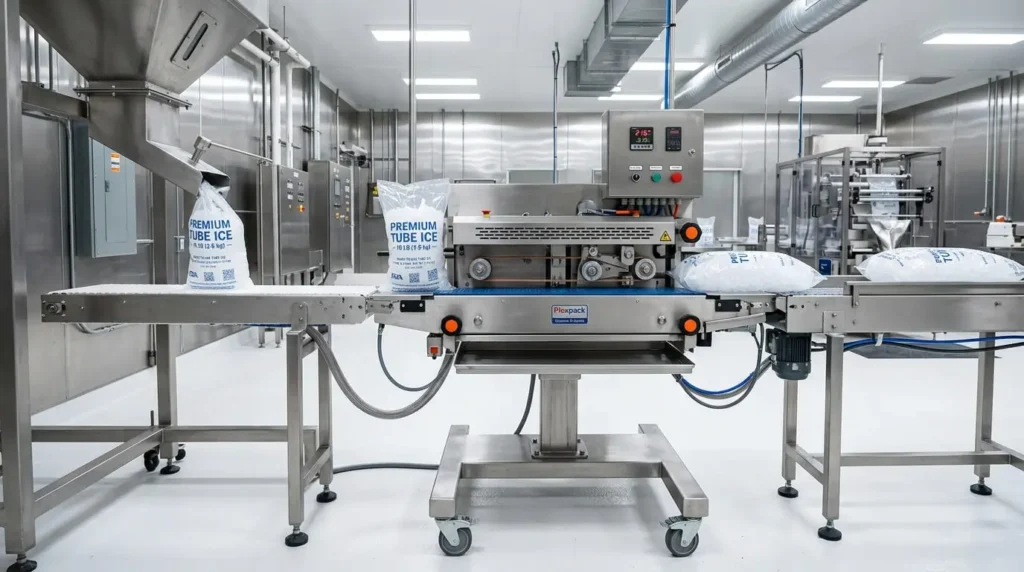
Bag Support and Alignment
The conveyor or base must support the full weight of the filled bag, allowing the sealing mechanism to guide and close the mouth without tension. Verify transition heights and bridge plates between the filling station and the sealer. If a heavy bag dips or tilts across transfer gaps, the opening pulls out of alignment, resulting in crooked or incomplete seals.
Controls and Changeovers
Controls should allow simple adjustments for temperature, conveyor speed, and line-stop coordination. In plants that switch between retail and commercial bag sizes, ensure guide rails and conveyor heights feature quick, tool-less adjustments with clear markings. Lengthy changeovers quickly erode the output gains of a fast machine.
Utilities and Installation Space
Confirm electrical specifications (voltage, phase, and total draw for continuous heating elements) and compressed air requirements (CFM and PSI) for pneumatic closers. In multi-vendor lines, a thorough packing line configuration review verifies transfer heights, footprint clearances, and electrical safety interlocks before equipment arrives on site.
Cleaning and Maintenance
In the United States, FDA regulations treat packaged ice as food (21 CFR Part 117), requiring sanitary handling and corrosion-resistant construction. The sealer must tolerate cold, wet environments and routine washdowns without electrical failure. Verify that common wear parts, such as Teflon bands, heating wires, and silicone pressure strips, can be inspected and replaced quickly without major disassembly.
Test Seal Quality Before Buying
Pre-purchase validation must replicate real operating conditions rather than bench tests with dry, empty packaging.
Trials With Your Bags and Ice
Test machines using your specific bag stock and actual cold ice at target fill weights. Dry, empty bag tests fail to simulate real conditions, where surface condensation and loose ice slivers test seal reliability. Reviewing an operational tube ice packing demonstration provides a clearer picture of bag stability and sealing behavior under load.
Continuous Runs at Target Speed
Run trials continuously for at least 30 to 60 minutes at target packaging speeds. Heating elements can lose temperature under continuous contact with cold film, or heat can build up excessively in adjacent components. Consistent seal quality over a sustained run is far more telling than a brief demonstration of top speed.
Seal Checks After Storage and Handling
Test finished closures after 24 hours in cold storage (-10°C to -18°C) using standard drop and pallet-stacking tests. Sub-zero temperatures can make overheated seals brittle, causing packages to split during handling even if they appeared secure immediately after sealing.
Compare the Total Cost of Ownership
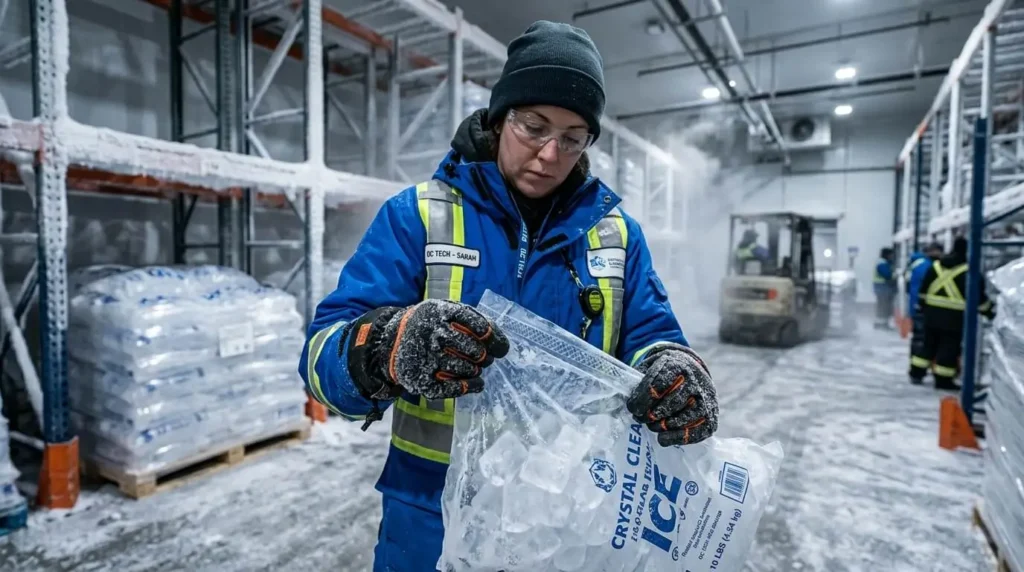
Beyond the initial purchase price, operating costs, consumable wear, and labor efficiency determine the true economic value of the machine. Calculate total costs over a three-to-five-year period, factoring in purchase price, required labor, energy, wear parts (heating elements and Teflon bands), and expected scrap rates. A lower-priced manual sealer may prove more expensive long term if it increases labor overhead or produces higher reject rates during peak demand.
FAQs About Ice Bag Sealers
Can an Ice Bag Sealer Print Date Codes?
Yes, through optional thermal transfer, inkjet, or embossing units installed on or alongside the sealer. Verify print adhesion and legibility on cold, damp poly film, and confirm the coder matches your regulatory traceability requirements.
Can Sealed Ice Bags Be Reopened and Resealed?
Heat-sealed bags must be cut open, reducing bag height and generally preventing a proper reseal. Wire and tape closures can be removed, but the bag neck often stretches or tears. Any product rework must also meet food safety and hygiene protocols.
Can Ice Bags Have Handles or Vent Holes?
Handles and vent holes are typically added during bag manufacturing or by upstream bag-forming equipment, not by a standalone sealer. If vent holes are used to help with pallet stacking, position them away from the seal area so they do not weaken the closure.