
Choose ice bag sizes from the finished pack your customer needs, then verify the physical bag with your tube ice and proposed packing line. A weight label such as 5 kg or 20 lb does not define the bag width, length, gusset, film feed, closure area, or filled shape. Those details affect how the bag enters the machine, receives ice, closes, and leaves the packing area.
No universal weight-to-dimension chart fits every tube ice plant. Use each target net weight as the start of a controlled bag specification. Confirm the final dimensions through a fill trial before ordering printed stock or approving packing equipment.
What does an ice bag size need to define?
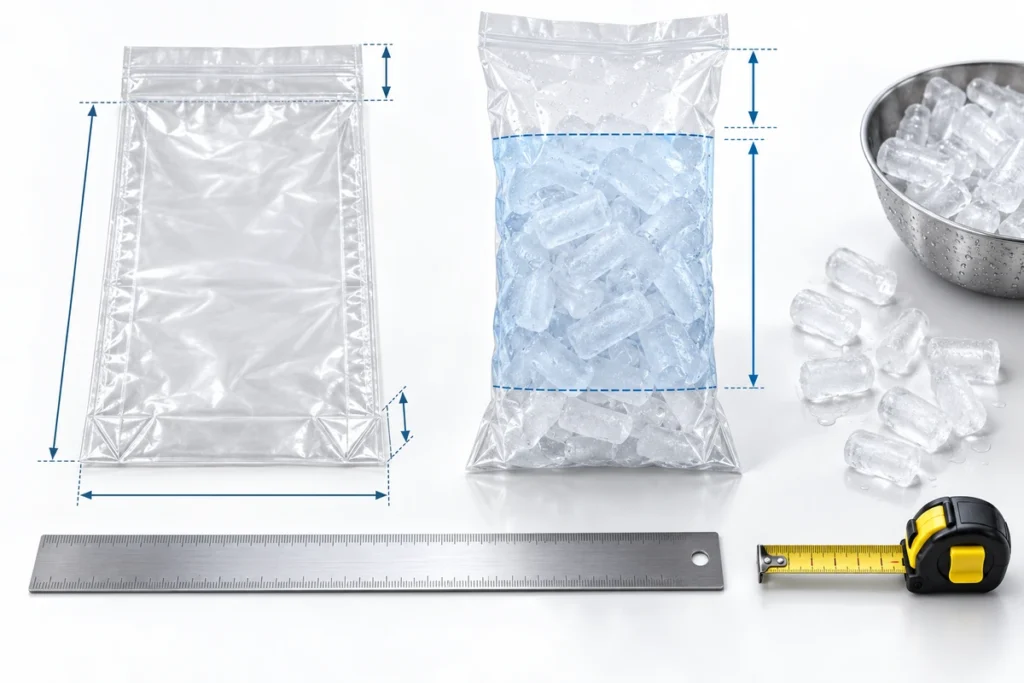
A bag size has to cover both the sales unit and the physical package. When a request lists only net weight, the bag converter and packing-line supplier are left to guess at the interfaces between the bag and the equipment. Replace that shorthand with a single bag schedule whose field names carry through the drawing, trial, quotation, and purchase order.
| Bag Schedule Field | What to Record | Why the Packing-Line Supplier Needs It |
|---|---|---|
| Target net ice mass | Weight of ice in one finished bag | Sets the weighing target and helps calculate required bags per hour |
| Flat bag width | Agreed measurement method and dimension | Affects bag opening or the roll-fed forming interface |
| Bag length | Total cut length and usable fill length | Provides space for ice, handling, and closure |
| Gusset | Type, depth, and measurement method, if used | Changes the filled shape and how the bag opens or forms |
| Supply format | Preformed bag or roll-fed film | Determines how the bag enters the packing process |
| Closure area | Seal or tie location and required clear zone | Keeps ice and moisture away from the intended closing area during the trial |
| Tube ice condition | Diameter, length, and whole or crushed form | Changes occupied volume and how pieces settle in the bag |
| Finished-bag route | Conveyor, manual take-away, crate, or pallet handoff | Sets downstream clearance and handling needs |
Use a controlled drawing for dimensions and a physical sample for fit. The drawing prevents inconsistent measurement, while the sample shows behavior that a flat dimension cannot capture.
How should a plant choose the target bag weight?
Choose the target bag weight from the customer’s order unit and the plant’s dispatch plan. Then calculate the line requirement for every format. A larger bag reduces the number of bags needed for the same ice mass, but it also changes lifting, sealing, conveying, stacking, and delivery conditions. The preferred format must work for the buyer’s sales channel and for the full packing route.
Customer pack requirements
Start with confirmed orders or a defined sales plan. Record the unit customers expect to buy, how staff or customers will lift it, the bag count per delivery unit, and whether the filled shape fits the intended freezer, crate, or pallet pattern. The ice business setup guide places packaging alongside storage and dispatch planning. Treat regional bag weights found in supplier catalogs as examples, not a rule for a new market.
If the plant needs retail and wholesale packs, define them as separate formats. One physical bag rarely covers both just because the weighing target is adjustable. Each format needs its own dimensions, closure, rate, and finished-bag handling review.
Bags per hour for each format
Convert the required mass flow into a bag rate for each selected net weight:
Required bags per hour = ice mass to pack in the time window / target net mass per bag
Use the actual packing window, not the plant’s daily production divided by 24 hours. The ice packing machine capacity guide explains how peak flow and target bag mass set the required bags per hour. If multiple formats share one shift, calculate the quantity and run time for each format, then include changeover and planned stops in the schedule. The supplier still needs to confirm that the proposed system can meet the requirement with the specified ice, bag, and operating conditions.
How do tube ice dimensions affect bag fit?
Tube ice dimensions affect how much space a target weight occupies and how the pieces move near the bag opening. Long pieces, short pieces, and crushed tube ice can settle differently. For that reason, bag dimensions should come from a fill trial with representative production ice rather than from net weight alone.
Fill trials with production ice
Run the trial with ice that represents the planned product at the packing point. Record tube diameter, piece length, whether pieces are whole or crushed, and the condition of the ice when it reaches the bag. Fill to the target net mass, let the product settle as it would during normal handling, and observe the finished profile. Fit this trial into the complete tube ice equipment flow so storage and transfer conditions match the proposed packing point.
The trial should answer practical questions: Does the bag open cleanly? Can ice enter without blocking the mouth? Does the target mass sit below the closing zone? Does the filled bag pass through the take-away path without snagging? If the plant sells more than one tube size or crushed format, repeat the trial for each product instead of carrying the first result forward by assumption.

Clearance for filling and closing
Bag length must include usable space above the ice. That space allows the product to enter and gives the selected closing process a clear working area. A bag that holds the target weight when laid open may still be too short for controlled filling and closing on the line.
Check this clearance with the proposed bag position and closure method. Watch for ice or water reaching the closing area, pieces bridging at the opening, and a filled profile that pulls against the closure during take-away. Acceptable clearance depends on the project because bag construction, ice geometry, and closing equipment all play a part.

How should bag dimensions match the packing line?
Match bag dimensions to the packing method before approving the bag drawing. The supplier needs the packaging-material entry method, width-control method, closure position, and finished-bag discharge clearance. A bag converter’s dimensional approval does not establish machine compatibility. Define the bag schedule, then review the proposed packing and storage equipment within the other-machines collection.
Bag supply format
State whether the project uses preformed bags or roll-fed film. A preformed-bag process needs a defined opening, orientation, presentation method, and operator or machine handling step. The Mike Ice automatic tube ice packing line forms, weighs, fills, seals, and conveys bags; configuration depends on bag weight and bags per hour. The public page does not state a universal dimensional range, so the project proposal must confirm the selected format.
Do not use the finished width of a preformed bag as an unqualified roll-film requirement. Ask the bag converter and equipment supplier to use the same drawing convention and identify every conversion needed between flat bag dimensions, gussets, and film width.
Width and forming interface
Check width against the exact proposed machine interface. For a preformed bag, review how the process opens, holds, and releases the mouth. For a line that forms bags, ask the supplier to identify the former and film path for each approved format. Record the supported range in the project proposal instead of relying on a general product-page statement.
Width also affects the filled profile. A narrow bag may become deep and difficult to stabilize; a wider bag may need more horizontal clearance. These are possible trial outcomes that depend on the specific bag and equipment. Use the sample fill and proposed equipment drawing to decide.
Length, seal area, and discharge
Confirm total length, the usable fill zone, the closure location, and any material needed above or below that zone. Then check the filled bag at discharge. The bag must clear guards, belts, guides, collection points, and any manual lift or pallet handoff in the proposal.
Measure the filled package during the trial because its working envelope is three-dimensional. Record where operators touch the bag, how it changes orientation, and where it rests after closing. If a larger format needs different take-away equipment or staffing, include that change in the quoted system boundary.

What should the buyer test before ordering printed bags?
Test the plain sample bag on the proposed process before committing to printed inventory. The acceptance record should connect the bag drawing, actual tube ice, target mass, machine settings, closing result, and finished-bag route. A successful hand-fill on its own does not approve automatic or semi-automatic operation.
| Acceptance Check | Record | Hold Point |
|---|---|---|
| Identification | Bag drawing revision, sample code, ice format, and target net mass | Stop if the sample and drawing do not match |
| Filling | Opening behavior, ice entry, target weight, and observed spillage | Stop if the closing zone cannot remain usable |
| Closing | Selected method, closure position, and result under trial conditions | Stop if the approved process cannot close the filled bag consistently |
| Discharge | Filled dimensions, orientation, conveyor or manual handoff | Stop if the bag cannot clear the proposed route |
| Format change | Parts, settings, operator work, and verification needed | Stop if another product format lacks a trial |
| Approval | Approval names, date, revision, open issues, and retained sample | Do not release bulk printing while an interface remains open |
Give the approved revision to the bag converter and packing-line supplier. If artwork, film construction, gusset, closure, ice form, or target weight changes, reopen the affected checks. Send the controlled bag schedule and packing-window requirement to Mike Ice Machine for a project-specific configuration review. This reduces the risk of buying bags that cannot run as intended but does not replace written compatibility confirmation from the supplier.
Frequently asked questions
Can one packing line run more than one ice bag size?
One packing line may run more than one ice bag size when the supplier confirms every format within the proposed configuration. Ask for the supported target weights and physical dimensions, required format parts, settings, operator tasks, expected changeover procedure, and confirmed rate for each bag. An adjustable weighing target by itself does not confirm that the former, bag handling, closure, and discharge path fit every size.
Can tube ice and crushed tube ice use the same bag?
Tube ice and crushed tube ice can share a bag after both products pass the required fill, closing, and handling checks. Crushing changes piece geometry and may change occupied volume, settling, spillage, or behavior at the bag mouth. Mike Ice has not published a universal compatibility rule for this choice, so send samples or representative dimensions and obtain written confirmation for both product conditions.
Does film thickness affect packing-line compatibility?
Film thickness can affect how the packaging material feeds, forms, and seals, so the packing-line supplier should review it separately from bag width, length, and target weight. Mike Ice does not publish a universal film-thickness range for these packing lines. Send the proposed film construction, thickness, bag drawing, and physical samples to the equipment supplier, then record the approved material in the project specification before ordering production bags.