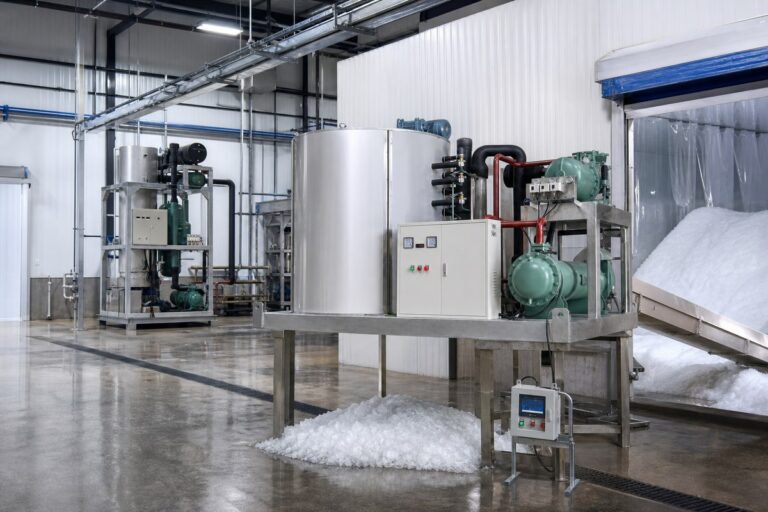
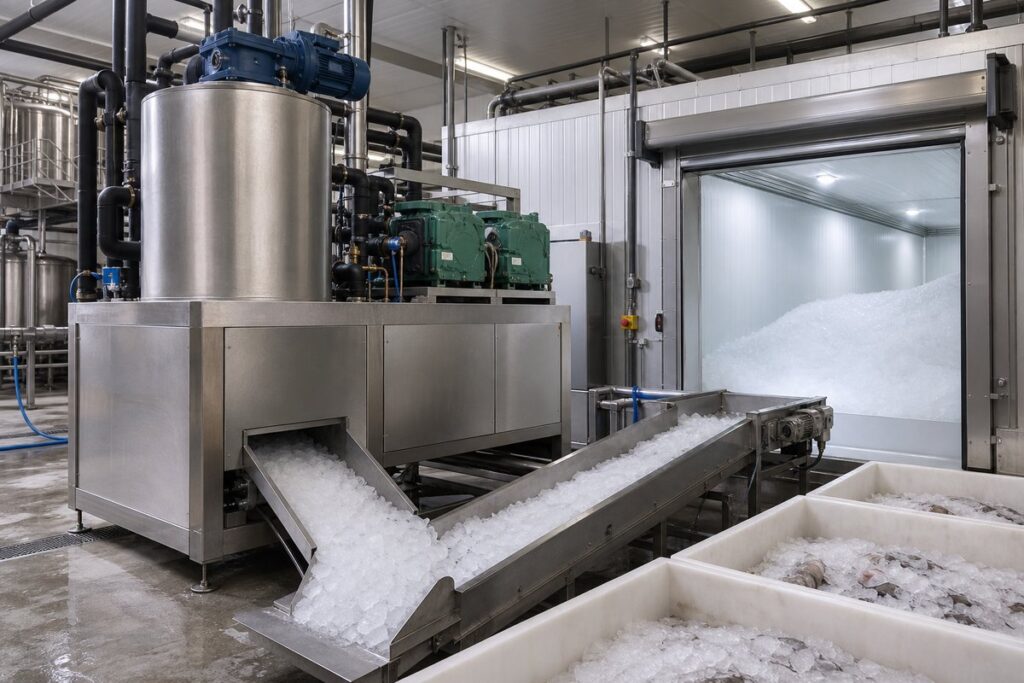
Select an industrial flake ice machine by confirming the ice duty, production and peak-demand profile, site conditions, and the full path from ice discharge to use. A daily capacity label is not enough when storage, transfer, cooling, power, or installation limits can prevent the system from meeting the actual process schedule.
Start with the process that will receive the ice. The final selection should state what the ice must do, how much must be available at the busiest period, what conditions the machine will operate under, and which party is responsible for every interface. That turns a model comparison into a workable project specification.
What Should Buyers Define Before Machine Selection?
Buyers should define the ice duty before comparing models. Confirm that loose flake ice fits the process, then record the application, whether ice contacts a product, the required daily amount, the peak withdrawal period, operating hours, storage time, and the point where the ice enters the process.
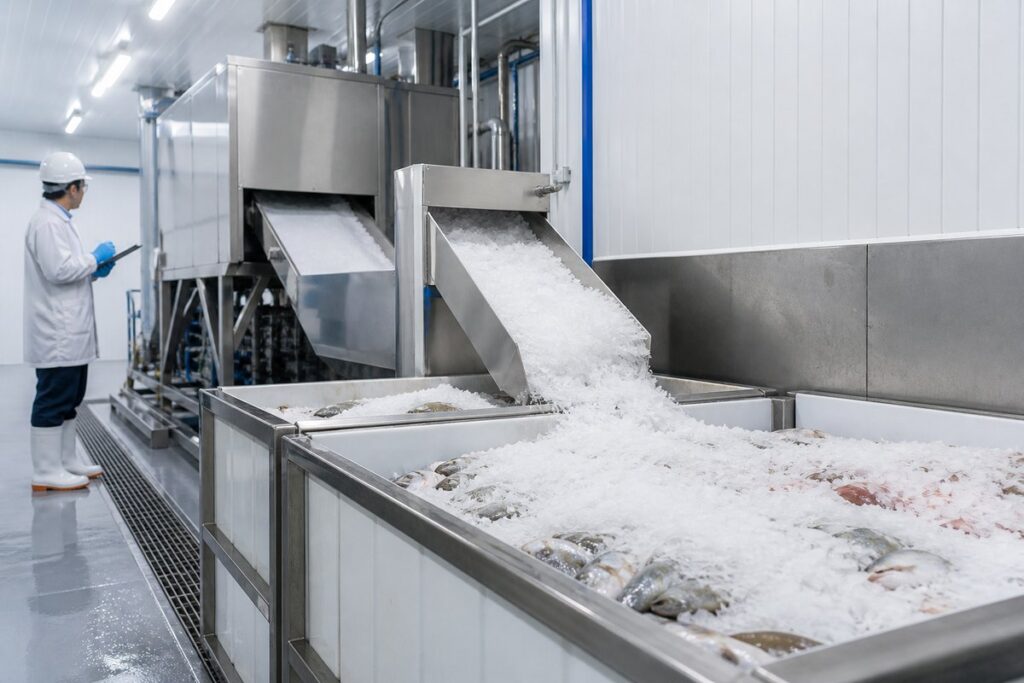
Create one design-basis record that states:
- the application, product-contact point, and required ice condition;
- daily demand, the highest planned demand, and the peak withdrawal period;
- operating hours, storage time, and the point where the ice enters the process;
- one unit of measure, including whether a ton means a metric ton or a US short ton; and
- seasonal changes shown in operating data and any known storage or handling loss.
After the design basis is clear, use the industrial flake ice machines to identify configurations that match the required duty. A model should remain a candidate until the supplier confirms capacity, cooling method, power supply, and site fit in writing.
How Should Buyers Size the Machine?
Buyers should size production, stored inventory, and ice transfer separately. The machine must make enough usable ice during the actual production window, while storage and handling must cover the highest withdrawal before inventory can recover.
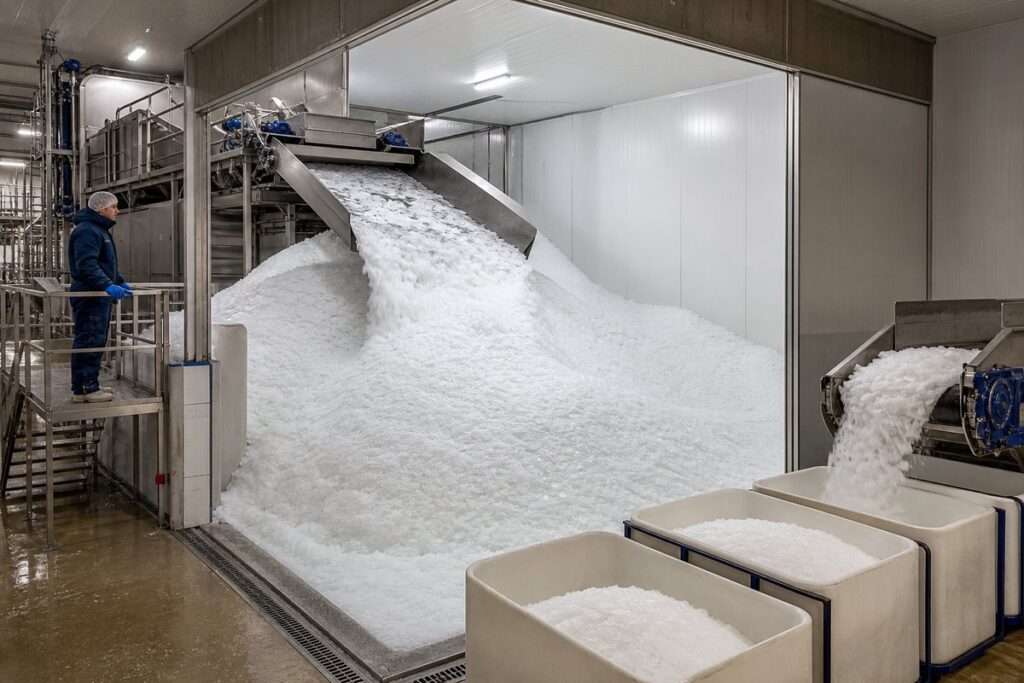
Calculating Daily Demand
Calculate daily demand from the ice that reaches the point of use, not from a rough machine size. Add the planned quantity for each process line, shift, loading period, or delivery run, then include storage and handling loss when site records or a defined process support it.
required daily production = daily usable ice demand + supported storage and handling loss
If the machine will not run for all 24 hours, convert that total into the required average rate during the available production hours. Cleaning, planned maintenance, shift limits, and known shutdowns reduce that window.
Sizing for Peak Demand
Size storage from the largest amount of ice that must leave the system within a defined period. A larger storage room can bridge a short demand spike, but it cannot correct a production shortfall that repeats every operating cycle. Check these three values together:
- peak withdrawal rate: ice required during the peak ÷ peak duration, checked against every storage outlet, conveyor, chute, hopper, and process inlet;
- required inventory before the peak: expected withdrawal minus ice the machine can produce and transfer during the same period, plus supported loss, with a minimum result of zero; and
- recovery time: whether production and transfer can rebuild inventory before the next peak.
Checking Rated Capacity
Compare rated capacity after the supplier states the conditions behind it. The quotation should identify the capacity period, ambient temperature, ice-making water temperature, condenser configuration, electrical supply, and conditions that could limit the stated output. Do not treat a 24-hour nameplate figure as site output unless the supplier has applied the correct operating conditions; warm inlet water, hot condenser air, low condenser-water flow, fouling, or unstable power may change available production.
| Planning input | What the supplier should state | Selection decision |
|---|---|---|
| Daily usable ice | Output at stated rating conditions | Whether production can cover the operating day |
| Peak withdrawal rate | Storage discharge and transfer rate | Whether ice can reach the process during the peak |
| Available production hours | Net production time after planned interruptions | Required average output per operating hour |
| Recovery window | Time between withdrawal periods | Whether inventory can recover before the next peak |
| Site design conditions | Expected output or correction data at the site | Whether the proposed capacity is suitable for the location |
How Should Site Conditions Guide Machine Configuration?
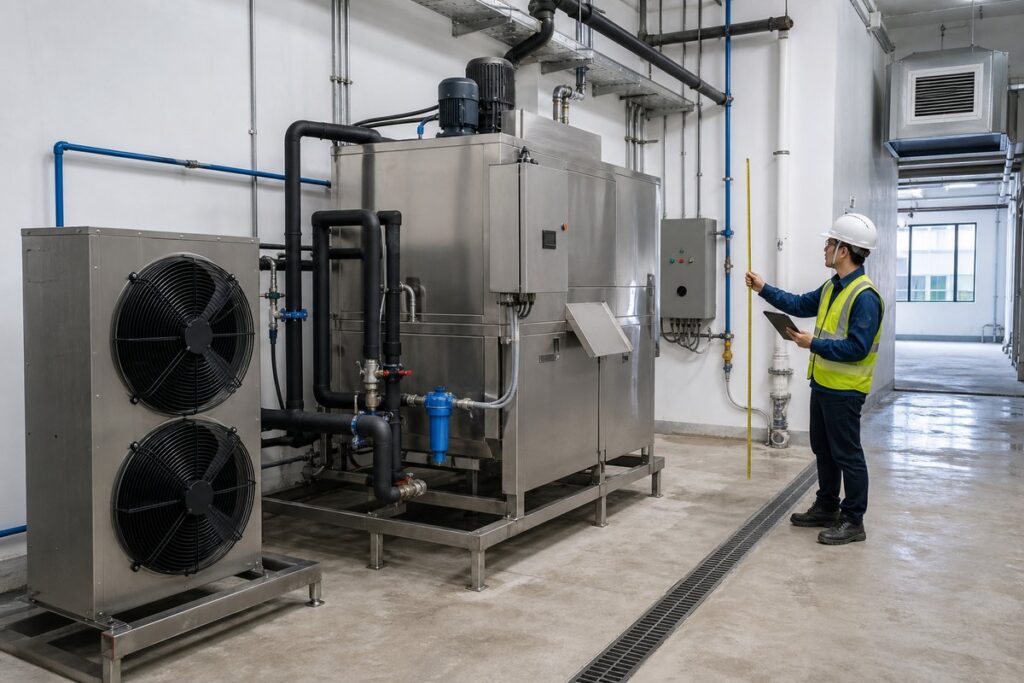
Site conditions should determine the condenser arrangement, utility connections, and physical layout before the buyer releases the purchase order. A suitable flake ice machine can still underperform or become difficult to service if the project team assumed rather than verified heat rejection, water, drainage, access, or electrical capacity.
Selecting a Condenser
Select the condenser from the site heat-rejection conditions, not from the initial equipment price. The air-cooled vs. water-cooled comparison explains the utility and maintenance differences in more detail. Confirm the exact condenser configuration for the selected model because availability can change with capacity, refrigerant, voltage, and project requirements.
| Condenser option | Site condition to verify |
|---|---|
| Air-cooled | Clean intake air, a clear hot-air discharge path, and enough ventilation to keep rejected heat from returning to the condenser |
| Water-cooled | A separate condenser-water supply or approved recirculating loop with known temperature, flow, pressure, water quality, and discharge or return arrangements |
Checking Utilities
Check the available voltage, phase, frequency, service capacity, circuit protection, grounding, and local electrical requirements against the proposed equipment schedule. The site must also identify the source, temperature, pressure, and available flow for ice-making water and, where applicable, condenser water.
Keep ice-making water, condenser water, cleaning water, and drainage requirements separate on the utility schedule. The layout should show drainage for normal operation, cleaning, meltwater, and overflow, while the responsible site designer confirms pipe sizing, slope, backflow protection, and local discharge rules.
Reviewing Installation Space
Review a dimensioned layout before ordering. Equipment that fits within a room footprint may still be impossible to install or maintain without first resolving access and service constraints. Confirm that it shows:
- the machine, condenser, storage, transfer equipment, electrical panel, water connections, drains, pipe routes, ventilation paths, service clearances, and the route from unloading to final placement; and
- doors, corridors, turning points, lifts, cranes, roof access, floor loading, foundations, and the space needed to remove serviceable components.
How Should the System Handle Flake Ice?
The system should store and move flake ice at the rate the process needs, with a defined path for meltwater, cleaning, and recovery from a downstream stop. The ice machine, storage volume, discharge equipment, and process inlet must use the same peak-demand basis.
Ice Storage Capacity
Set usable storage capacity from the peak inventory requirement, recovery window, ice bulk behavior, loading method, access needs, and planned stock rotation. Gross room volume is not the same as usable ice mass because discharge equipment, aisles, ice depth, and operating access reduce the space available for ice.
The storage specification should state the temperature-control method, insulation scope, how ice enters the room, how operators retrieve older ice, where meltwater drains, and how operators inspect and clean the space. A storage target without a retrieval method does not show whether the process can use the stored ice when it needs it.
Ice Transfer Rate
Set a required transfer rate for each handoff from the machine to storage and from storage to the process line. The slowest verified handoff sets the practical system rate, even when the ice machine has adequate daily capacity.
An automatic flake ice room is suitable when a continuous or high-volume process needs scheduled discharge into a conveyor, weighing system, batching point, or similar downstream equipment. The selection still needs the required discharge rate, level-control sequence, cleaning access, maintenance plan, and a response plan for a conveyor or discharge fault.
What Should the RFQ State?
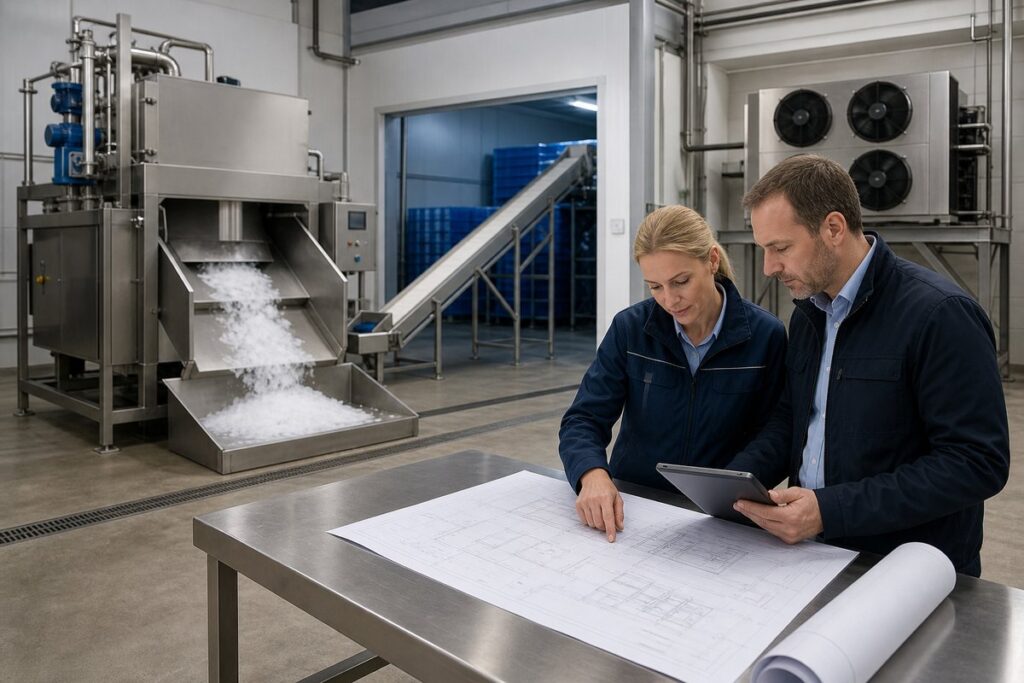
An RFQ should give every supplier the same demand, site, and scope information so that quoted capacity and price refer to the same project. Ask each supplier to identify the rated conditions, expected site output, equipment supplied, exclusions, utility requirements, drawings, acceptance test, and delivery boundary.
Demand Data
State demand data separately for normal operation, the busiest planned day, seasonal maximums, and any contractual demand. Use the same demand basis in every RFQ. When asking Mikeicemachine for a project quotation, comparable inputs make it easier to see whether a difference in price comes from capacity, equipment scope, or an unstated site assumption. Include:
- ice type, end use, daily usable ice demand, production hours, peak withdrawal quantity and duration, recovery window, storage target, and any supported future expansion;
- the ice contact point and applicable water, sanitation, and local compliance requirements for seafood or other product-contact use; and
- feedwater conditions, salt exposure, vessel motion where relevant, maintenance access, and available power and cooling arrangements for marine use.
Project Scope
State whether the proposal includes the ice machine, condenser, pumps, storage, conveyors, controls, electrical panel, water treatment, insulation, packing or process interface, export packing, freight, installation, commissioning, training, and spare parts. Assign each connection, civil work item, refrigerant activity, and local permit responsibility to a named party.
Use the same line-by-line basis described in the flake ice machine price guide when comparing offers. A lower price can reflect missing equipment or a narrower delivery boundary rather than a less expensive equivalent system.
Layout Information
Provide the installation city, indoor or outdoor location, floor plan, ceiling height, equipment-room temperatures, available footprint, delivery route, ventilation route, drainage points, utility connection locations, and required ice destination. Include nearby equipment that adds heat, blocks airflow, restricts access, or competes for electrical or water capacity.
Request a general arrangement drawing, utility schedule, electrical load list, connection diagram, and clear list of buyer-supplied work before production. Layout changes made after shipment can alter cost, installation time, and performance risk.
Frequently Asked Questions
Can an Industrial Flake Ice Machine Use Seawater?
Yes, when the project uses a seawater flake ice machine designed for the stated feedwater and marine conditions. Do not connect a freshwater machine to seawater unless its documented design approves that use. Confirm the water source, salinity, temperature, components exposed to seawater, cooling arrangement, corrosion-control requirements, cleaning method, and warranty limits in the project documents.
When Is Automatic Ice Discharge Suitable?
Automatic ice discharge is suitable when the process needs controlled, scheduled ice delivery at a known rate and the site can maintain the storage and conveying equipment. It often fits continuous or high-volume lines, but the project should still verify the discharge rate, level controls, cleaning access, manual intervention procedure, and what happens if a downstream line stops.
Can One Flake Ice Storage System Feed Multiple Process Lines?
Yes, one flake ice storage system can feed multiple process lines when the stored inventory, discharge equipment, conveyor branches, and controls can meet the combined peak demand without starving a priority line. The design should state each line’s demand profile, simultaneous-use case, delivery sequence, transfer capacity, and the operating rule when one line pauses or requests more ice.
What Should a Factory Test Verify Before Shipment?
A factory test should verify the final machine configuration and its measured performance under an agreed written protocol, not merely show ice appearing in a video. The protocol should identify the model and serial number, test duration, ambient and water conditions, condenser conditions, measured output, electrical readings, controls, alarms, safety devices, and the records supplied after the test. The flake ice machine manufacturer scorecard provides a fuller checklist for reviewing factory-test evidence.
Can a Storage Room Be Customized for the Workflow?
Yes, project teams can configure a storage room around the required ice capacity, loading route, discharge method, transfer rate, power supply, dimensions, and process interface. The final configuration should also show refrigeration or insulation scope, floor and drainage details, cleaning and maintenance access, controls, and the party responsible for installation and commissioning.