
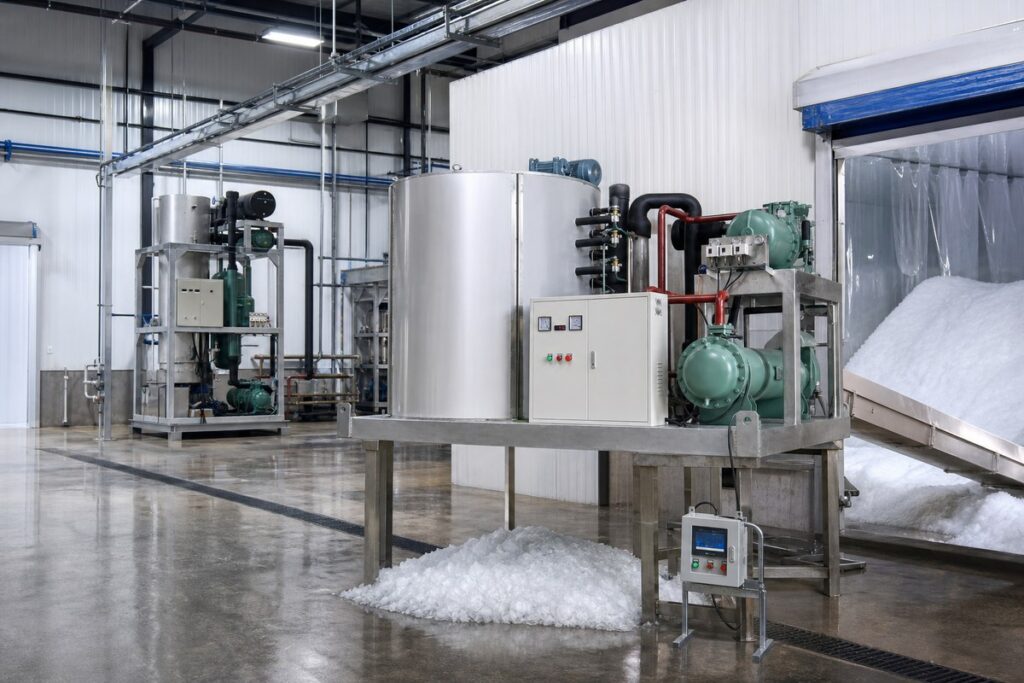
Size an industrial ice machine around usable daily ice, the highest withdrawal period, and the time available to rebuild storage. A nameplate daily rating is only one input. The proposed system must also produce enough ice under the stated site conditions and release it at the required peak rate.
What Is Your Ice Demand?
Start with a demand profile that shows what ice is needed, when it leaves the system, and how quickly the plant must recover. A daily total without this timing data can hide a shortage during loading, processing, or bagging.
Ice Type and End Use
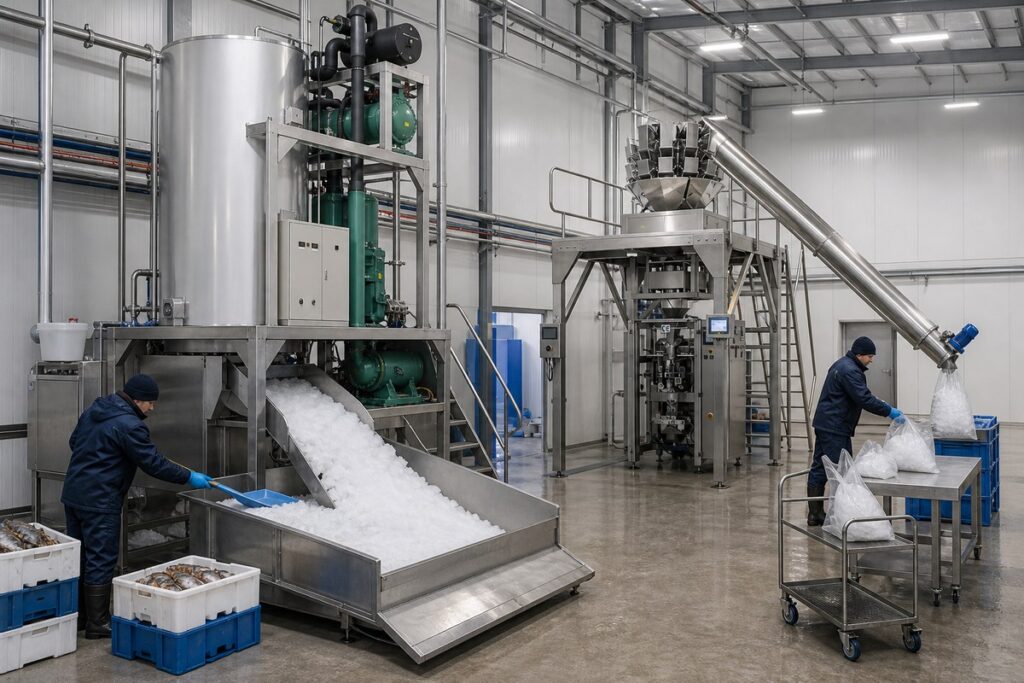
Select the ice type around the job it must perform. Product cooling, packaged ice sales, bulk delivery, and process cooling can place different demands on storage, handling, and packing. The comparison in tube ice vs. flake ice helps separate ice-form selection from the later capacity calculation.
When the project includes production, storage, and packing, the related ice plant accessories need the same demand basis as the ice machine. A storage or packing bottleneck can limit usable output even when the machine’s rated daily capacity is adequate.
Daily Demand by Shift
Build the daily total from each shift, process line, packing run, or delivery route. Record normal demand and scheduled high-demand periods separately. A monthly average is not a safe substitute for the largest planned operating day.
Use one unit throughout the calculation. Convert bags, kilograms, metric tons, and short tons before adding them together.
Peak Withdrawal Rate
Measure the largest quantity of ice that must leave storage within a defined time. This rate determines whether the storage discharge, conveyor, crusher, chute, and packing inlet can keep the operation moving during its busiest period.
For example, an operation that needs 6 metric tons of ice over one hour has a 6 metric-ton-per-hour withdrawal requirement. The machine may make enough ice over a full day, yet the system can still fall behind if the handling path cannot deliver that rate.
Available Production Hours
Use the hours the site can actually produce ice. Deduct planned cleaning, maintenance, shift limits, scheduled shutdowns, and other known interruptions. Do not assume that every project has 24 production hours available.
The capacity plan must make the required daily quantity within this production window and rebuild the inventory needed for the next peak.
How Do You Calculate Required Industrial Ice Machine Capacity?
Convert the daily requirement into an hourly production rate, then compare that requirement with the proposed machine under stated rating conditions. This keeps the planning calculation separate from a supplier’s rated capacity.
Actual Operating Conditions
Ask the supplier to state the conditions behind the rated output. The quote should identify the rating period, cooling arrangement, water temperature where relevant, power supply, and any ambient condition that affects the published capacity.
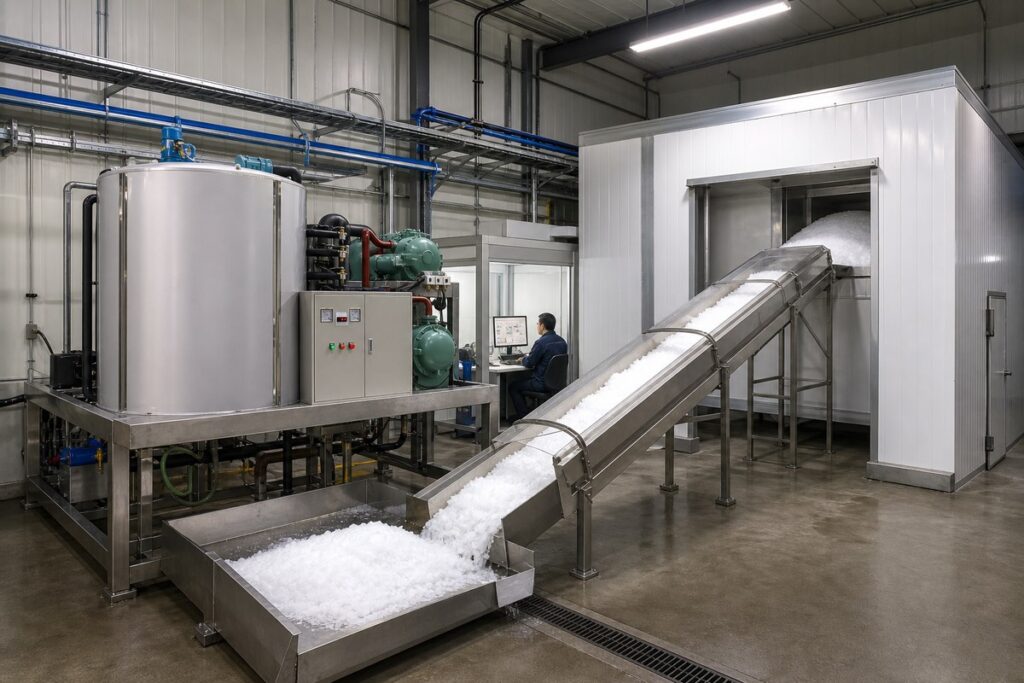
Do not treat a rated daily figure as the expected site output unless the supplier confirms how the rating applies to the project conditions.
Converting Daily Demand Into Production Output
Calculate the average production rate from the daily usable demand and the available production hours.
Required average output = daily usable ice demand ÷ available production hours
Equivalent 24-hour capacity = required average output × 24
The 24-hour figure is a common comparison basis, not the final selection. For a tube ice project, the decision path in choosing tube ice machine capacity shows why operating hours and application details belong beside the daily tonnage.
| Planning input | What to record | Capacity decision it supports |
|---|---|---|
| Daily usable ice | Total ice required by all shifts | Sets the production target |
| Available production hours | Hours available after planned interruptions | Converts daily demand into an hourly requirement |
| Peak withdrawal rate | Largest quantity issued in a defined period | Sizes storage discharge and conveying |
| Recovery window | Time between high-demand periods | Tests whether inventory can rebuild |
Allowing for Losses and Downtime
Add only allowances that the site can define. These may include planned cleaning time, scheduled maintenance, documented handling loss, or expected storage loss under the intended operating method.
List every allowance and show where it applies. An allowance for usable storage does not automatically increase machine output, and a downtime allowance does not automatically change the peak discharge requirement.
Comparing Rated Capacity With Site Capacity
Compare the proposal on a like-for-like basis. The capacity review should show the rated output, rating conditions, expected operating hours, stated allowances, and calculated usable ice at the point of use.
If the site calculation and the quoted capacity use different conditions or time bases, ask for a revised comparison before selecting equipment.
How Much Ice Storage Capacity Is Needed for Peak Demand?
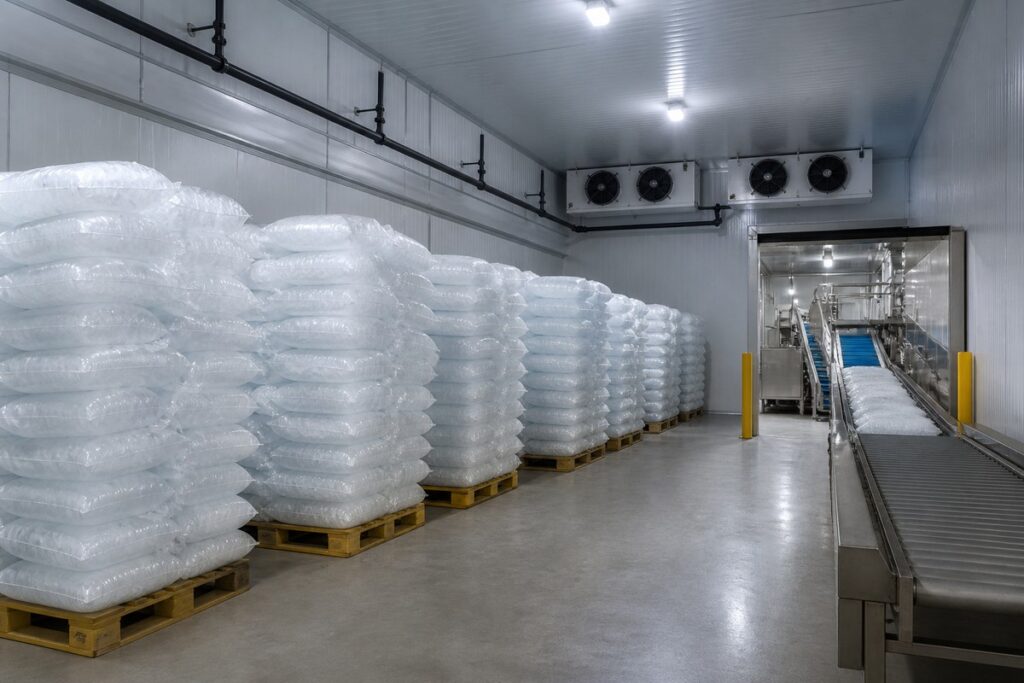
Storage capacity must cover the usable inventory required before the largest withdrawal period. Gross room volume does not answer that question because ice movement, discharge equipment, access, and operating space affect what can actually be released.
Calculating Usable Peak Inventory
Calculate the inventory that must be present before the peak begins.
Required usable inventory = peak withdrawal requirement − ice produced into storage during the same peak period
If a peak needs 10 metric tons and the system can add 3 metric tons during that period, the plan needs at least 7 metric tons of usable inventory before the peak. Any project allowance belongs on a separate line so the buyer can review its basis.
Checking Recovery Before the Next Peak
After the peak, calculate the remaining inventory, the net ice that can be added during the recovery window, and the inventory required for the next peak. The plan works only when the recovery output closes the inventory gap within the available time.
If it does not, change the production hours, site capacity, storage target, or demand schedule. Increasing room size alone does not solve a recovery shortfall.
Matching Discharge Rate to Peak Flow
Set the required discharge rate before choosing the storage discharge method. The lowest verified rate across the storage outlet, conveyor, chute, crusher, hopper, or packing inlet becomes the practical system flow rate.
Specify the required rate in metric tons per hour or kilograms per minute. That allows each equipment supplier to check the same peak-flow requirement.
Which Equipment Should Match the Capacity Plan?
The ice machine, storage room, handling equipment, and packing interface must work as one capacity plan. Each part needs a stated output or flow rate that matches the next part of the system.
Storage Room Configuration
Define the storage room from usable peak inventory, recovery time, ice type, loading method, discharge method, and access needs. The proposal should distinguish gross room capacity from usable ice inventory and explain how ice is loaded and removed.
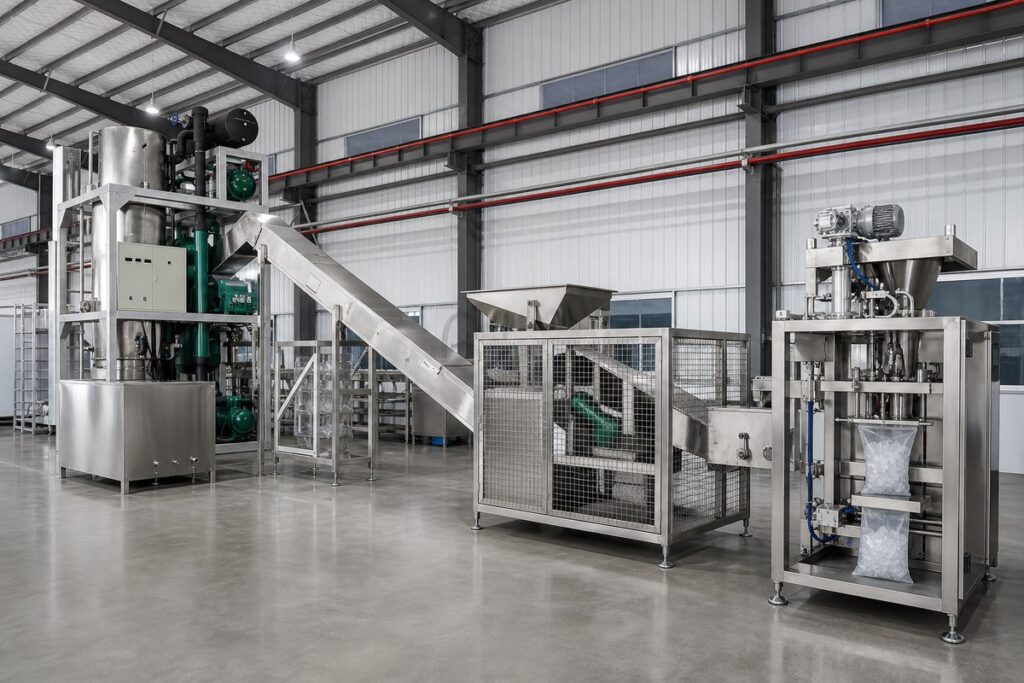
A complete ice plant solution is easier to review when the layout shows the transfer path from production to storage and then to the final process. The buyer can then test each handoff against the required peak rate.
Ice Handling and Conveying
Set a required flow rate for every transfer point. Include the route from the ice machine to storage, storage to processing or packing, and packing to dispatch when those steps are in scope.
Check where ice changes direction, waits in a hopper, passes through a crusher, or enters a bagging machine. Each transfer point needs enough capacity for the peak flow, not just the average daily total.
Packing and Delivery Interface
Define the bag size, required bags per hour, batch schedule, and dispatch method before selecting the packing interface. The packing rate must match the storage discharge rate during the periods when packed ice is needed.
The flake ice machine price guide explains why a capacity quote needs a defined configuration instead of a daily tonnage alone. The same rule applies when storage, conveying, and packing are part of the project scope.
What Should Your Quote Request Include?
A complete quote request gives the supplier enough information to check site capacity, not just name a machine size. It also makes exclusions and rating assumptions visible before the buyer compares proposals.
Demand and Peak Data
Provide the daily ice total, demand by shift, peak withdrawal quantity, peak duration, recovery window, ice type, end use, and packing or delivery schedule. Label whether each figure represents normal production, a seasonal maximum, a contract commitment, or a future expansion.
Site and Utility Data
Provide the installation location, available footprint, operating hours, water source, water temperature where known, power supply, cooling arrangement, drainage, and access constraints. A capacity request to Mikeicemachine can then be reviewed against the project’s stated site data rather than against tonnage alone.
Rating Conditions and Scope
Ask the proposal to state the capacity rating conditions and the scope of supply. The document should identify the ice machine, storage, handling equipment, packing interface, controls, utilities, installation boundaries, and equipment supplied by others.
Ask for a demand and peak-flow calculation with the equipment list. This allows the buyer to compare what the system is expected to produce, store, move, and pack under the stated assumptions.
FAQs
How Should Large Quantities of Industrial Ice Be Stored?
Large quantities of industrial ice should be stored as usable inventory for the planned peak withdrawal period, not simply as a room-volume target. The design needs a defined loading route, discharge method, access arrangement, and recovery plan so the stored ice can reach the process when required.
How Do Door Cycles Affect Ice Storage Room Design?
Door cycles affect the operating layout because they can interrupt ice movement during loading, access, and dispatch. State the opening frequency, typical open time, traffic route, and whether those cycles overlap with a peak withdrawal period so the storage plan can account for them.
Can a Storage Room Use Manual or Automatic Ice Discharge?
A storage room can use manual or automatic discharge when the chosen method meets the required flow rate, operating sequence, access needs, and labor plan. The proposal should state the discharge capacity, cleaning access, controls, and downstream equipment needed to move ice to the next process.
Can an Ice Storage Room Feed a Packing Line Directly?
An ice storage room can feed a packing line directly when the discharge and conveying rates match the packing line’s required intake. The capacity plan also needs to show how ice flow is controlled when packing stops and whether a simultaneous bulk withdrawal can still be covered.
What Documents Help Buyers Review a Capacity Proposal?
Buyers should request the demand profile, peak-flow calculation, stated rating conditions, site-capacity comparison, usable storage calculation, equipment data sheets, utility requirements, layout drawing, scope of supply, and exclusions. Together, these documents show whether the proposed system can meet the site’s required production and peak-demand schedule.