Industrial ice machine buyer guide cover](https://www.mikeicemachine.com/wp-content/uploads/2026/08/industrial-ice-machine-buyer-guide-cover-1024x683.jpg)
Choosing an industrial ice machine starts with three decisions: the ice type required by the process, the production capacity needed within the available operating hours, and the equipment scope from ice making through storage and dispatch. Nameplate output alone cannot show whether a system will cover peak withdrawal, recover stored inventory, or operate under actual site conditions.
Before comparing configurations, define the application, daily demand, largest short-term withdrawal, production window, storage target, water conditions, power supply, heat-rejection method, packing requirements, and installation responsibilities. These inputs provide a consistent basis for comparing capacity, scope, and project cost.
Which Ice Production System Fits the Process?
The finished ice must suit the job it performs. Contact cooling, marine catch handling, packaged edible ice, and process dosing require different ice properties and handling equipment.
| Process need | Likely starting point | Main selection check |
|---|---|---|
| Loose ice that spreads over an uneven load | Flake ice machine | Contact method, transfer route, storage, and meltwater |
| Ice made from seawater on a vessel or coastal site | Seawater flake ice machine | Feedwater conditions, corrosion exposure, motion, and service access |
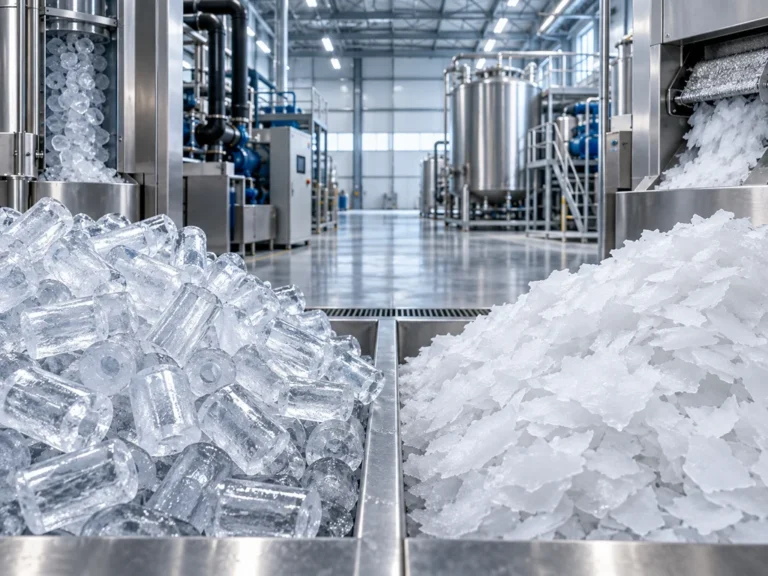
| Separate pieces for bagging or distribution | Tube ice machine | Water treatment, tube dimensions, storage, and packing rate |
Use the table as a first filter. Product-contact rules, site utilities, climate, and the downstream process still determine the final configuration.
Flake Ice Machines
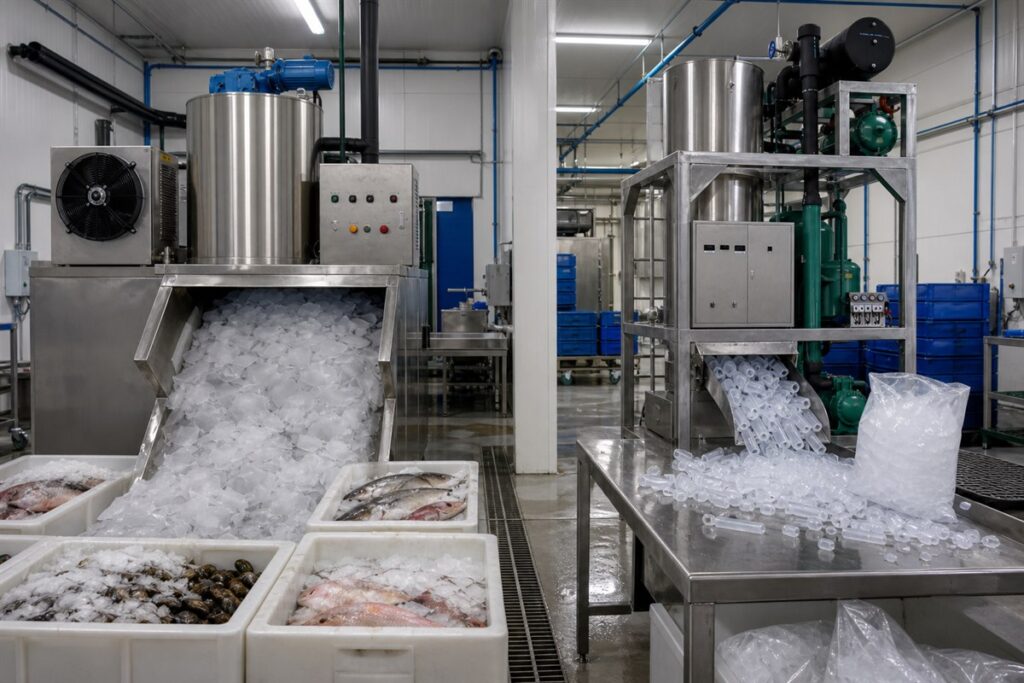
Choose a flake ice machine when thin, loose ice must cover an irregular load, mix into a product or batch, or move through a bulk handling system. These duties are common in seafood cooling, food processing, concrete batching, and fresh-product displays. Broad surface contact alone does not settle the choice because the contact route also changes water treatment, sanitation, storage, and cleaning requirements.
We map the full ice path before selecting a model. We record where ice leaves the evaporator, how it enters storage, how your process retrieves it, and where meltwater drains. Our flake ice machine range supports the shortlist, while verified output and site data determine the final model.
Seawater Flake Ice Machines
Choose a seawater flake ice machine when a fishing vessel, port, or coastal operation needs to make ice from seawater. We do not assign that duty to a freshwater unit unless its design is approved for the stated feedwater. To review the project, we need the salinity, feedwater temperature, installation location, salt exposure, vessel motion, power source, room temperature, footprint, ventilation, and maintenance access.
A circuit designed to freeze seawater does not prove that its condenser can use seawater. We treat condenser cooling as a separate design decision. Ask us to identify the components exposed to seawater and state the water limits, treatment requirements, condenser arrangement, wetted materials, cleaning method, discharge plan, and warranty limits in the project documents.
Tube Ice Machines
Choose a tube ice machine when the business needs separate cylindrical pieces for packing, beverage supply, or ice distribution. For edible ice, review the full route because suitable source water does not prove that storage and packing are hygienic. Check each water, ice, and food-contact surface, along with cleaning access and local compliance duties.
Tube diameter, center opening, cut length, and acceptable breakage affect both the product and the packing equipment. In our proposal, we identify the available dimensions and explain how the cutter and transfer system handle them. If the ice form is still open, compare tube ice and flake ice by the required handling task rather than appearance.
How Should Buyers Size Production Capacity?
When we size an industrial ice machine, we calculate production and storage separately. Production must cover usable daily demand within the actual operating window. Storage must cover peak withdrawal while the machine rebuilds inventory.
Daily Demand and Peak Withdrawal
Send us operating records when they exist. We need the average daily use, busiest expected day, largest short-term withdrawal, internal process demand, customer dispatch pattern, seasonal changes, and documented handling losses. Before we compare configurations, we confirm whether “ton” means a metric ton or a US short ton and whether “per day” refers to a 24-hour rating under stated test conditions.
Peak withdrawal determines how much ice must be ready before use begins. A packing operation that ships most of its volume in two dispatch periods needs enough stored ice and transfer capacity for both peaks. Daily production may look adequate even when storage or discharge is too slow.
Operating Hours and Production Window
We base selection on the hours in which the machine can produce ice. We deduct cleaning, inspection, maintenance, shift limits, utility interruptions, and any process-specific harvest or defrost time rather than assuming all 24 hours are available. For a tube ice project, our method to size tube ice machine capacity pairs this production window with a separate storage and packing calculation.
We state the rating conditions behind the output figure in our proposal. Ambient temperature, inlet-water temperature, condenser conditions, fouling, and voltage stability can change production. We use correction data or a project calculation for your design conditions instead of adding an arbitrary safety percentage.
Storage Target and Production Recovery
We set the storage target from the largest planned withdrawal and the time available to rebuild inventory. We add only the operating reserve that the project can justify. Storage can bridge a short peak, but it cannot correct a repeated production shortfall.
Use this sequence:
- Set the usable ice required before the peak begins.
- Add expected storage and handling loss using project evidence.
- Subtract any production that can continue during the withdrawal period.
- Confirm the machine can restore the target inventory before the next peak.
- Check whether the room, discharge equipment, and packing line can move ice at the required rate.
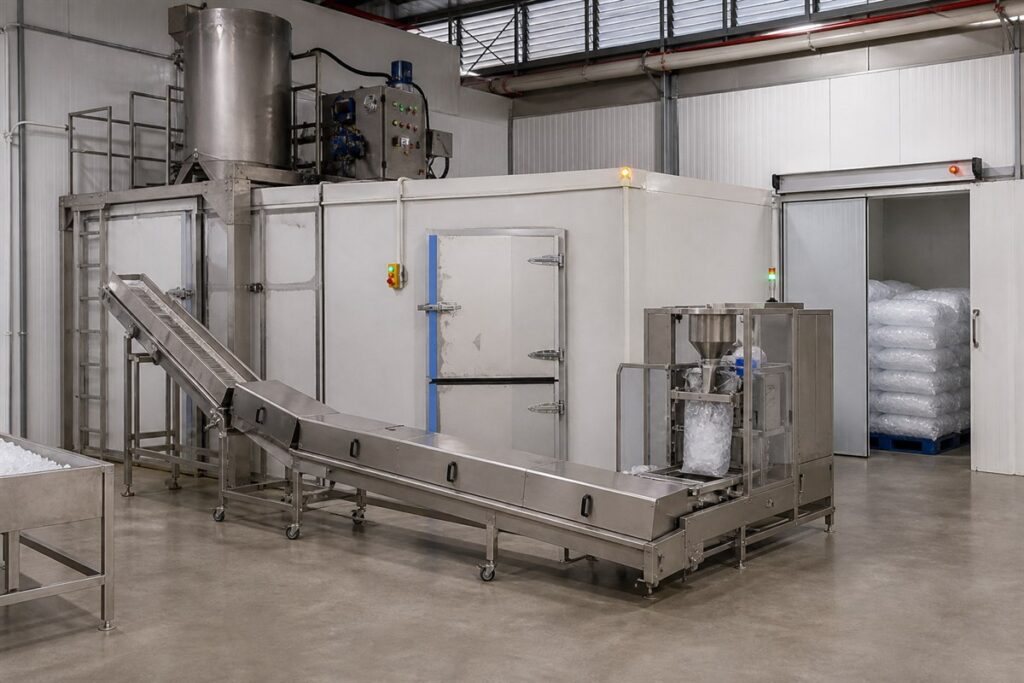
Do not treat the nominal room volume as usable ice capacity. Floor geometry, ice depth, access aisles, discharge equipment, safe loading limits, and stock rotation reduce usable storage.
Which Site Conditions Must Buyers Validate Before Finalizing Capacity?
Before we finalize capacity, we validate water, heat rejection, power, space, and access. Site conditions can reduce output or require a different condenser, layout, or utility plan.
Industrial ice machine site survey](https://www.mikeicemachine.com/wp-content/uploads/2026/08/industrial-ice-machine-site-conditions-1024x683.jpg)
Water Supply and Drainage
Report ice-making water and condenser water separately when the system uses both. For each supply, send us:
- Water source and intended use
- Available flow and pressure range
- Minimum and maximum water temperature
- Seasonal changes that affect supply
- A current laboratory analysis when scaling, corrosion, sanitation, or edible-ice quality affects the design
The water report should identify the laboratory, sample date, sample point, test methods, and measured values. We compare those results with the equipment requirements, while your water-treatment provider and local authority determine any additional treatment or compliance duties.
Plan drainage for normal discharge, cleaning, meltwater, overflow, and equipment-room housekeeping. Confirm drain locations, pipe sizes, slope, discharge temperature, backflow protection, and local disposal requirements with the responsible site designer.
Heat Rejection and Ventilation
We match heat rejection to the site climate and room design. Air-cooled condensers need a path for intake air and hot exhaust air. Recirculating hot air can raise condensing conditions and reduce production, so we also need to see other heat-producing equipment on the room layout.
Water-cooled systems need confirmed flow, pressure, temperature, treatment, and an approved discharge or recirculation arrangement. Remote and evaporative condensers add piping, controls, structural support, and maintenance work. We record the conditions used for selection in our proposal, while your site design must address the total room heat load and applicable refrigerant safety requirements.
Power, Space, and Equipment Access
Send us the electrical supply, installed space, and delivery-route data together. We record the following in the project file:
- Voltage, phase, frequency, service capacity, grounding, and local electrical requirements
- Separate loads for the ice maker, condenser, pumps, conveyors, cold room, crusher, and packing line
- Connected load, running current, starting method, and protection requirements
- Service clearance, pipe and cable routes, ventilation space, drainage, and cleaning access
- Floor loading, foundation needs, and vibration requirements
We trace the delivery route from the unloading point to the final position. We check door, corridor, elevator, roof, crane, and turning limits because a machine that fits the room may still require planned disassembly or lifting work.
Which Supporting Equipment and Services Belong in the Project Scope?
When we define project scope, we include the components needed to store, move, size, pack, and dispatch the specified ice. An ice maker alone is not a working ice plant.
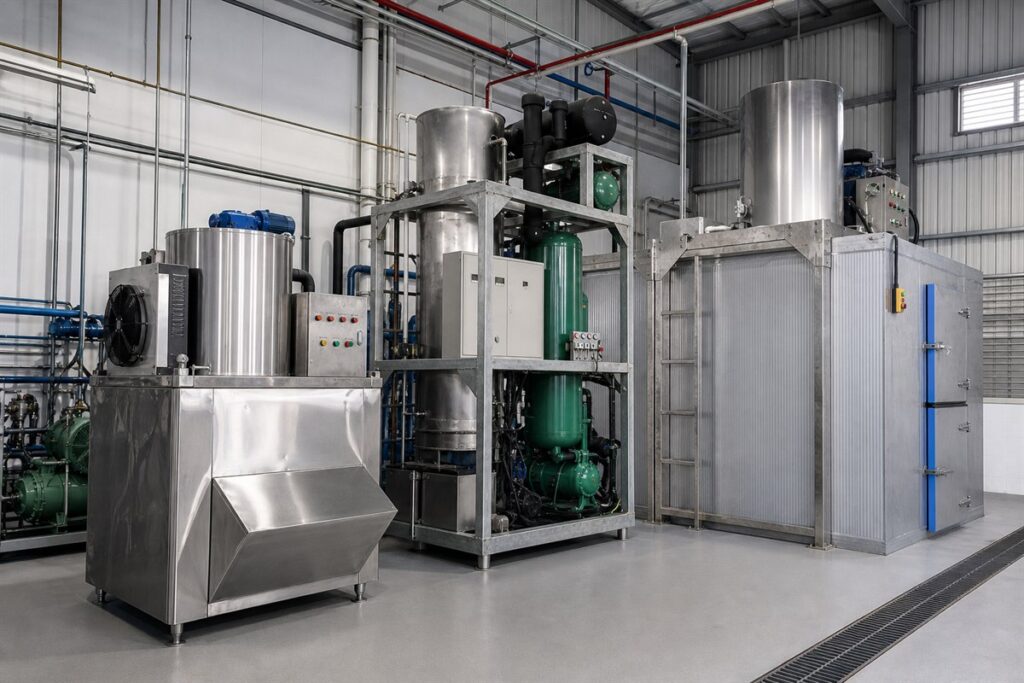
Our complete ice plant solution may combine the ice maker with storage, delivery, and packing equipment. We still itemize the scope because civil work, utilities, permits, installation, commissioning, training, and spare parts may belong to different parties.
Traditional and Automatic Flake Ice Rooms
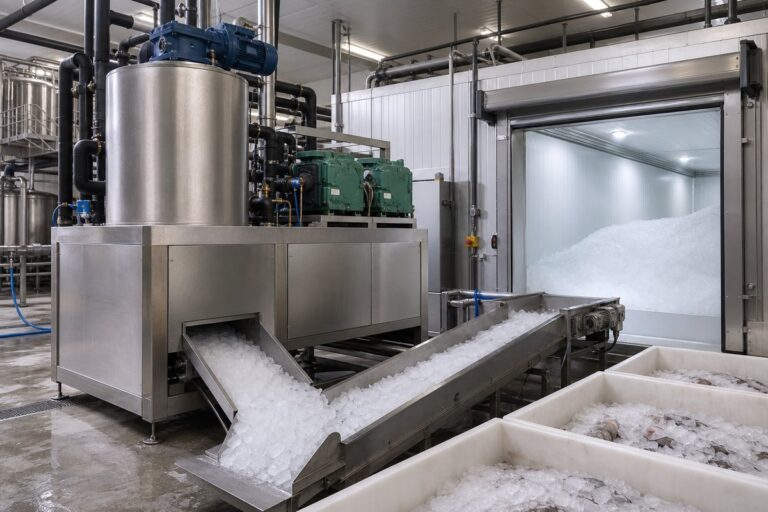
We compare traditional and automatic flake ice rooms by usable storage, retrieval rate, stock rotation, cleaning access, meltwater control, maintenance access, and response to a discharge fault. A traditional room fits projects that can meet the retrieval rate with planned labor and handling tools. An automatic room fits projects that need controlled discharge into a conveyor, dosing system, or other downstream process.
Automation can reduce manual handling, but it adds controls and mechanical equipment that need service support. In our scope, we identify who supplies the room panels, refrigeration unit, floor, doors, level sensing, discharge mechanism, controls, conveyors, and ice-machine connection. We also state whether the room is refrigerated or only insulated.
Tube Ice Storage and Packing
We match tube ice storage to the production schedule and packing line. The design states the usable capacity, room temperature target, retention time, loading method, discharge method, level control, sanitation plan, and stock rotation method.
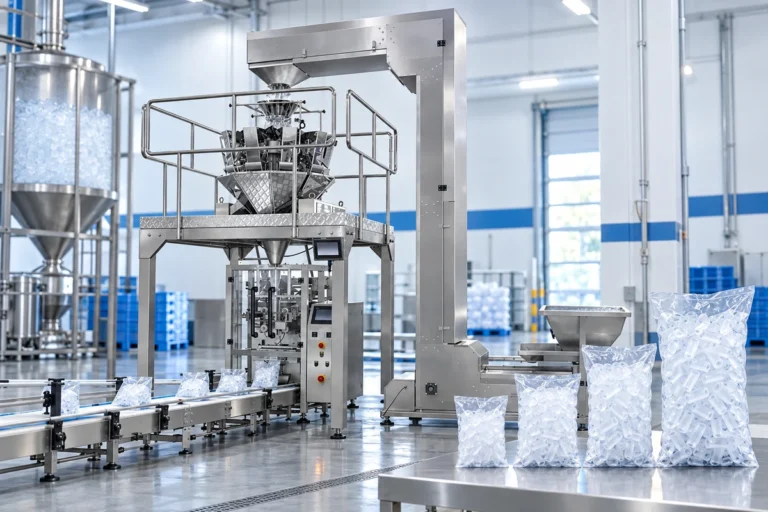
We match packing equipment to ice size, target bag weights, bags per hour, weighing tolerance, bag material, sealing method, date coding, inspection needs, and pallet or dispatch flow. The slowest transfer or packing step sets the practical line rate. Ask us to show how the controls respond when downstream storage or packing cannot accept more ice.
Tube Ice Crushing Requirements
We add a tube ice crusher only when your customers or downstream process require a smaller, irregular product. We first define the required output size, acceptable fines, feed rate, discharge rate, and whether crushing occurs before storage, before packing, or at the point of use.
We match the crusher and feed system to the tube dimensions and required flow rate. The scope includes guarding, emergency stops, cleaning access, foreign-material controls where applicable, and a safe method to clear jams. If crushed-ice size is an acceptance requirement, you can inspect a sample or witness the test.
Installation and Commissioning Responsibilities
Before the purchase order, we assign each installation task to Mikeicemachine, the buyer, or a local contractor. The responsibility schedule should cover:
- Unloading, lifting, foundations, and room construction
- Electrical work, water, drainage, and refrigeration piping
- Insulation, refrigerant charge, and control connections
- Startup, performance checks, operator training, and final records
We use the same scope basis explained in our guide to flake ice machine project quotes. A lower equipment price may exclude work included elsewhere, so compare equipment, services, buyer-supplied items, assumptions, and exclusions line by line.
When you plan a project with Mikeicemachine, we confirm whether support is remote or on site. Our proposal also lists the drawings, buyer preparations, and test records included at each stage. This written scope matters when travel, local licensing, or refrigeration work can change responsibilities.
Frequently Asked Questions
What Water Quality Information Should a Buyer Provide?
Send us the water source, intended use, flow, pressure, temperature range, and a current analysis from the actual supply point. State whether the supply makes edible ice, process ice, seawater ice, or serves the condenser. We use that information to identify the parameters and equipment limits that apply to the quoted water circuit.
When Does a Project Need a Dedicated Ice Storage Room?
We usually specify a dedicated room when production and use do not occur at the same rate. A room may also be needed when your operation builds inventory before dispatch or holds ice for packing. We size it by usable ice mass and retrieval rate, then define refrigeration, insulation, drainage, hygiene, stock rotation, and discharge equipment.
Can Buyers Review Drawings and Utility Requirements Before Ordering?
Yes. We can prepare a preliminary layout, equipment list, and utility schedule for project review before ordering. These documents show the proposed arrangement, major dimensions, connection points, loads, water needs, drainage, heat rejection, and buyer-supplied work. We mark preliminary drawings clearly because final documents depend on the approved configuration.
What Installation and Commissioning Support Should Be Confirmed Before Shipment?
We define who supervises installation, connects utilities, performs startup, tests safeguards, trains operators, and issues commissioning records. Our agreement states whether support is remote or on site, what site readiness it requires, and which travel or local labor costs remain with the buyer.
What Should Buyers Confirm Before a Factory Running Test?
Before we run a factory test, we agree with you on the scope and acceptance criteria. The test checklist records the machine identity, duration, ambient and inlet-water conditions, power supply, condenser conditions, measurement method, ice form, production measurement period, safety checks, and allowed deviations. We also confirm how you will witness the test and which records we will provide.