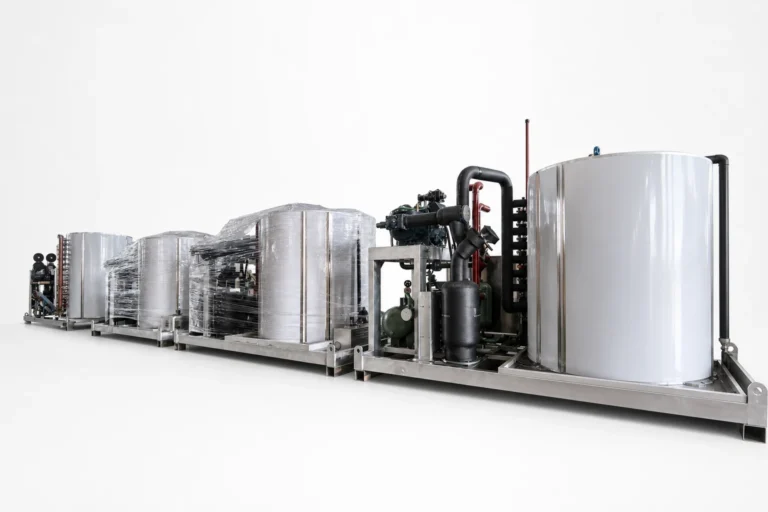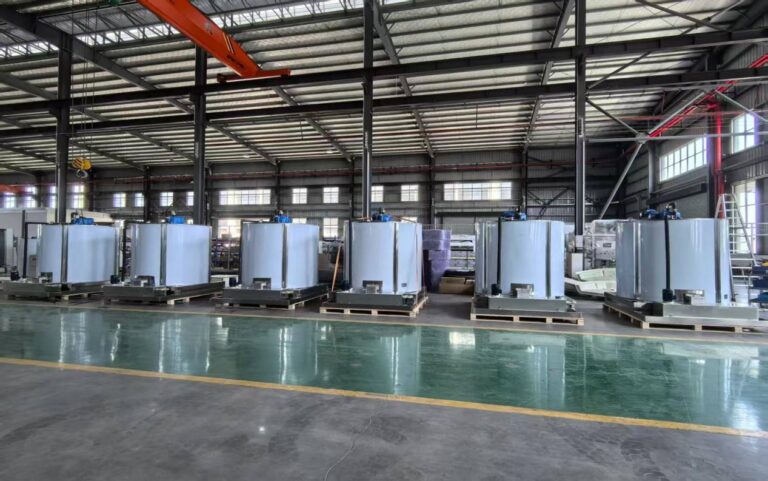
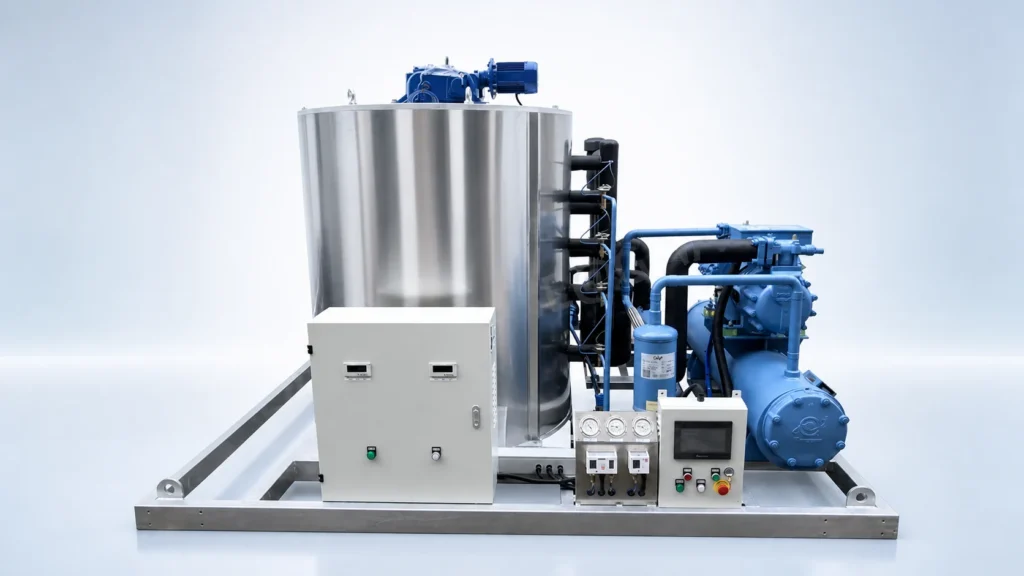
A practical planning framework for Senegal fishery ice projects covering catch volume, tropical heat load, water, power, storage, distribution and factory testing.
Important note: this is a planning guide
This page is a technical planning framework for a flake ice project in Senegal. It is not presented as a named customer case study, and it does not claim project performance without a signed design basis and operating records. The purpose is to show how a port, fish market, vessel operator or seafood processor can develop a defensible capacity and utility specification before requesting quotations.
Begin with the fish flow, not the machine size
Map the product from landing to sale or processing. Record the catch or receiving profile by hour, the temperature of the fish when it enters the chain, the time before icing, the storage duration, the transport distance and where melted ice is lost or replaced. Peak days matter more than monthly averages.
For each operating point, define:
- Maximum fish or seafood quantity per day.
- Peak landing quantity over the busiest two to four hours.
- Initial product temperature and target temperature.
- Time in insulated boxes, vessel holds, market bins or cold rooms.
- Ice used for initial chilling, layering, transport and display.
- Ice that must be sold or distributed to third parties.
Use an ice-balance calculation
The FAO notes that fish should be chilled rapidly toward 0°C and that actual ice demand depends on product temperature, ambient conditions, insulation and storage time. A 1:1 ice-to-fish ratio is commonly used as a tropical rule of thumb for vessel planning, but the correct value must be verified for the actual operation.
Build the daily balance as:
Daily ice demand = initial chilling ice + holding and transport ice + process or sales ice + handling losses – usable ice already in storage.
Do not convert the final number directly into machine nameplate capacity. The machine must also recover storage after a peak, operate within the available production window and deliver the required output at the real air and water temperatures.
Worked planning example
Consider an illustrative operation receiving 8 tons of fish on a peak day. If the preliminary operating assumption is 1 kg of ice per 1 kg of fish, the base requirement is 8 tons of ice. Adding a 10% allowance for handling and distribution gives 8.8 tons of usable ice. If the plant has only 20 productive hours available per day, the equivalent average rate is:
8.8 tons ÷ 20 hours × 24 hours = 10.56 tons per 24 hours.
This does not automatically mean that a nominal 10-ton or 15-ton model is correct. The supplier must state output at the design air and inlet-water temperatures, while the project designer must decide how much peak demand is covered by stored ice. Run at least low, normal and peak-season scenarios.
| Scenario | Fish handled | Preliminary ice ratio | Base ice demand |
|---|---|---|---|
| Small landing point | 3 t/day | To be validated; example 1:1 | 3 t/day before losses and other uses |
| Medium port or market | 8 t/day | To be validated; example 1:1 | 8 t/day before losses and other uses |
| Large collection operation | 20 t/day | To be validated; example 1:1 | 20 t/day before losses and other uses |
The table is a calculation starting point, not a purchase recommendation.
Choose freshwater or seawater ice deliberately
Land-based freshwater system
A freshwater flake ice plant is typically appropriate when potable or treated freshwater is available and ice is supplied to boxes, trucks, markets or processing areas. Water analysis should cover hardness, suspended solids, chloride and microbiological suitability for the intended food use.
On-vessel or marine seawater system
A seawater flake ice machine may be appropriate where ice is produced onboard and space, corrosion, motion, cooling-water routing and marine power are addressed in the design. Materials and electrical protection must match the seawater environment. A land machine should not be assumed suitable for marine installation merely because it can make flake ice.
Design for local utilities and site conditions
Power
Confirm measured voltage, frequency, phase, transformer capacity, generator operation and outage profile at the exact site. If a standby generator is required, size it for compressor starting method, pumps, fans, storage equipment and other simultaneous loads. Record acceptable voltage imbalance and define automatic restart behavior after an outage.
Water
Separate ice-making water from condenser water in the utility schedule. Test the source before selecting filtration, softening or other treatment. For edible or food-contact ice, the water and all downstream handling must meet the applicable local hygiene requirements.
Heat rejection and ventilation
Air-cooled condensers need clean airflow and enough clearance to prevent hot-air recirculation. Water-cooled systems need reliable flow, water quality and a plan for discharge or recirculation. The supplier should calculate the condenser duty for the site condition rather than copying a standard workshop arrangement.
Storage is part of capacity
Ice production is continuous; fish landings are not. Storage bridges that mismatch. The FAO reports a stowage rate of approximately 420-480 kg/m³ for flake ice, but real usable capacity also depends on room geometry, access, compaction, rake or discharge equipment and the amount of ice that cannot be recovered.
Specify:
- Hours of production to be buffered.
- Manual or automatic loading and discharge.
- First-in, first-out operating procedure.
- Insulation, floor drainage and cleanability.
- Backup plan if the ice machine or discharge system stops.
Plan the distribution system
At a busy landing point, the bottleneck may be weighing and delivery rather than refrigeration. Define how ice moves from the machine to storage, then to boxes, vessels or trucks. Screw conveyors, blowers, bins, weighing stations and bagging systems must be sized for peak hourly demand. Protect the ice from hands, contaminated floors, fuel, seawater spray and dirty containers.
Factory acceptance test for a Senegal project
Before shipment, agree on a test protocol that records the final serial number, ambient and water conditions, measured ice output, running power, safety devices, alarms, ice appearance, automatic controls and all included auxiliaries. If the factory cannot reproduce the hottest site condition, require an engineering performance statement that shows how site output was calculated.
Request a live remote witness or complete running video, final drawings, packing list, spare-parts list and commissioning checklist. The Mikeicemachine video center shows the type of visual evidence buyers can review before defining a project-specific FAT.
Information to send with the RFQ
- Installation city, exact site type and distance from the coast.
- Daily and peak-hour fish or seafood volume.
- Fishing-trip or storage duration and current icing practice.
- Freshwater or seawater source and available analysis.
- Measured electrical supply and generator details.
- Maximum ambient and inlet-water temperatures.
- Required storage hours and distribution method.
- Food-contact, marine or destination documentation requirements.
- Shipping destination, site access and lifting constraints.
- Preferred installation and commissioning support.
Compare the freshwater flake ice machine range, review the broader fishery and seafood solution, and send the completed data to Mikeicemachine Engineering for configuration review.
Sources and technical references
- FAO: The use of ice on small fishing vessels – tropical ice-to-fish planning, storage and vessel considerations.
- FAO: Ice requirement calculations – heat load, handling losses and worked planning examples.
- FAO/WHO Codex Code of Practice for Fish and Fishery Products – prompt chilling and hygienic handling principles.
Frequently asked questions
Is this page a completed customer case study?
No. It is a transparent project-planning guide. A real case study should include an identified design basis, installation scope and verified operating records.
How much ice is needed per ton of fish in Senegal?
FAO guidance describes 1:1 as a common tropical planning rule, but the actual ratio depends on fish temperature, insulation, trip length, ambient heat, handling and replenishment. Validate the operating process before sizing.
Should the project use freshwater or seawater flake ice?
Land plants usually use suitable freshwater, while onboard systems may use seawater with marine-resistant construction. The water source, hygiene duty, materials and installation environment must be designed together.
How large should the ice storage room be?
Size storage from peak production and consumption timing, required buffer hours, flake-ice density, room geometry, discharge method and unusable residual volume, not only from daily machine capacity.
What site data is needed before selecting a machine?
Provide location, peak fish volume, icing practice, maximum air and water temperatures, water analysis, measured power supply, outage profile, storage hours, distribution method and shipping constraints.