Use FAO-backed icing principles to estimate flake ice demand, cool fish quickly and select the machine, storage and distribution system for the operation.
Cooling speed is the first design requirement
Fish begins to lose quality as soon as it is harvested. The FAO recommends chilling fish as quickly as possible toward the temperature of melting ice, approximately 0°C. The ice system must therefore be designed around time, contact and distribution, not only around a daily tonnage figure.
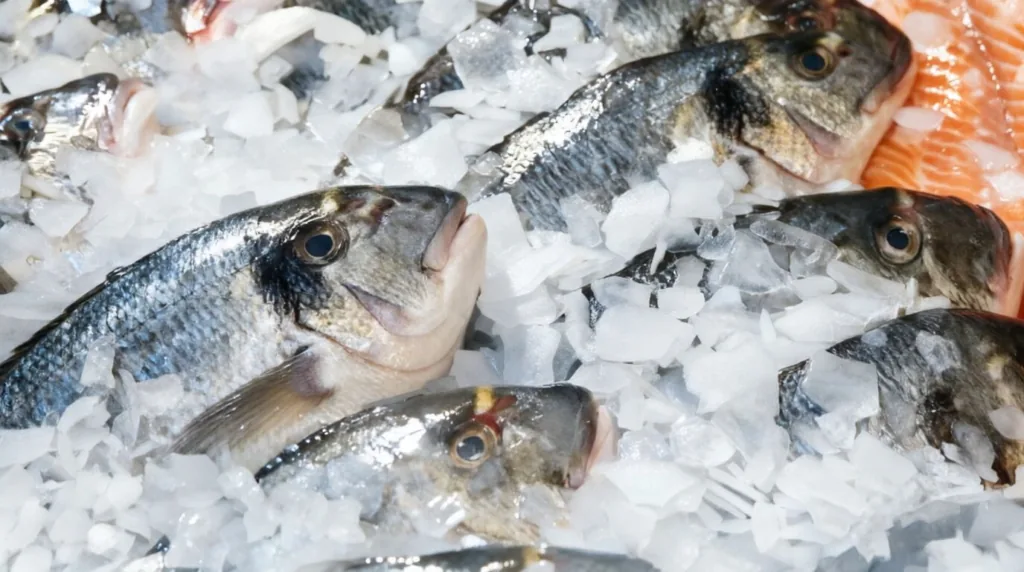
Flake ice is useful because the small pieces can be distributed between layers of fish and over irregular surfaces. Good contact helps remove heat, while meltwater carries heat away. The result still depends on using enough clean ice, applying it promptly and maintaining insulated storage.
Understand the two parts of ice demand
Total ice demand has two different loads:
- Initial chilling load: ice required to reduce the fish from its receiving temperature to approximately 0°C.
- Holding load: ice that melts later because of ambient heat, containers, handling, storage duration and transport.
Buying a machine from an ice-to-fish ratio alone can under-size the project because the ratio may not include heat leakage, operational loss or ice sold to other users.
How much ice is needed to cool fish?
The FAO provides a useful theoretical reference. Cooling 1 kg of fish from 30°C to 0°C requires about 0.34 kg of melting ice under ideal conditions. This covers only the heat in the fish; it excludes heat entering through the box or hold, warm surfaces, handling losses and the ice needed during storage.
| Initial fish temperature | Approximate theoretical ice for initial chilling | What is not included |
|---|---|---|
| 5°C | About 0.06 kg ice/kg fish | Holding, handling and distribution losses |
| 15°C | About 0.17 kg ice/kg fish | Holding, handling and distribution losses |
| 25°C | About 0.28 kg ice/kg fish | Holding, handling and distribution losses |
| 30°C | About 0.34 kg ice/kg fish | Holding, handling and distribution losses |
These figures are planning references, not operating ratios. FAO guidance describes ratios around 1:2 ice to fish for some temperate storage conditions and around 1:1 for tropical vessel planning. The correct ratio depends on product temperature, trip length, insulation, ambient conditions, box design and how often ice is replenished.
Build a site-specific ice balance
Use the following structure:
Daily ice demand = fish chilling load + storage and transport melt + process/display ice + handling loss + third-party ice demand.
Collect data for a peak operating day, not only the annual average. Separate the daily total from the peak hourly demand because storage and distribution equipment may need to deliver several tons in a short landing window.
Example
A seafood facility receives 12 tons of fish on its peak day. If the validated operating practice requires 0.8 kg of ice per kilogram of fish from landing through dispatch, the fish-related demand is 9.6 tons. If an additional 1.0 ton is used for display and cleaning transitions and the operation allows 5% for handling loss, the preliminary total is:
(9.6 + 1.0) × 1.05 = 11.13 tons of usable ice per peak day.
The selected machine must then be checked against available production hours, stored inventory and output at the site’s air and water temperatures.
Freshwater or seawater flake ice?
| Configuration | Typical use | Critical checks |
|---|---|---|
| Freshwater flake ice machine | Ports, fish markets, seafood plants, trucks and retail displays | Potable or treated water, food-contact hygiene, condenser and storage |
| Seawater flake ice machine | Fishing vessels and selected coastal operations | Marine corrosion resistance, motion, space, power, cooling and seawater quality |
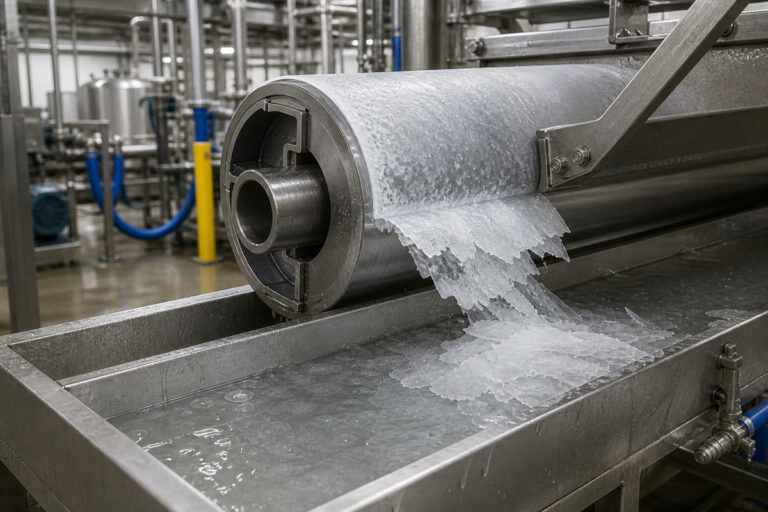
Choose the water source and machine construction together. For onboard production, review the dedicated seawater flake ice machine. For land-based food operations, compare the freshwater flake ice machine range.
Machine capacity is not usable capacity
A rated 10-ton machine does not guarantee 10 tons of usable ice at every site. Require the supplier to state:
- Capacity at the quoted reference air and inlet-water temperatures.
- Expected output at the project’s maximum design condition.
- Running power and included pumps or condenser fans.
- Ice temperature, thickness and water source.
- Operating hours and defrost, cleaning or maintenance allowance.
Storage must cover the difference between continuous production and irregular landings. FAO guidance gives a flake-ice stowage rate of roughly 420-480 kg/m³, but room design, compaction, access and automatic discharge reduce the usable fraction. Calculate storage from measured operating cycles rather than simply dividing tons by density.
Apply ice so it can do its job
- Start icing immediately after harvest or receiving.
- Use shallow layers and distribute ice around the fish, not only on top.
- Pre-cool warm boxes or surfaces when they would otherwise consume the working ice.
- Keep drainage open so contaminated meltwater does not pool around the product.
- Replenish ice based on actual melting and product temperature.
- Keep boxes, shovels, conveyors and storage rooms clean and protected.
Temperature checks should verify the process. Record receiving temperature, time to first icing, product temperature at dispatch and remaining ice at key stages. This turns a general icing rule into an auditable cold-chain procedure.
Food safety: ice must be handled as food
When ice contacts seafood, it can transfer contamination. NSF/ANSI 12 covers sanitation requirements for automatic ice-making equipment and related components used to make, store, dispense, package and transport ice for human consumption. The applicable local food code still controls the finished operation.
At minimum, the project should address:
- Suitable source water and a documented water-treatment plan.
- Cleanable food-contact materials and protected ice storage.
- Dedicated scoops or automatic discharge instead of direct hand contact.
- Drainage that prevents wastewater or pests from reaching the ice.
- Written cleaning, sanitizing and inspection procedures.
- Separation of edible ice from floor contact, fuel, lubricants and dirty containers.
Select the complete system
A fishery project normally includes more than an ice generator:
- Water treatment and water storage.
- Flake ice generator and refrigeration system.
- Condenser and heat-rejection system.
- Insulated ice room or bin.
- Manual or automatic discharge.
- Conveying, weighing or bagging.
- Insulated boxes, vessel hold or truck interface.
- Backup power, spare parts and temperature monitoring.
Explore the complete fishery and seafood ice solution and inspect running machine videos before finalizing the FAT. To receive a configuration, send the daily fish volume, peak landing profile, location, water source, power supply and storage requirement through the project quotation form.
Sources and technical references
- FAO: Icing of fish – chilling target, theoretical ice requirement and practical ice-to-fish considerations.
- FAO: The use of ice on small fishing vessels – tropical planning ratios and flake-ice storage density.
- FAO/WHO Codex Code of Practice for Fish and Fishery Products – prompt chilling and hygienic handling.
- NSF Food Equipment Standards – scope of NSF/ANSI 12 for automatic ice-making equipment.
Frequently asked questions
Why is flake ice used for fish and seafood?
Its small pieces can be distributed between layers and around irregular product surfaces, supporting close contact and rapid heat removal when enough clean ice is applied promptly.
How much ice is needed for one ton of fish?
The answer depends on initial fish temperature, target temperature, insulation, ambient heat and storage duration. FAO gives about 0.34 kg of ice per kg of fish only to cool fish from 30°C to 0°C under ideal conditions; real operations require additional holding ice.
Can seawater be used to make flake ice?
Yes, with a seawater flake ice machine designed for salinity, corrosion, marine power, motion, space and cooling. A standard land machine should not be assumed suitable onboard.
Does ice used on seafood need potable water?
For food-contact use, the source water and ice-handling system must meet the applicable hygiene regulations. The project should include water treatment, protected storage, cleanable surfaces, drainage and sanitation procedures.
How do I choose the machine capacity?
Calculate peak daily and hourly ice demand, add holding and handling loads, subtract usable stored inventory, then verify machine output at the project air and water temperatures and available production hours.