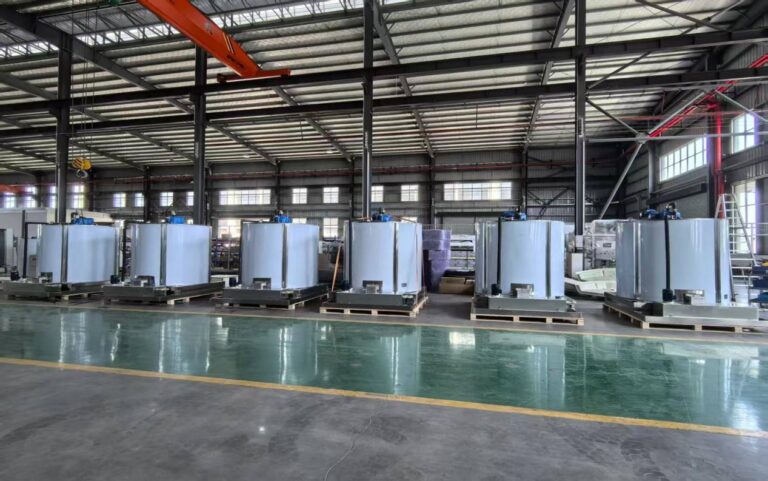
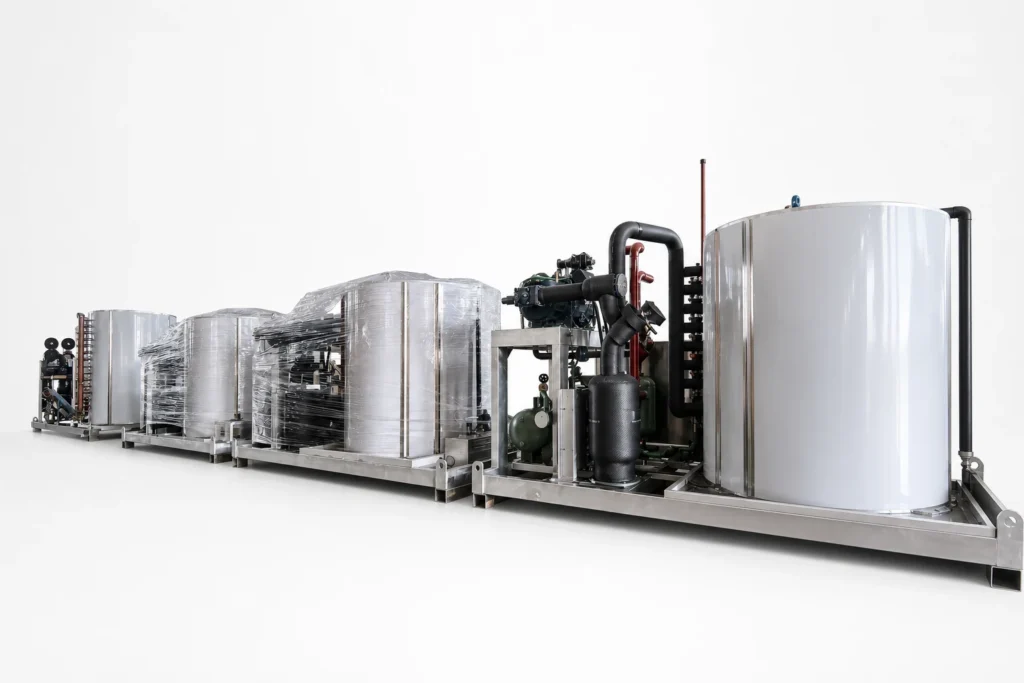
Learn which technical and commercial factors change a flake ice machine quote, how to normalize supplier scope, and how to compare total project cost.
Why a flake ice machine does not have one universal price
A useful flake ice machine quote is an engineered project scope, not a single equipment number. Two systems with the same nominal daily capacity can have materially different compressors, condenser arrangements, electrical panels, evaporator construction, storage, controls, shipping scope and site support. A low headline price may therefore describe less equipment rather than better value.
The correct way to buy is to compare the same operating duty and the same delivery boundary. Start with the amount of usable ice required at your site, the local ambient and water conditions, the available utilities and the equipment that must be included between water inlet and final ice discharge. Only then should you compare commercial offers.
The eight factors that change a project quote
1. Verified output at the real working condition
Nominal capacity is meaningful only when the test condition is stated. Higher ambient air temperature, warmer inlet water and restricted condenser airflow increase refrigeration load and may reduce output. Ask every supplier to state the rated capacity, reference air and water temperatures, condenser type and expected output at your design condition.
2. Condenser arrangement
An air-cooled condenser is simple to install but needs adequate ventilation and clean air. A water-cooled condenser can be suitable for hot or enclosed sites, but it adds water-quality, flow and heat-rejection requirements. Evaporative or remote condensers introduce their own pumps, controls and installation scope. Compare complete installed systems, not only the ice generator.
3. Refrigeration components and refrigerant
Compressor selection, refrigerant, heat exchangers, valves, receiver, oil management and control strategy influence efficiency, serviceability and spare-parts access. Brand names alone are not enough. Request the exact component schedule and confirm that replacement parts and qualified service are available in your country.
4. Evaporator construction
The evaporator is the working core of a flake ice machine. Material, machining accuracy, heat treatment, surface protection, shaft and reducer design, refrigerant circuit and scraper arrangement all affect long-term reliability. Ask for drawings, material specifications, manufacturing records and a running test rather than relying on a brochure photograph.
5. Electrical and controls
Voltage, frequency, phase, enclosure rating, short-circuit protection, control language, remote monitoring and destination-country requirements can change panel cost. Confirm the actual site supply before ordering. A transformer or frequency converter should not be treated as a casual afterthought.
6. Ice storage and handling
The machine may stop creating value if the ice cannot be stored, discharged or transported. Define whether the quote includes a manual ice room, automatic rake system, screw conveyor, weighing, bagging or a delivery system to the process. Storage volume should be based on production and consumption timing, not only on machine capacity.
7. Project packaging and logistics
Skid mounting, containerization, export packing, ocean freight, insurance, customs documents, duties and inland delivery are separate cost layers. Incoterms must be written clearly. An EXW, FOB, CIF and delivered-site quotation are not directly comparable.
8. Installation, commissioning and after-sales support
Clarify who supplies piping, cables, water treatment, foundations, refrigerant charging, lifting, commissioning and operator training. Also define warranty coverage, response time, remote support, commissioning records and the recommended spare-parts package.
Use one quote-normalization table
Place every supplier into the same table. A blank cell is not a minor formatting issue; it is an unresolved project risk.
| Comparison item | What the supplier must state | Why it matters |
|---|---|---|
| Usable ice output | kg or tons per 24 h at stated air and water temperatures | Prevents nameplate-only comparisons |
| Ice specification | Thickness, temperature, water source and intended application | Confirms the machine produces the required ice |
| Electrical load | Running power, maximum demand, voltage, frequency and phase | Sizes the site supply and operating cost |
| Water demand | Ice-making water plus condenser and cleaning water | Exposes hidden utility requirements |
| Included equipment | Generator, condensing unit, pumps, panel, storage and handling | Defines the real project boundary |
| Factory test | Test duration, measured output, conditions, alarms and video | Provides evidence before shipment |
| Commercial basis | Incoterm, packing, lead time, payment and validity | Makes the landed-cost comparison fair |
| Support | Warranty scope, commissioning, manuals and spare parts | Reduces lifecycle downtime risk |
Estimate total project cost, not only purchase price
A practical total-cost model includes the following terms:
Total project cost = equipment + storage and handling + electrical and water works + civil works + freight and import charges + installation and commissioning + initial spare parts.
For lifecycle comparison, add electricity, water, scheduled maintenance, consumables, expected replacement parts and the financial impact of downtime. The ENERGY STAR program publishes energy and potable-water criteria for eligible commercial ice makers, illustrating why measured efficiency belongs in equipment comparison. Its published ranges do not automatically apply to every large industrial plant, so request model-specific consumption at the stated duty instead of borrowing a generic efficiency claim.
How to compare energy claims
Ask for energy in kWh per ton of ice, together with the exact test condition and included auxiliaries. A power rating in kW is not the same as energy consumption per ton. The supplier should identify whether condenser fans, pumps, ice-room drives and conveyors are included in the figure.
For a useful estimate:
Annual electricity = daily ice production × operating days × verified kWh per ton.
Run at least three scenarios: expected production, high-season production and hot-condition production. This reveals whether a lower purchase price is offset by higher annual utility cost.
Red flags in a low-price quotation
- Capacity is listed without ambient and inlet-water temperatures.
- The quote says “complete machine” but excludes the condenser, pumps or control panel.
- Component brands are listed without model numbers or country-specific availability.
- No general arrangement drawing, electrical load list or utility schedule is supplied.
- The factory test is only a short video with no measured output or time record.
- Warranty wording does not identify covered parts, labor, freight or response procedure.
- The supplier cannot explain the difference between EXW, FOB and delivered scope.
- The price requires a different voltage, refrigerant or cooling system than your site needs.
A better RFQ produces a better quotation
Send the same request for quotation to every candidate. Include:
- Required usable ice per day and peak hourly demand.
- Application, operating schedule and ice delivery point.
- Country, installation city and indoor or outdoor location.
- Maximum ambient air and inlet-water temperatures.
- Water source, known hardness or salinity and available flow.
- Voltage, frequency, phase and available electrical capacity.
- Preferred condenser type or site constraints.
- Required ice storage hours and discharge method.
- Shipping destination and requested Incoterm.
- Destination-country documentation and inspection requirements.
Mikeicemachine provides industrial flake ice machines, flake ice evaporators and related storage and handling equipment. Review real machine videos, then send the project data through the quotation form so the proposed configuration can be tied to your site rather than a generic price list.
Decision rule: buy the clearest verified scope
The best quotation is not automatically the cheapest or the most expensive. It is the offer that demonstrates adequate output at your condition, defines every interface, documents the factory test and gives you a credible plan for installation and service. When two offers are normalized to the same scope, the commercial decision becomes much easier and the risk of late project additions falls sharply.
Sources and technical references
- U.S. EPA ENERGY STAR: Commercial Ice Makers – equipment classifications, buying considerations and efficiency context for eligible commercial models.
- IEC 60204-1: Safety of machinery – Electrical equipment of machines – scope of electrical equipment requirements for industrial machinery.
- ISO 9001:2015 – quality-management-system requirements and the role of controlled processes and documented information.
Frequently asked questions
How much does an industrial flake ice machine cost?
There is no reliable universal price because capacity, site temperatures, condenser type, electrical standard, storage, handling, shipping and commissioning change the scope. Request a project quotation based on the same design duty from every supplier.
Why are two quotes for the same daily capacity so different?
The offers may use different test conditions, component grades, condenser arrangements, storage scope, electrical standards or Incoterms. Normalize every line item before comparing the total.
Is an air-cooled machine cheaper than a water-cooled machine?
It can be simpler at some sites, but installed cost depends on ventilation, ambient temperature, water availability, condenser duty and local utilities. Choose the condenser from the site condition, not purchase price alone.
What should a factory test prove before shipment?
It should identify the serial number and final configuration, record air and water conditions, measure ice output over time, verify power and controls, test alarms and document the finished machine.
What information is needed for an accurate quotation?
Send usable ice demand, peak operating profile, application, location, maximum air and water temperatures, water quality, voltage, condenser constraints, storage requirement, destination and requested delivery scope.